
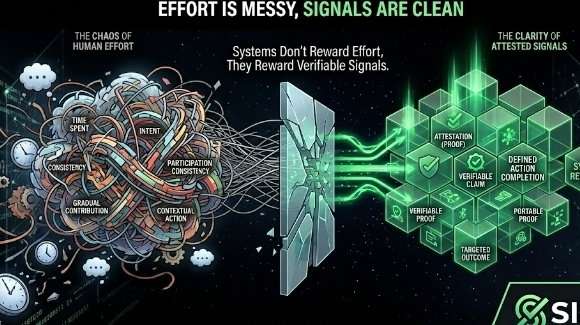
I keep and I’ve spent time doing things that felt like they should matter more than they actually did. Using a platform early, interacting regularly, trying to stay consistent. There’s a quiet assumption behind that kind of effort, that if you show up enough, the system will eventually recognize it.
But that doesn’t always happen.
Sometimes someone shows up once, does a very specific action, and gets rewarded immediately. Meanwhile, the person who’s been there longer, doing more in a general sense, gets nothing. It feels uneven at first. Almost unfair.
But after seeing it repeat across different platforms, the pattern starts to make more sense.
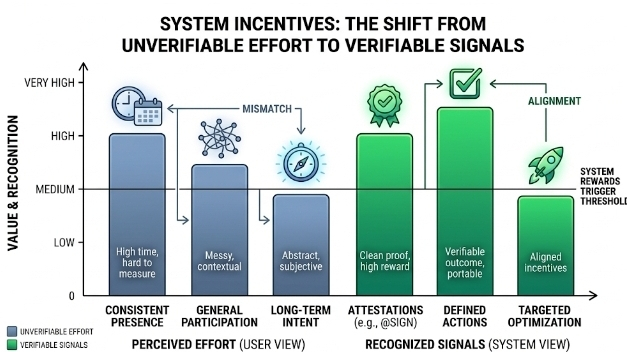
At that moment, I realized systems don’t really track effort the way we think they do. They don’t measure intent, time spent, or consistency in a human sense. They respond to signals. And not just any signals, but ones that can be verified clearly and quickly.
Effort is messy. Signals are clean.
That shift in thinking is what pulled me back toward @SIGN. Not because it rewards anything directly, but because it seems to focus on how signals themselves are created, structured, and reused.
If I try to simplify it, the idea revolves around attestations. Instead of assuming activity equals contribution, the system defines specific claims that can be verified. You didn’t just “participate,” you completed a defined action, and that action gets recorded as a reusable proof.
Initially, I thought this approach felt a bit rigid. Not everything meaningful can be reduced to a clean signal. Some contributions are gradual, contextual, or hard to define. Turning everything into attestations risks oversimplifying behavior.
But I don’t think the goal is to capture everything. At least not yet.
What I find interesting is how this changes the way systems make decisions. Instead of trying to interpret vague patterns of activity, they rely on explicit proofs. Something either happened in a verifiable way, or it didn’t. That reduces ambiguity, even if it doesn’t capture the full picture.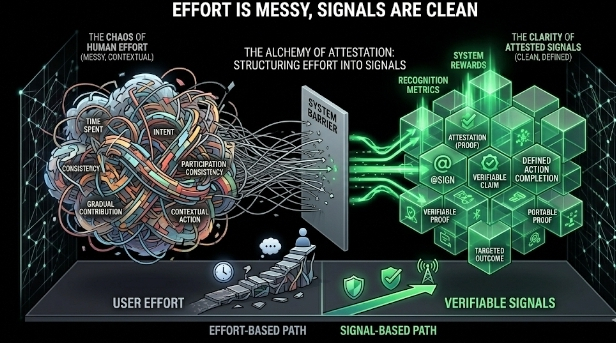
Upon reflection, that might be the trade-off most systems are already making, just without saying it clearly. They prioritize what can be measured over what actually matters. @SIGN just makes that process more structured and portable.
And if it works as intended, it opens up a different kind of coordination.
Signals don’t stay trapped in one platform. A verified action in one place can be recognized somewhere else. That starts to reduce duplication. Instead of re-proving the same thing across different systems, you carry the signal with you.
It also changes incentives in subtle ways. If rewards are tied to verifiable signals, then behavior starts aligning around producing those signals. Not necessarily more effort, but more targeted actions.
But I don’t think this is automatically positive. At least not yet.
Because once systems reward signals, people start optimizing for them. And when that happens, signals can lose their original meaning. What was once a genuine action becomes something performed just to generate proof.
There’s also the challenge of standardization. For signals to be reusable, different platforms need to agree on what they represent. Without that, you end up with isolated definitions that don’t translate well.
Right now, I’m mostly observing. I hold a small amount of $SIGN, but it’s less about conviction and more about staying close to how this evolves. The idea makes sense at a structural level, but real-world behavior tends to complicate clean designs.
But I keep coming back to the same condition.
The system works if I stop thinking about effort entirely, and start seeing consistent outcomes from clear signals. Not just in one app, but across multiple platforms that recognize the same proofs without needing reinterpretation.
When a single verified action carries weight wherever it goes, without being repeated or questioned, that’s when I’ll know this approach holds up.
Until then, it feels like a system that understands how incentives work, but is still figuring out how people will respond to them.
@SignOfficial #SignDigitalSovereignInfra $SIGN
