
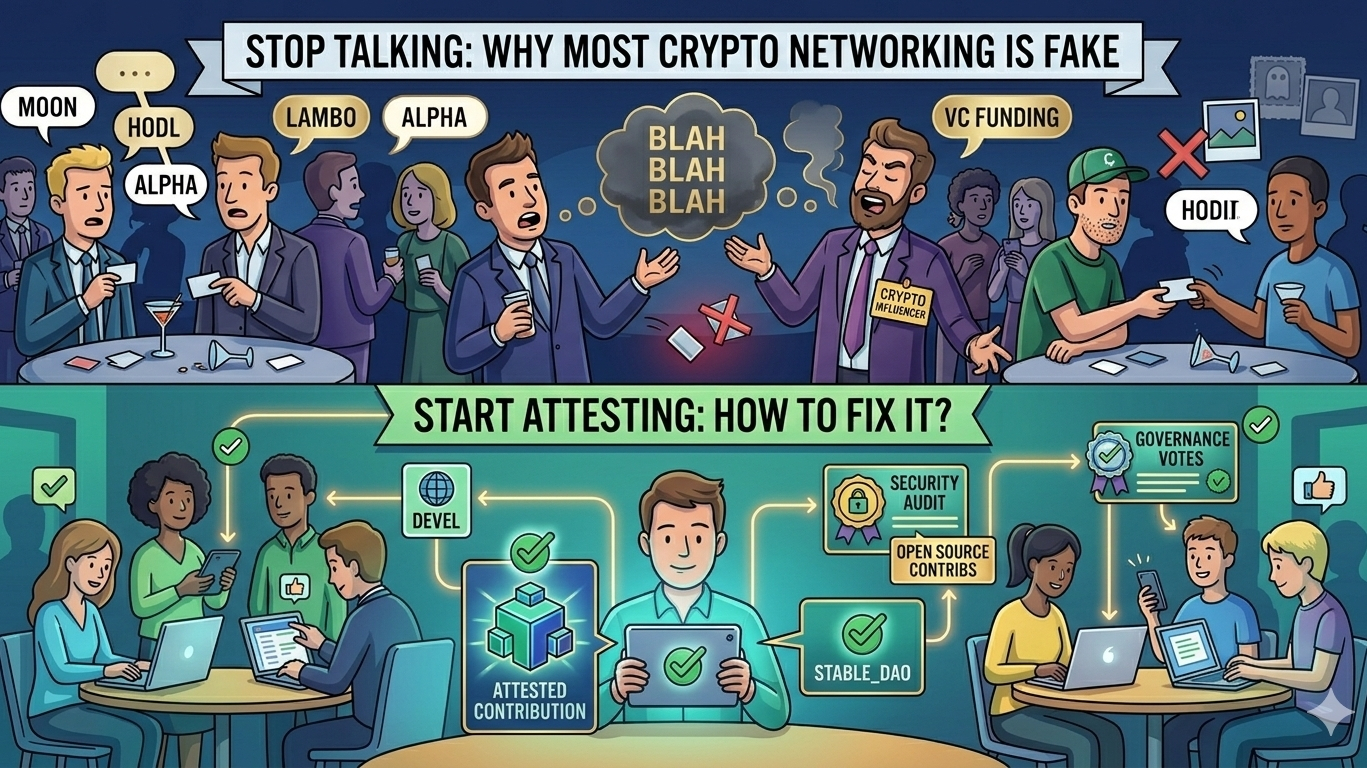

I remember standing in a sweltering side event during a crypto conference, and listening to a conversation I didn't believe in. Everyone spoke in placeholders. “We’re building something massive.” “We’re early.” “Let’s sync on a collab.” It was a script we’d all memorized. I nodded, swapped handles and walked away with a strange discomfort I couldn’t quite name. It wasn't that people were lying. It was that nothing was anchored. No statement carried weight beyond the breath used to say it.
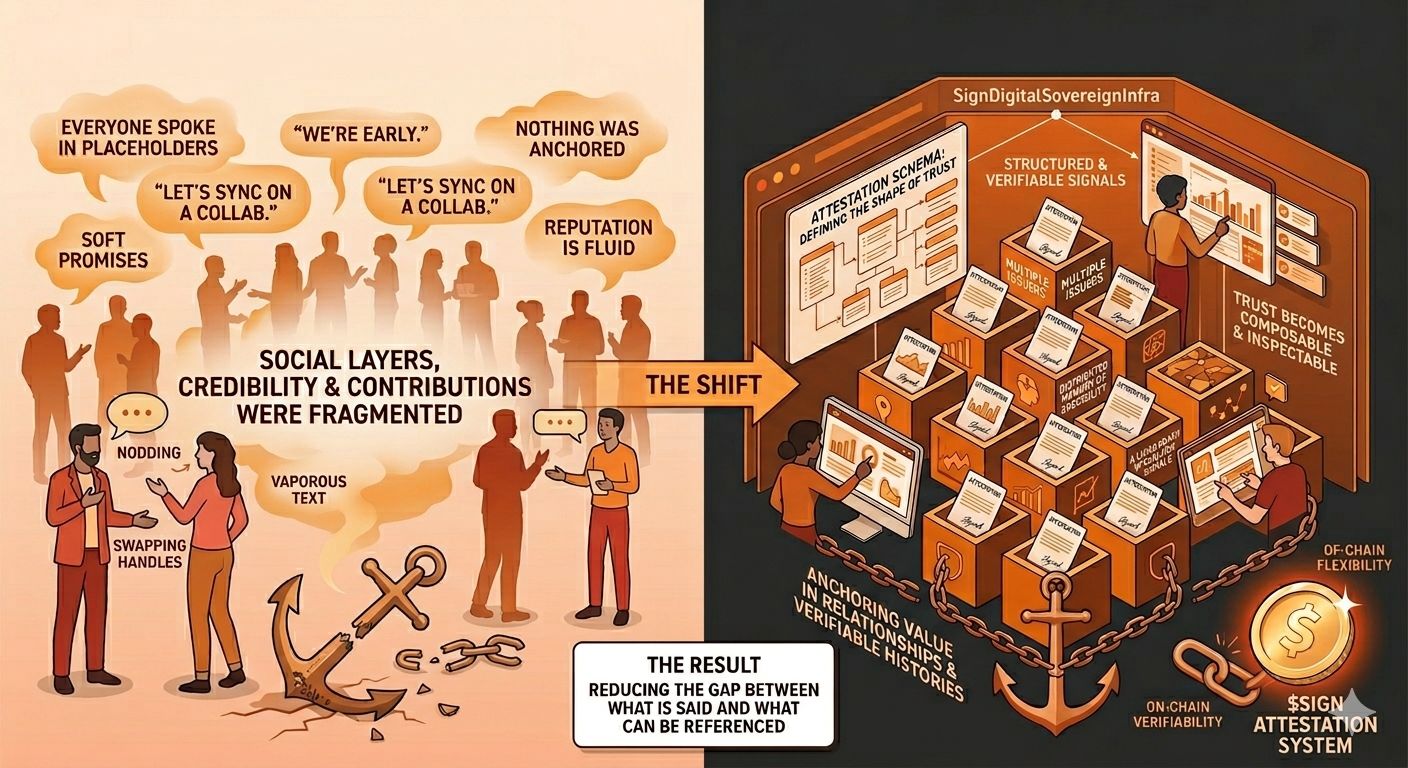
And I think that is where something fundamental in crypto still feels unresolved. The space prides itself on transparency, yet so much of it operates on soft promises and unverifiable claims. Reputation is fluid, credentials are self declared. Even “on-chain” identity often reduces to wallet activity, which tells you what someone did but not why or in what context. I started noticing a pattern: the more decentralized things became, the harder it was to trust anything beyond raw transactions. Social layers, credibility and contributions were either fragmented or performative. We replaced institutions, but we didn’t replace the mechanisms that made trust durable.
I came across the idea of attestation based systems almost by accident, buried in a conversation around @SignOfficial . At first, it felt overly abstract another layer, another primitive, another attempt to formalize something that might be better left organic. Crypto already has a tendency to over engineer social problems. But what surprised me was how structured it actually was: schemas quietly defining the shape of trust and attestations filling those structures with real, verifiable signals.
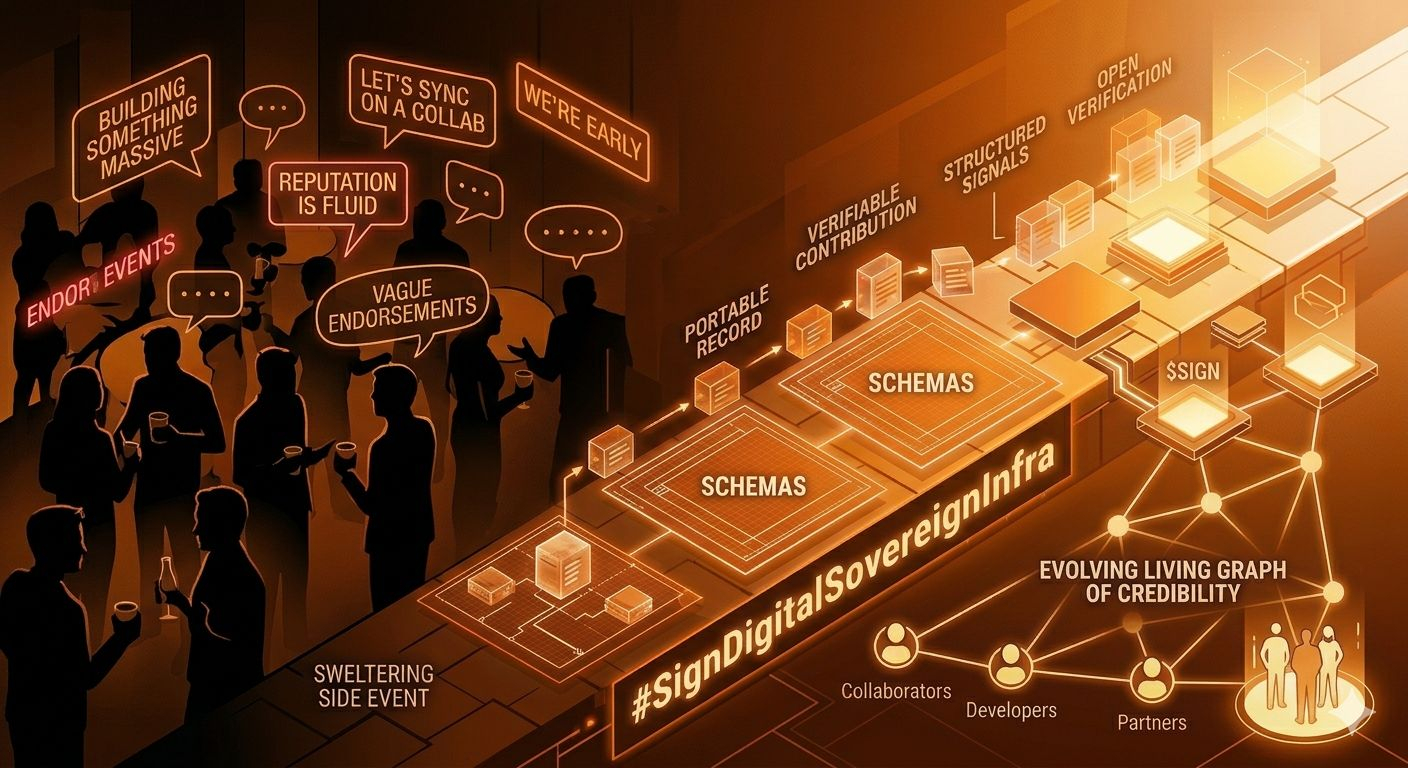
An attestation is simple on the surface,a claim issued by one party about another entity or event, anchored in a schema. But the power isn’t in the claim, it’s in its persistence and reusability. Instead of saying “this person contributed,” you create a verifiable, portable record of that contribution. Instead of introductions based on vague endorsements, you have structured signals that can be referenced, built upon and cross validated. Statements don’t just exist in conversations anymore. They exist in systems queryable, indexable and quietly accumulating meaning over time.
The real difference isn’t technical, it’s psychological. Humans trust patterns, not isolated events. We look for consistency, repetition and corroboration. Traditional institutions worked because they aggregated and standardized these signals over decades. Crypto disrupted that aggregation but didn’t immediately replace it with something equally coherent. #SignDigitalSovereignInfra begins to rebuild that layer in a decentralized way. Multiple issuers, shared schemas and open verification create a distributed memory of credibility. Trust becomes composable and more importantly, inspectable.
There’s also an execution detail I didn’t fully appreciate at first: not everything needs to live on-chain. Just enough to remain verifiable. The rest can exist off-chain structured but flexible without sacrificing integrity. That balance between permanence and scalability feels less like a compromise and more like a design principle. It allows the system to grow without collapsing under its own weight.
This creates an incentive shift that feels subtle but vital. In most online systems, signaling is cheap. You can claim anything with little consequence. But when attestations are structured, signed and persistently linked to an identity, the cost of issuing low quality signals increases. Not financially but reputationally. If I issue careless attestations, it reflects back on me. My credibility becomes part of the system. Over time, this creates a feedback loop where both issuers and subjects are incentivized to maintain signal quality. It’s not enforced, it emerges.
For the builders actually shipping, the $SIGN attestation based system becomes part of a structured narrative that others can build on. A developer’s contributions can be attested to by collaborators. A protocol’s integrations can be attested to by partners. A user’s participation can be attested to by the systems they engage with. This creates a living graph where schemas define the structure and attestations continuously fill it with evolving signals.
Zooming out, it feels aligned with a broader shift. We’re moving through a period where online trust is eroding, social platforms are saturated and verification is either centralized or absent. In emerging markets, where formal institutions are less accessible, trust isn’t a luxury it’s infrastructure. Attestation based systems begin to anchor value not just in transactions, but in relationships and verifiable histories. Even the token itself starts to feel less like a speculative asset and more like a coordination layer around these signals.
How does this resolve the discomfort I felt at that conference so? Not by eliminating ambiguity that’s unrealistic but by reducing the gap between what is said and what can be referenced. If someone claims experience, there can be attestations supporting it. If a collaboration is proposed, there can be a history of verifiable interactions. It doesn’t make conversations less human but it makes them less fragile.
Technology often tries to replace human judgment but the more effective systems tend to augment it. Attestations don’t decide who to trust, they provide context and surface patterns. They formalize social capital without stripping it of nuance. I still go to events. I still have those conversations. But now, I listen a little differently not just to what’s being said, but to what persists beyond the moment, what fits into a schema and what can actually be built upon?In a space full of signals, the ones that matter aren’t the loudest. They’re the ones that hold their shape over time.
@SignOfficial #signdigitalsovereigninfra $SIGN #SignDigitalSovereignInfra