
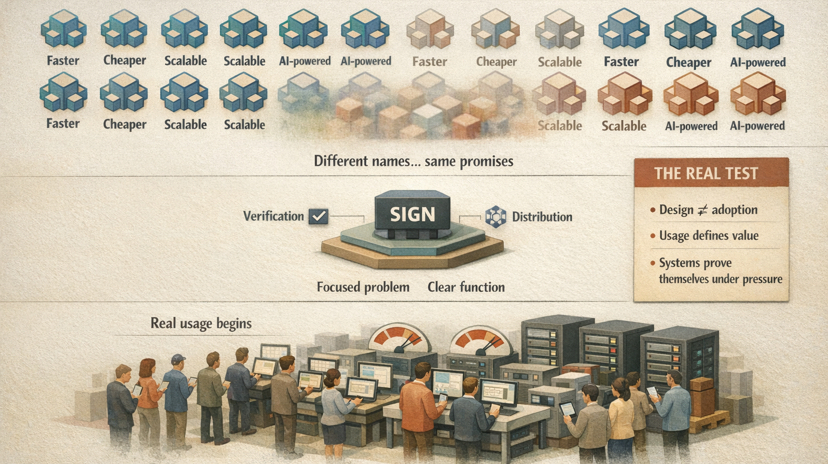
Every week, a new blockchain appears claiming it will fix everything faster transactions, lower fees, better scalability, more advanced architecture. Lately, even “AI integration” has become part of the standard pitch. After a while, these narratives start to blur together. The branding changes, but the core message often feels repetitive.
In that context, $SIGN stands out slightly differently. It is not positioning itself as a universal solution or another “do-it-all” chain. Instead, it focuses on a more specific problem: credential verification and token distribution. That alone makes it feel more grounded than many projects that revolve around reshaping liquidity flows without addressing a clear real-world need.
However, there is an important point that is often overlooked. Blockchain systems rarely fail because the underlying technology is flawed. More often, they encounter problems when real usage begins. Early environments—testnets or low-traffic mainnets—tend to present an idealized version of performance. But once users, bots, and complex interactions enter the system, new challenges emerge. Even well-established networks have faced this reality. Performance under load is not a theoretical issue; it is where systems are truly tested.
From that perspective, SIGN’s decision to focus on a narrower function appears logical. Not every blockchain needs to operate as a general-purpose platform. There is a valid argument for distributing responsibilities across specialized systems rather than concentrating everything into a single layer. In theory, this could lead to more efficient and manageable ecosystems.
That said, architectural clarity does not guarantee adoption.
The real challenge lies in attracting sustained participation. Developers tend to build where users already exist, and users tend to stay where liquidity is active. This creates a form of inertia that is difficult to overcome. A system can be well-designed, efficient, and even necessary, yet still struggle if it fails to reach a critical level of engagement.
This is where many promising ideas slow down. The gap between “this makes sense” and “this is being used consistently” is often wider than expected. In practice, markets tend to reward momentum more than design quality.
SIGN, as a concept, aligns with a more practical direction for the space. Separating verification from distribution and focusing on infrastructure rather than narrative-driven cycles reflects a more mature approach. It addresses a real layer that is often overlooked.
However, the outcome ultimately depends on whether that approach translates into real usage.
At this stage, it remains a system with clear potential but unproven adoption. The direction is reasonable, but the decisive factor will be whether it becomes part of actual workflows rather than remaining an isolated idea.
In the end, that distinction determines whether a project evolves into infrastructure—or remains a concept.