
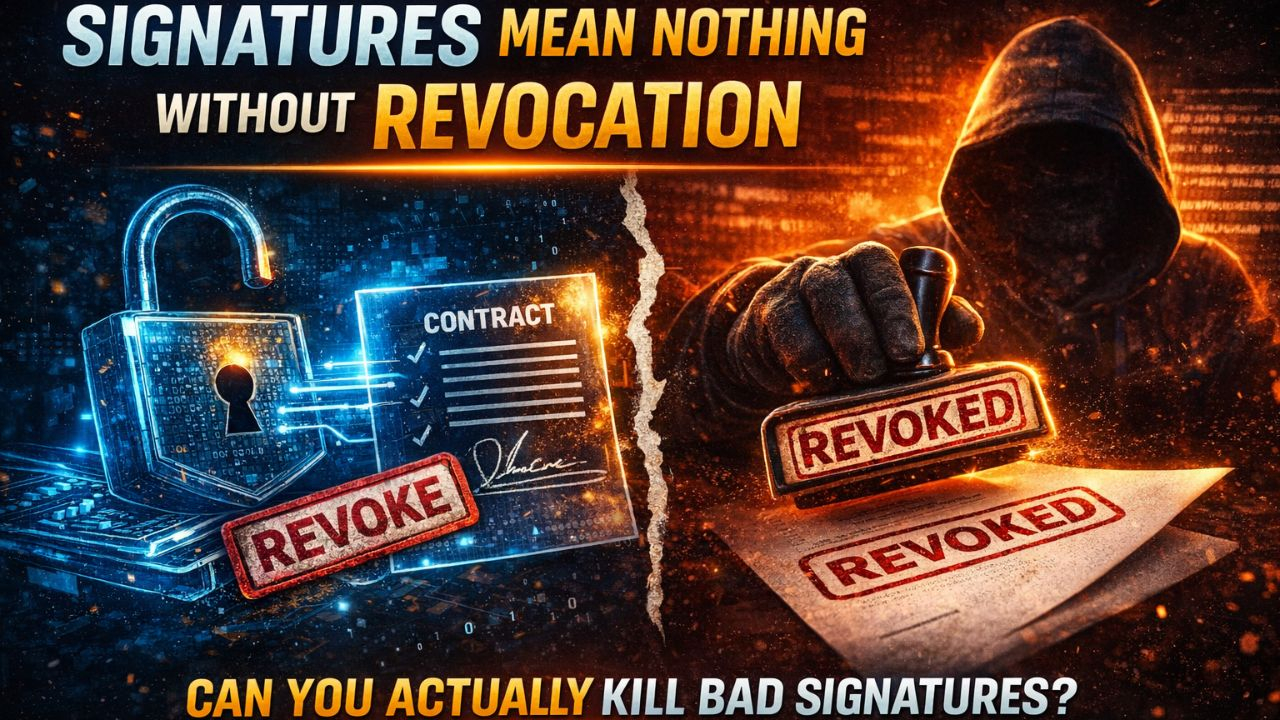

There was a moment I didn’t think much about revocation. A signature was a signature — done, recorded, final. That’s how we’re conditioned to think about trust. Once it’s written, it stands.
But the deeper I looked into systems like $SIGN, the more I realized that permanence without an exit isn’t trust — it’s risk.
What I like about Sign’s direction is that it doesn’t treat revocation as an afterthought. It treats it as hygiene. The kind you only notice when it’s missing. Because in any real system, things go wrong. Keys get compromised, intentions change, mistakes happen. And when they do, the system needs a way to acknowledge that reality without pretending everything is still valid.
That’s where most “trust infrastructure” quietly breaks.
A signature that cannot be clearly revoked doesn’t just sit there — it lingers. It keeps signaling validity even when the context is gone. And over time, that creates a dangerous layer of outdated truth. Old approvals, old attestations, old permissions — still visible, still technically valid, but no longer aligned with reality. That’s not trust. That’s noise pretending to be signal.
Sign approaches this differently by making revocation explicit, not implied. It forces the uncomfortable but necessary questions into the open: who has the authority to revoke, under what conditions, and how that action is recorded for everyone to see. Because without clear answers, revocation becomes arbitrary — and arbitrary control is just another form of hidden risk.
What stands out to me is that this isn’t just a technical feature. It’s a design philosophy. It acknowledges that trust is not static. It evolves, it breaks, it gets repaired. And any system that wants to represent trust honestly has to reflect that lifecycle, not freeze it at the moment of signing.
That’s why revocation matters more than people think.
Not because it’s exciting — it isn’t. But because it defines whether a system can correct itself when reality changes. Without it, every signature becomes a permanent liability, even when it shouldn’t be. With it, trust becomes something that can adapt, expire, and stay aligned with the truth over time.
And in something like $SIGN, where the whole premise revolves around verification and attestations, that difference is everything.
@SignOfficial $SIGN #SignDigitalSovereignInfra
