
a few months ago i had to verify something simple. not even important. just needed to prove a small detail about myself for an online task. nothing sensitive. still, it turned into a loop.
upload document. wait. get rejected. upload again. slightly different format. still not accepted. at some point it stopped feeling like verification and more like asking for permission.
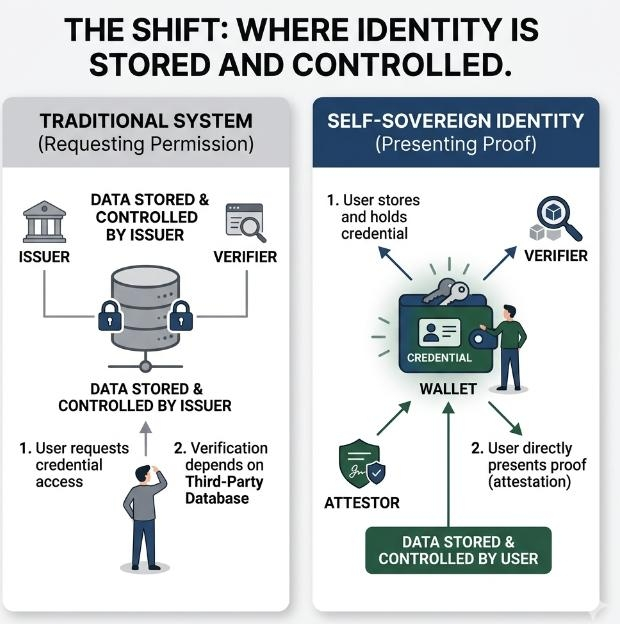
what bothered me wasn’t the delay. it was the feeling that my own data wasn’t really mine. it lived somewhere else. controlled by someone else. and every time i needed it, i had to request access again.
i kept thinking about that while going through how sign handles identity. because this is exactly the problem self-sovereign identity has been trying to solve for years.
and for once, it feels like someone actually built it in a way that works.
what sign does differently starts with where the credential lives.
it sits in your wallet.
not in a database you don’t control. not behind a login. you hold it the same way you hold tokens. that sounds small, but it changes the entire dynamic. you’re not requesting your identity anymore. you’re presenting it.
but holding a credential means nothing if nobody trusts it.
this is where sign’s attestations come in.
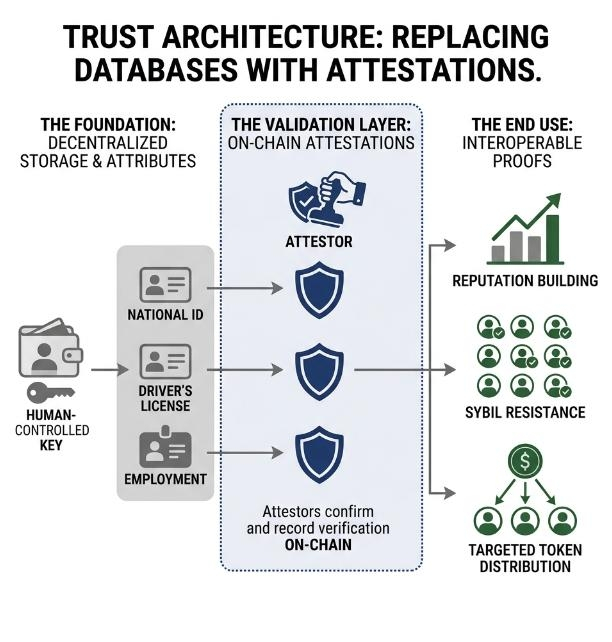
instead of you claiming something about yourself, an attestor confirms it. that confirmation is recorded on-chain. so when you share your credential, anyone can verify that it was actually issued and hasn’t been tampered with.
no back-and-forth. no hidden verification step. it’s just there.
i think this is where most older SSI systems struggled. they focused too much on storage and not enough on verification. sign flips that balance. the verification layer feels like the core, not an afterthought.
and once you look at identity as a set of attestations, things start to connect.
sybil resistance becomes less about guessing who is real and more about who has credible attestations. if multiple trusted entities confirm something about you, that signal compounds. it’s not perfect, but it feels more grounded than behavioral scoring systems.
token distribution also starts to make more sense in this model. instead of spraying tokens across wallets and hoping for the best, projects can target users with specific attestations. people who actually did something. contributed somewhere. proved something.
it reduces noise. at least in theory.
but there’s something that keeps nagging at me.
the system works because of attestors. and that creates a new center of gravity.
if an attestor is trusted, their word carries weight across the network. but what defines that trust? reputation? authority? partnerships? it’s not always clear.
a bad attestation is still a valid attestation at the technical level. the system will verify it perfectly. which means the risk doesn’t disappear. it just moves.
from platforms to issuers.
and then there’s the question of what gets attested.
if credentials become too easy to issue, or too shallow in meaning, the system could slowly fill with signals that don’t really say much. not fake, just… weak. and weak signals at scale can look a lot like noise.
so while the structure feels solid, the quality of what flows through it will matter a lot.
still, i can’t ignore how different this feels compared to earlier attempts.
wallet-based credentials actually in user control
verification that works without asking anyone
identity built from attestations instead of profiles
these are not ideas here. they’re implemented in a way that feels usable.
for the first time, self-sovereign identity doesn’t feel like a concept waiting for adoption. it feels like something that could quietly become default infrastructure if enough real actors plug into it.
but that depends on who those actors are.
because if the right attestors participate, this system becomes powerful.
if the wrong ones dominate, it becomes another layer people have to trust without fully understanding why.
and that leaves me thinking
is this finally identity that belongs to the user
or just a cleaner system for deciding who gets to define it.