
SIGN Protocol is one of those projects that doesn’t scream for attention, which, honestly, is part of why it’s interesting.
A lot of crypto stuff feels like it was written by a marketing team that drank too much coffee. This doesn’t. It feels more like boring but important plumbing. The kind of thing you only notice when it’s missing.
What I actually like about it is the basic idea behind it: instead of making people trust a claim because someone said it’s true, it tries to make the claim itself verifiable. Clean. Simple. A little ruthless, even.
That matters more than people think. Because most systems today still run on a weird amount of hand-waving. A record gets created somewhere, somebody approves it, and then everyone else just accepts it as good enough. Maybe it is. Maybe it isn’t. The point is, the process usually depends on trust being spread across a bunch of places that don’t really deserve it.
SIGN Protocol tries to cut that down.
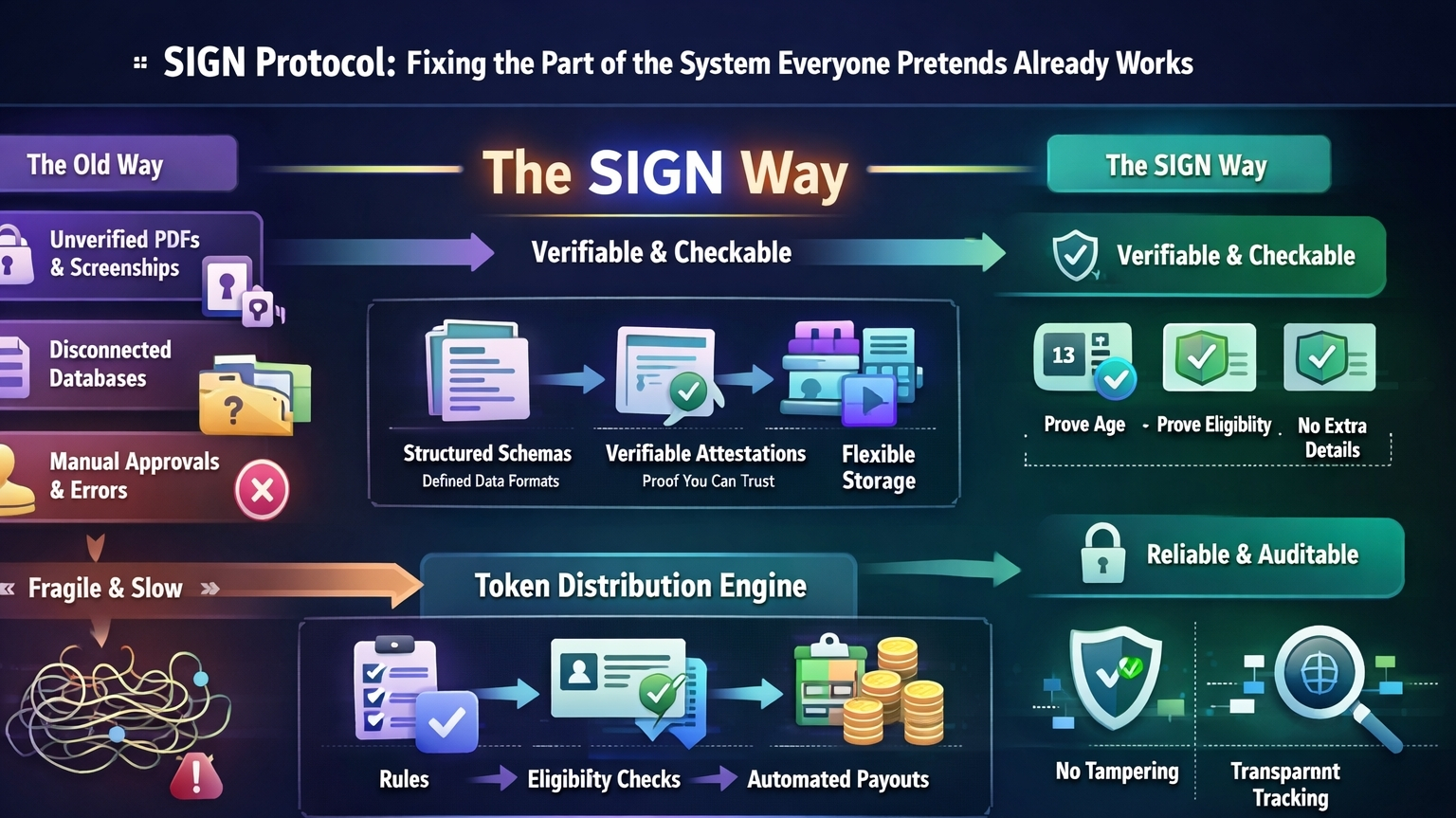
It does that by using structured records, so the information has a defined shape instead of turning into random data soup. That sounds dry, and it is dry, but dry things are often the ones that actually hold the whole system together. Once the structure is set, you can attach signed statements to it. Those statements can be checked later without having to go back and beg the original issuer for confirmation every single time.
That’s the part that feels useful. Not fancy. Useful.
And it doesn’t force everything into one setup, which is smart. Some data can stay public, some can stay private, and some can sit somewhere in between. That flexibility matters because not every piece of information should be thrown into the open just to prove one small thing. People don’t want that. Businesses don’t want that. Regulators definitely don’t want that.
The better move is to prove only what needs proving. Nothing extra. That’s the whole game.
That’s also where the project starts to feel less like a crypto experiment and more like the stuff that actually matters. If you can prove a condition without dumping the full underlying data, that opens the door to a much less annoying way of handling credentials, eligibility, and verification. You don’t need the whole file. You just need the answer.
And then there’s the distribution side, which I think is where the project becomes a bit more practical than people might expect.
Because once you can verify who qualifies for something, you can stop doing distribution the ugly old way. No more endless spreadsheets. No more weird manual checks. No more “wait, who changed this row?” energy.
You set the rules. You define who gets what, when they get it, and what has to be true first. Then the system handles the rest. That’s it. Not glamorous. Just the kind of setup that keeps things from falling apart.
And to be fair, that’s the real value here. Not buzzwords. Not grand speeches. It’s the fact that the project is trying to make verification and distribution less fragile. Less dependent on people remembering to do the right thing. Less dependent on someone being awake at the right moment.
That said, none of this automatically makes it a winner. Plenty of good ideas stay good ideas. Adoption is the part that decides whether a project becomes useful or just stays technically interesting. And this one will have to prove it can hold up outside of polished docs and neat diagrams.
But the direction makes sense. There’s a real problem here. Trust is messy, records get messy, and distribution gets messy fast. SIGN Protocol is trying to clean up that mess without pretending the mess doesn’t exist.
That’s probably why it stands out. It’s not trying to be magical. It’s trying to be solid. And in this space, solid is rarer than people admit.