
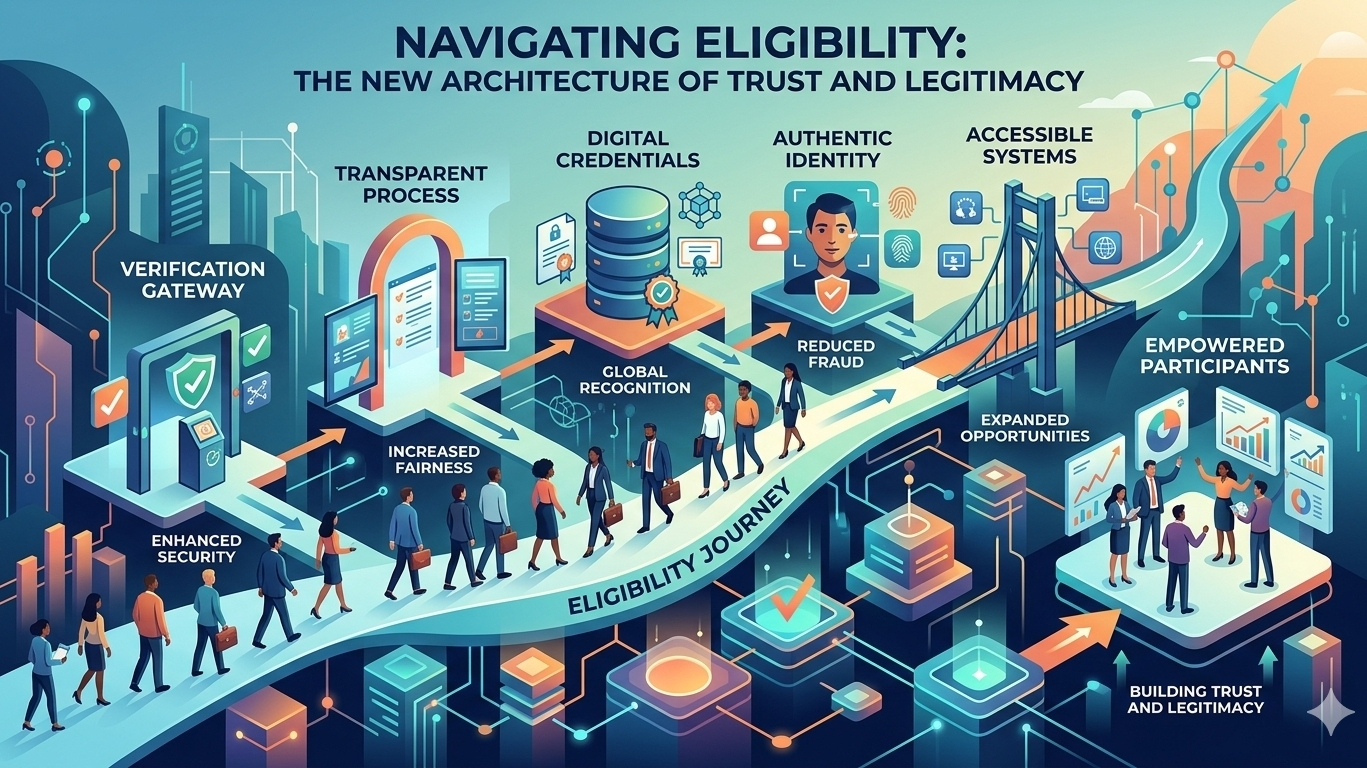

The word sounds small, even plain. But almost every digital system eventually converges on a single binary question that Who counts?
Who belongs?
Who finished the task and who earns the access on the status or the reward?
Once you start seeing this pattern, you realize it is the heartbeat of the internet. Yet, the answer is always messier than the interface suggests.
A system might track an action a contribution made, an asset held, a course passed, or a threshold crossed. Within that sandbox, the record is clear. But the moment that record needs to travel, the certainty evaporates. We often mistake a "simple" process for a solved one, failing to realize the difficulty has just been pushed out of sight. Behind every clean Eligible, Verified, Claimable lies a scaffolding of human assumptions. Someone had to draw the line. Someone decided what counts as evidence. Someone determined how long that truth lasts before it rots.

The real challenge isn't just issuing a credential or moving a token, it’s connecting proof to consequence in a way that survives the noise of the open web. Traditionally, we treat these as separate silos, first you prove it, then you decide what to do with it. But in the wild, these layers collapse into one another. If the proof is flimsy, the distribution feels like noise. If the logic is opaque, the proof becomes a dead end. When these systems rely on private spreadsheets or "trust me" internal logic, they break the moment they leave home. What we actually crave isn't just data it’s proof that travels with its meaning intact.
Different ecosystems speak different languages of legitimacy. One community trusts a wallet’s history, another demands a signed attestation. A regulator ignores technical verifiability if the audit trail is a black box. The struggle is rarely about whether something can be proven, but whether that proof can survive contact with a foreign set of rules without a fresh negotiation every time. This is the unglamorous work of infrastructure making records actionable across borders.
Technical writing often ignores the human side of broken eligibility. People don't experience these as design flaws, they experience them as doubt and erasure. They are told they don’t qualify for reasons they can't see. They are forced to prove themselves over and over. When this infrastructure finally works, it doesn't feel like a technological breakthrough it just feels like the relief of finally being recognized properly.

The question is shifting. We are moving past the first generation concern of whether we can verify something at scale. The real question for the next decade is that :
Can one system make a judgment that another system accepts without a middleman?
Can recognition move from one context to another without losing its shape?
This is why the approach of $SIGN matters. It isn't a loud promise of a utopia. It’s a quiet, structural attempt to make eligibility legible and portable. It’s about moving away from closed rooms where a few people decide who counts I'mand toward a world where the "why" behind a digital decision is as transparent as the "what." This shift starts in the background, long before most people realize how many digital decisions were waiting on it.
@SignOfficial SignOfficial#signdigitalsovereigninfra $SIGN #SignDigitalSovereignInfra