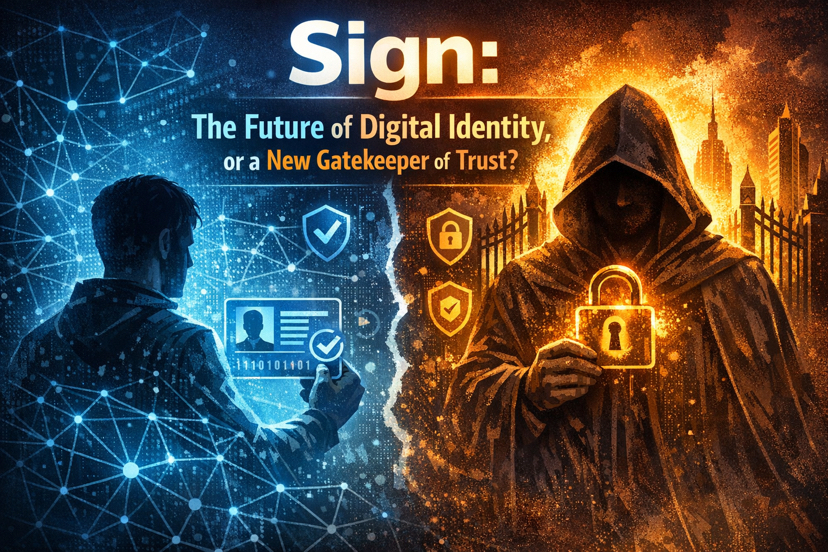
Some projects do more than introduce new technology.
They force a bigger question into the open.
Sign feels like one of those projects.
The more I think about it, the more one tension keeps standing out to me: simplicity vs control.
On paper, the model is impressively clean.
Credentials are issued, verified by a distributed network of validators, and then can move across platforms without needing to be constantly rechecked. That reduces friction, makes identity more reusable, and saves users from having to prove themselves over and over again.
It is a strong idea.
Maybe even a necessary one.
But the real question begins where the architecture ends:
Who actually holds the trust?
A system can be decentralized without becoming neutral.
Sometimes power does not disappear.
It just changes form.
Today, trust may sit with a central authority.
Tomorrow, it may sit with a network of validators.
But the deeper question remains the same:
who decides which credentials are credible, which standards matter, and what counts as valid identity in the first place?
That is where Sign becomes more than just a technical framework.
Because in one sense, it empowers users.
Portable credentials mean less dependency on isolated platforms and fewer repetitive verification steps.
But in another sense, it also benefits platforms.
They get to outsource verification, reduce overhead, and rely on a trust layer that someone else maintains.
So who benefits more?
The user, or the platform?
Honestly, probably both.
And that is exactly what makes the project so interesting.
Then there is the tension between user experience and protocol complexity.
Light clients are a great example. They open the door for people in low-bandwidth environments to verify credentials without needing heavy infrastructure. From an accessibility standpoint, that is genuinely powerful.
But real-world systems are never as smooth as whitepapers make them sound.
A dropped connection.
A malicious node.
A small bug in verification logic.
These can sound like minor issues, but in identity systems, small failures can have delayed consequences. By the time the damage becomes visible, trust may already be eroding in the background.
Privacy adds another layer to this.
Yes, Sign is designed to preserve confidentiality.
But validators still need some level of visibility to confirm authenticity. That may be technically reasonable, but it is still a compromise.
And the issue is not that compromise exists.
The issue is that most everyday users will never fully see it.
On the surface, they get a seamless experience.
Underneath, there are still assumptions about visibility, trust, and data exposure quietly doing the real work.
That is why I do not think Sign’s biggest challenge will necessarily be technical.
It may be human.
Regulators may hesitate.
Institutions may resist.
Platforms may adopt it only when it suits their incentives.
Users may embrace the convenience without fully understanding the trade-offs.
And that matters, because history has shown again and again that elegant systems do not fail only because of bad code.
Sometimes they stall because human systems are messy, political, and slow to align.
What keeps pulling me back to Sign is that it tries to make identity both portable and standardized at the same time.
That is not easy.
Usually, identity systems lean in one direction or the other.
They are either rigid and controlled, or flexible but fragmented.
Sign is trying to bridge that gap.
And that is exactly why it feels important.
But standardization always carries a hidden question:
Who sets the standard?
If traditional institutions are no longer the only gatekeepers, could validators slowly become a new institutional class of their own?
That is not a dramatic fear.
It is just the question that quietly sits underneath every trust protocol.
For me, the real test of Sign will not be the technical design alone.
It will be what happens when it meets the real world.
How will it be adopted?
Who gains influence?
Who gets excluded?
Do users actually become more free, or simply more portable?
Sign is promising, no doubt.
But in digital identity, promise and power usually arrive together.
And that is why this project is worth watching.
Because it is not only about credentials.
It is about the future shape of digital trust itself.
Making identity portable is the easy part.
Making it fair is much harder.
And maybe that is where Sign’s real story begins.