
I didn’t really understand what SIGN was trying to do the first time I came across it. It looked like another infrastructure project, something about attestations, credentials, verification. Useful, but abstract. The kind of thing you assume is important without ever fully grasping where it fits.
It only started to make sense when I stopped thinking about verification as the end goal.
Because in real systems, verification is never the finish line. It is just the moment before something actually happens. Someone gets paid. Someone unlocks tokens. Someone gains access. Someone proves they belong. That shift in perspective makes SIGN feel less like a technical tool and more like a bridge between “this is true” and “this now leads to something real.”
That is where the project feels different to me.
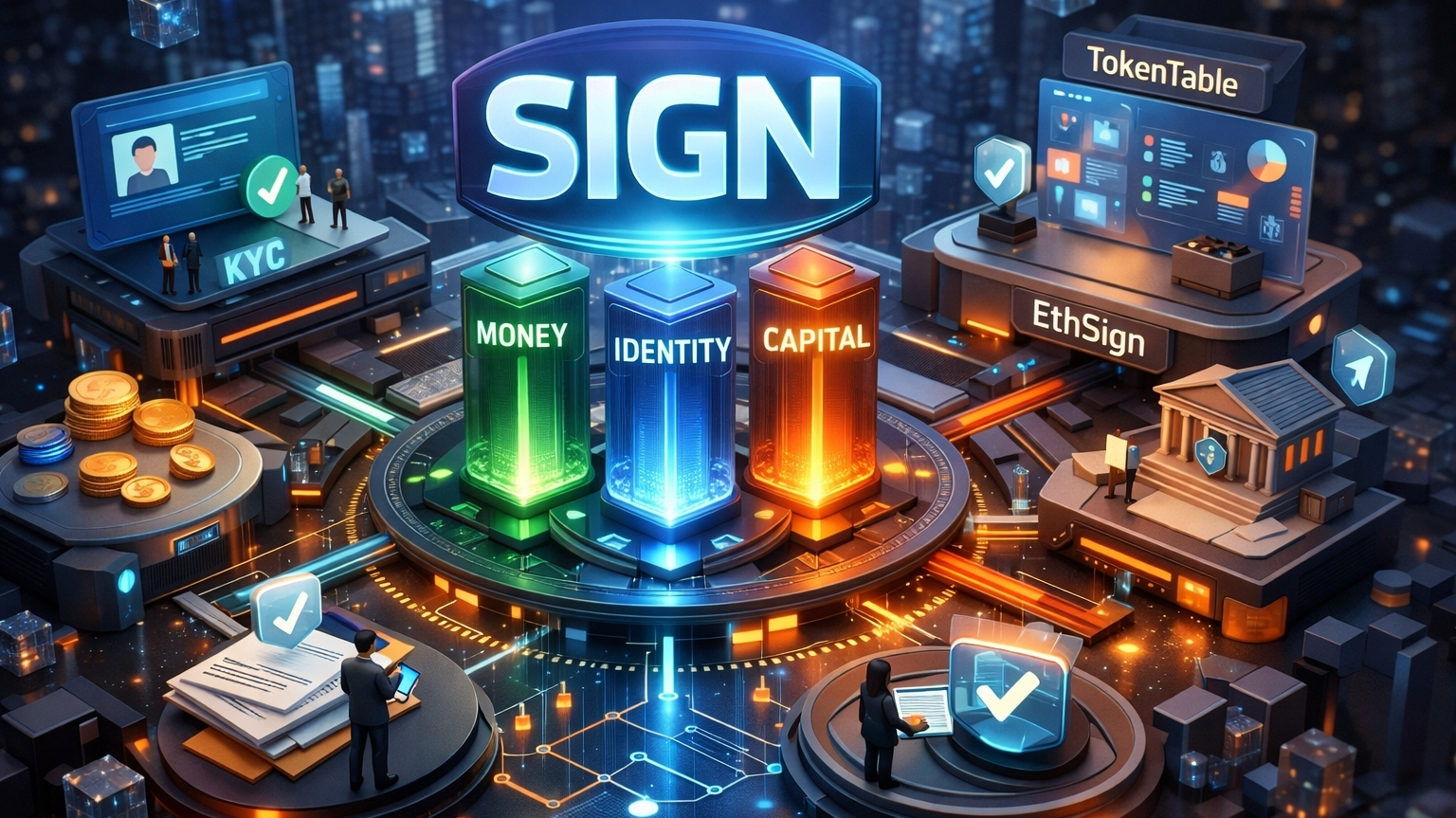
Earlier versions of SIGN were easier to categorize. Sign Protocol was described as an omni-chain attestation system, basically a way to create and verify claims across different blockchains. Clean, simple, and easy to explain. But the newer direction, especially in the updated 2026 materials, tells a more ambitious story. Now SIGN is framed as a system that connects money, identity, and capital, with different components working together instead of existing in isolation.
At first, that sounds like typical expansion language. Every project eventually tries to sound bigger. But this one feels more grounded because the pieces already exist. Sign Protocol handles the verification layer. TokenTable handles distribution, vesting, and unlocking. EthSign handles agreements. When you look at them together, it starts to feel less like a collection of tools and more like a workflow.
And that workflow is surprisingly familiar.
Think about how things usually work in the real world. Before any money moves or access is granted, there is always a quiet step where someone checks if you qualify. That step is often messy. It lives in spreadsheets, internal dashboards, email approvals, or systems that do not talk to each other. Crypto was supposed to fix coordination, but even here, eligibility is still strangely fragile.
Airdrops get gamed. Reward systems break. Distribution lists are patched together. Teams spend weeks figuring out who should receive what, and then hope the execution matches the intention.
This is where SIGN starts to feel practical rather than theoretical.
TokenTable, in particular, is easy to underestimate. Distribution sounds like a boring problem until you realize how many things can go wrong when money is actually involved. According to their own data, TokenTable has already unlocked billions of dollars to tens of millions of wallets. Numbers aside, what that really suggests is repetition. The system has been used enough times to encounter edge cases, mistakes, and complexity.
And that matters more than any clean architecture diagram.
Another thing that stood out to me is who SIGN seems to be building for. A lot of crypto projects still speak as if everything will remain purely decentralized and permissionless. SIGN does not really pretend that. The way it talks about its future includes governments, regulated assets, identity systems, and hybrid environments where not everything is fully open.
Some people will dislike that direction. It is less idealistic. But it also feels more honest. Real systems are rarely clean. They involve oversight, rules, and compromises. SIGN seems to be designing for that reality instead of avoiding it.
Even the funding story reflects this shift. When existing investors come back with more capital, it usually means the project has grown into its narrative rather than drifting away from it. In SIGN’s case, the focus has moved from simple credential verification toward something closer to infrastructure for large-scale coordination.
What I find most interesting is not any single feature. It is the type of question SIGN is trying to answer.
Not “how do we move assets faster?”
But “how do we decide, in a way that can be trusted later, who should receive them at all?”
That question shows up everywhere once you start noticing it. In grants, in token unlocks, in governance, in identity, in access control. It is the quiet layer behind almost every system, and it is usually the least polished part.
If SIGN succeeds, it will not be because it created a new flashy use case. It will be because it made that quiet layer more reliable, more consistent, and less dependent on manual trust.
The easiest way I can describe it now is this: SIGN is not trying to move value. It is trying to justify movement.
And in the long run, that might turn out to be the harder and more important problem to solve.
#SignDigitalSovereignInfra @SignOfficial $SIGN
