
I’ve spent the last few years watching crypto move through its cycles.
Speculation.
Infrastructure.
Then speculation on that infrastructure.
We’ve seen:
The store of value phase
The smart contract boom
The scalability wars
And now…
Something quieter is starting to take shape.
Something that doesn’t trend easily.
Digital sovereignty.
Why This Category Feels Different
This isn’t a narrative that explodes overnight.
It doesn’t have the same energy as memes or AI hype.
It’s slower.
Heavier.
More foundational.
And honestly, easier to ignore.
Until you realize how much of your digital life you don’t actually control.
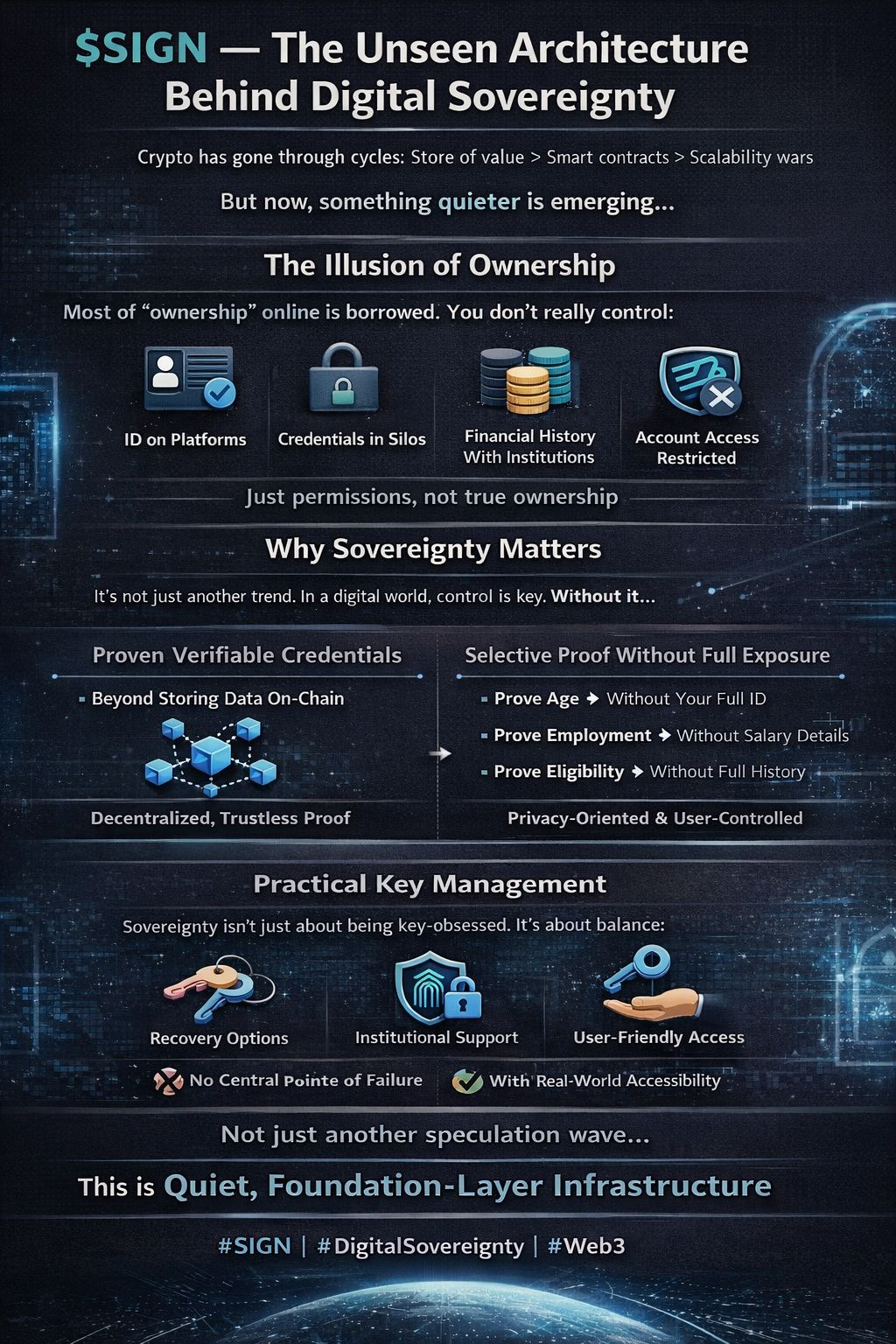
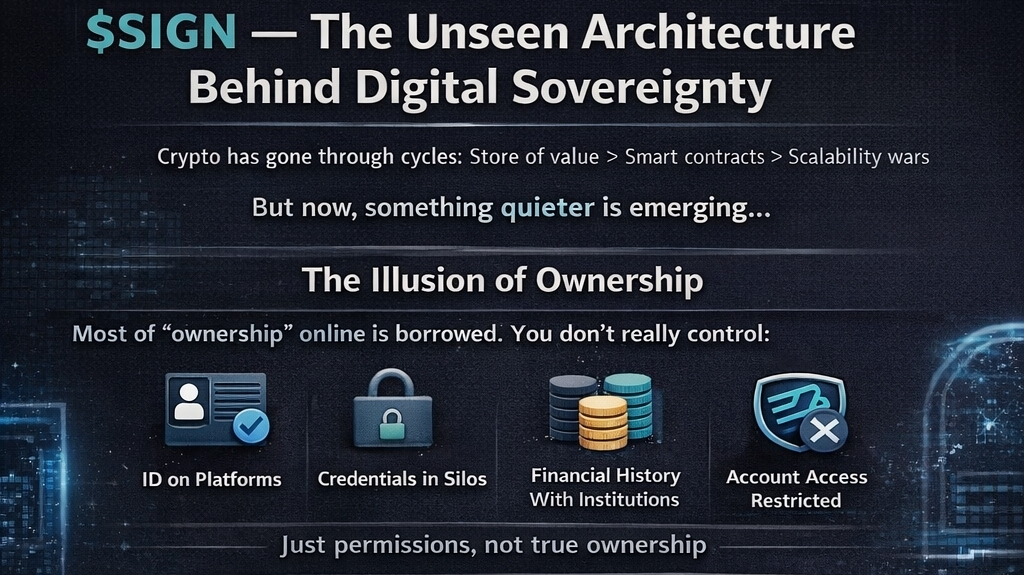
The Illusion of Ownership
Right now, most of what we call “ownership” online is borrowed.
Your identity lives on platforms
Your credentials sit in silos
Your financial history is stored by institutions
Your accounts can be restricted, frozen, or removed
You don’t own these things.
You’re allowed to use them.
That distinction matters more than people think.
Where $SIGN Changed My Perspective
When I first came across $SIGN, I was skeptical.
We’ve seen too many projects talk about: “identity”
“ownership”
“decentralization”
Most of them repeat the same ideas with different packaging.
But digging deeper into $SIGN, something felt different.
This wasn’t just about putting identity on-chain.
It was about restructuring how ownership itself works.
From Documents to Verifiable Truth
A lot of systems focus on anchoring data.
Timestamping files.
Storing records.
But $SIGN takes a different approach:
Verifiable credentials.
Not just proving something exists…
But proving specific truths without exposing everything.
For example:
Prove your age → without revealing your full ID
Prove employment → without sharing salary details
Prove eligibility → without exposing full history
That level of selective disclosure is critical.
Because real privacy isn’t about hiding everything.
It’s about controlling what you reveal.
The Hardest Problem Nobody Talks About
In crypto, people obsess over speed.
Throughput.
TPS.
Scalability.
But the hardest problem is something else:
Key management.
Because sovereignty only works if you don’t lose access.
Lose your keys…
And your identity, assets, and credentials disappear with them.
Where Most Systems Fail
This is where many projects break.
They build for: Hardcore users
Self-custody purists
But ignore real-world behavior.
SIGN seems to recognize this.
It’s not just about pure self-custody.
It’s about balance:
Social recovery
Institutional support
User-friendly access
Without reintroducing central points of failure.
That’s a difficult line to walk.
Building in a Noisy Market
Right now, the market is loud.
Narratives dominate: AI
Memes
Restaking
Short-term plays
In that environment, something like $SIGN doesn’t stand out immediately.
Because it’s not designed to.
It feels more like infrastructure.
And infrastructure doesn’t need attention.
It needs adoption.
Why Sovereignty Isn’t a Trend
Sovereignty isn’t tied to market cycles.
It becomes more relevant every time:
A platform bans users
Data gets exposed
Systems fail to prove authenticity
Trust breaks down
We’re moving into a world where:
AI can generate identities
Deepfakes challenge reality
Digital presence becomes harder to verify
In that world…
Proof matters more than ever.
The Role of the Token
One thing that stood out is how SIGN approaches its token.
Instead of existing purely for speculation…
It’s tied to function:
Verifying credentials
Securing identity
Preventing spam
Enabling trust
The token becomes a tool.
Not just a trade.
A Subtle but Powerful Shift
I also explored how they handle digital agreements.
Normally: You upload documents to third-party services.
They store it.
They control access.
With $SIGN:
The signature becomes a cryptographic event
The proof is on-chain
The document stays with the user
That separation is important.
Because it removes unnecessary exposure.
While keeping verification intact.
Why This Actually Matters
After a while in crypto, you start noticing patterns.
Hype cycles repeat
Weak systems get exposed
“Infrastructure” often ends up centralized
This doesn’t feel like that.
It feels like something built from a deeper understanding:
Crypto isn’t just about money.
It’s about autonomy.
The Bigger Shift
We already have infrastructure for:
Finance
Trading
Gaming
But we’re still early in:
Digital personhood.
And that might be the most important layer of all.
Because everything else depends on it.
Final Thought
I’m not here to hype anything.
And I’m definitely not here to tell anyone what to buy.
But I am paying attention.
Because I’m looking for things that matter:
Not just when the market is up…
But when it’s quiet.
SIGN feels like it’s working on something that doesn’t need a narrative to exist.
It needs time.
And if digital sovereignty becomes essential…
Then infrastructure like this won’t just be useful.
It will be necessary.