
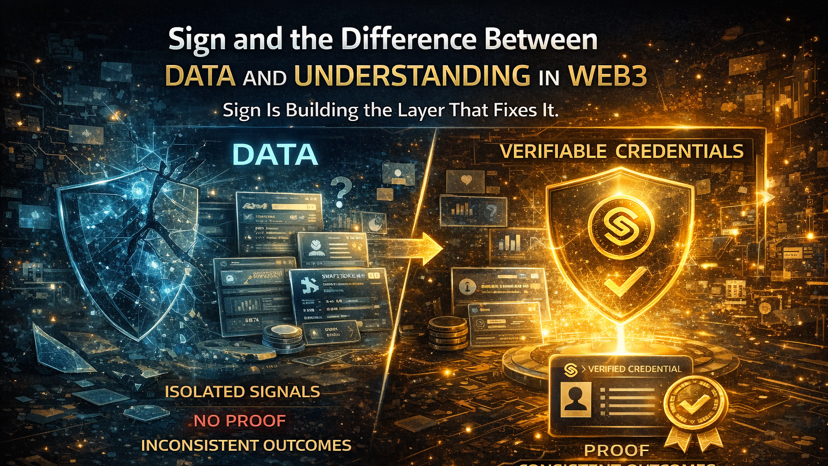
One of the biggest misconceptions in Web3 is that having data is the same as understanding users.
At first glance, it feels like everything is measurable. Wallet activity, transaction history, token balances, interactions across protocols. The data is there, and it’s publicly accessible.
But when you look closer, something doesn’t add up.
Despite all this data, systems still struggle to recognize real participation.
That’s because data alone doesn’t create clarity.
Most platforms operate using isolated datasets. They can see what happens داخل their own environment, but they lack the context to interpret that data in a broader way. A wallet might look inactive in one place while being highly active somewhere else.
This creates blind spots.
And those blind spots directly affect how decisions are made.
One of the clearest examples is token distribution.
Projects try to reward users based on activity, but without a unified way to verify that activity, they rely on simplified metrics. Snapshots, balances, or limited interactions become stand-ins for real contribution.
The result is inconsistency.
Not because the system is broken on the surface,
but because the foundation underneath it is incomplete.
Sign is built around closing this gap.
It focuses on transforming raw activity into verified credentials. Instead of treating data as isolated events, it creates a structure where that data can be validated and reused across different systems.
This introduces something Web3 currently lacks.
Continuity.
Your actions stop being temporary signals tied to a single platform and start becoming part of a broader identity that can be recognized elsewhere.
That shift changes more than just identity.
It changes how value is distributed.
When systems can rely on verified credentials instead of fragmented data, they can make more accurate decisions. Rewards can be tied to proven participation, not estimated behavior.
This reduces noise.
It also creates stronger alignment between users and the ecosystems they interact with.
From a bigger perspective, Sign is working on something that sits below most visible activity in Web3.
It’s not building another application competing for attention.
It’s building a layer that connects how users are understood across systems.
And that kind of layer tends to grow in importance over time.
Because as Web3 expands, the complexity doesn’t just increase.
It multiplies.
More users, more platforms, more interactions. Without a way to organize and verify all of that, systems become less efficient, not more.
Sign introduces structure to that complexity.
It turns scattered signals into something coherent.
It turns activity into something provable.
And most importantly, it connects identity to value in a way that makes sense.
That’s not a short-term narrative.
It’s a foundational one.
#SignDigitalSovereignInfra $SIGN
