
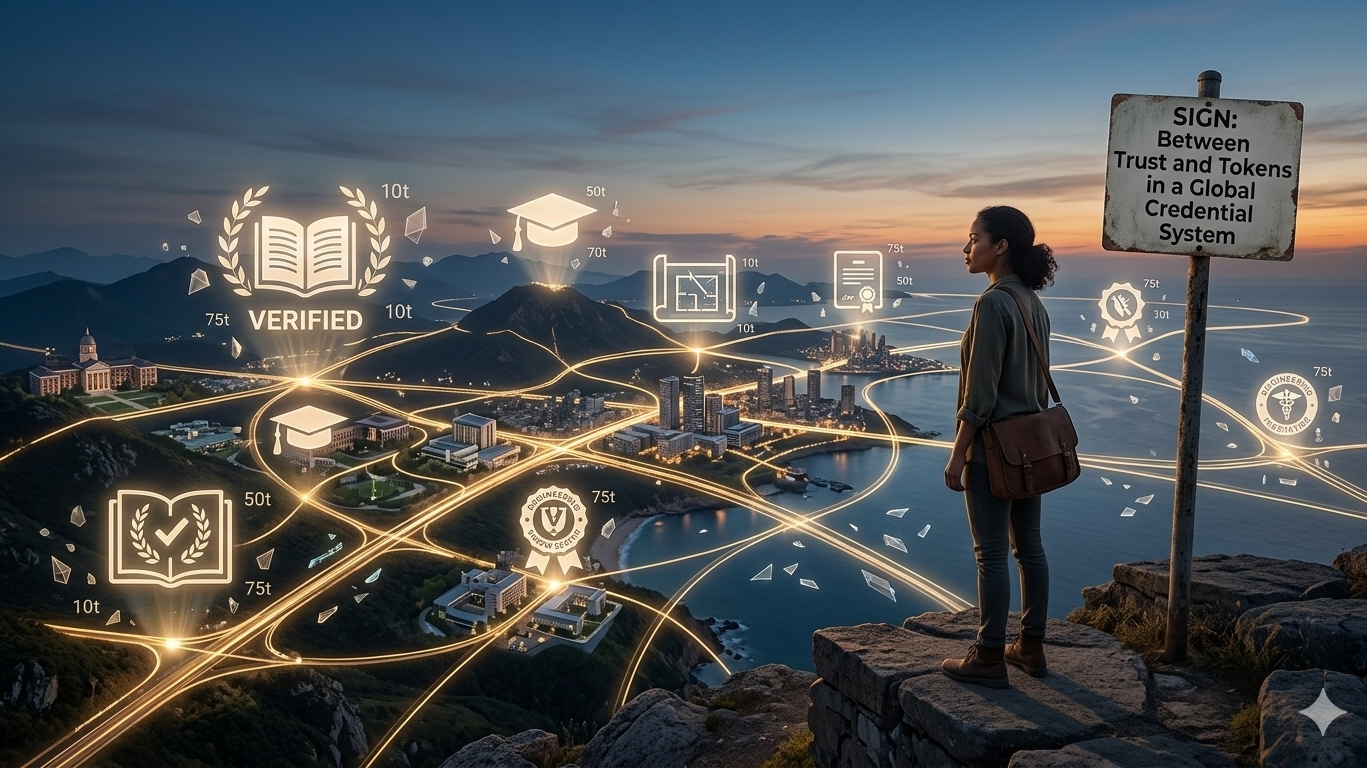

I keep thinking about this idea of SIGN, and honestly, I’m still trying to make sense of how I feel about it. On the surface, it sounds simple—almost too simple. A global system where you can verify credentials instantly, and where tokens somehow flow through that same system. No long processes, no waiting, no back-and-forth. Just… proof, confirmed.
And yeah, part of me likes that.
I’ve seen how messy verification can be in real life. You apply for something, you upload documents, you wait days or weeks, and half the time you’re not even sure if anyone looked at them properly. So the idea that all of that could be streamlined into something quick and reliable feels like a natural step forward. It’s the kind of thing that makes you think, “Why didn’t we already fix this?”
But then I slow down a bit.
Because whenever something sounds this clean, I start wondering what’s hiding underneath. Real life isn’t clean. People aren’t consistent. Institutions aren’t either. A degree from one place doesn’t always mean the same as a degree from another. Experience isn’t just a checkbox. Reputation isn’t always measurable. So if SIGN tries to turn all of that into neat, verifiable pieces of data… I can’t help but wonder what gets flattened in the process.
Maybe that’s the trade-off. You gain speed and clarity, but you lose some depth.
And then there’s the token side of it, which makes things a little more complicated in my mind. Tokens mean incentives. Rewards. Value attached to actions. And that’s where things can shift without us even noticing. If credentials are connected to some kind of token system, people might start chasing whatever the system rewards the most. Not necessarily what’s meaningful, but what’s measurable.
We’ve already seen how that plays out in other areas. People optimize for likes, views, scores—whatever the system values. So it’s not hard to imagine the same thing happening here. Suddenly, learning or achieving something might feel less about growth and more about how it fits into the system.
But at the same time, I get why something like SIGN is even being considered.
The world is kind of all over the place when it comes to trust. Different countries, different platforms, different rules. Nothing really connects smoothly. So having one shared system, one common way to verify things, does make sense. It could remove a lot of confusion. It could make opportunities more accessible, especially for people who get overlooked because their credentials aren’t easily recognized.
That part feels important.
Still, I keep coming back to one question: who decides how this system works?
Because once something like this becomes widespread, most people won’t question it. It’ll just become part of everyday life, like logging into an app or sending a message. And when that happens, the decisions behind it—the rules, the structure, the priorities—kind of fade into the background.
That’s the part that makes me pause.
I’m not against SIGN. I wouldn’t say I fully trust it either. I’m somewhere in the middle, just observing. It feels like one of those ideas that could genuinely help in some ways, but also quietly change things in ways we don’t immediately see.
So I guess I’m just watching it, trying to understand it, and staying a little cautious. Not because it’s bad, but because anything that reshapes how trust works on a global level deserves a second thought.