

@SignOfficial #SignDigitalSovereignInfra $SIGN
I have seen many crypto projects rise very quickly.
Some appear with massive confidence, loud communities, and the kind of marketing that makes people feel like they need to react immediately. For a short time, that formula works. The project gets attention, people repeat the same lines, and the whole thing starts looking bigger than it really is. But in crypto, attention is easy to manufacture. What is difficult is building something that still feels important after the noise fades.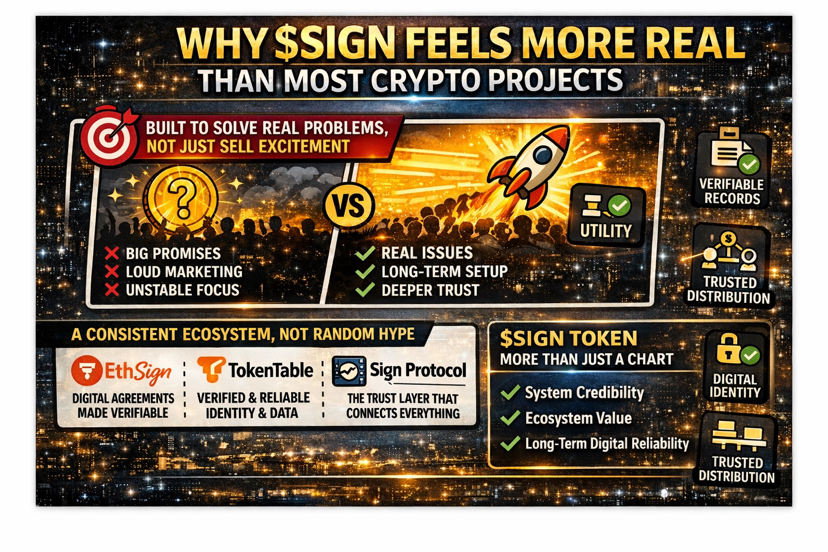
That is one reason why @SignOfficial feels different to me.
It does not come across like a project trying too hard to look important. It feels more like a project working on a weakness that has existed in digital systems for a long time, even if people do not always describe it clearly. That weakness is trust.
Not trust as a slogan.
Trust as structure.
Trust as proof.
Trust as something systems can actually rely on when scale increases and things become more complicated.
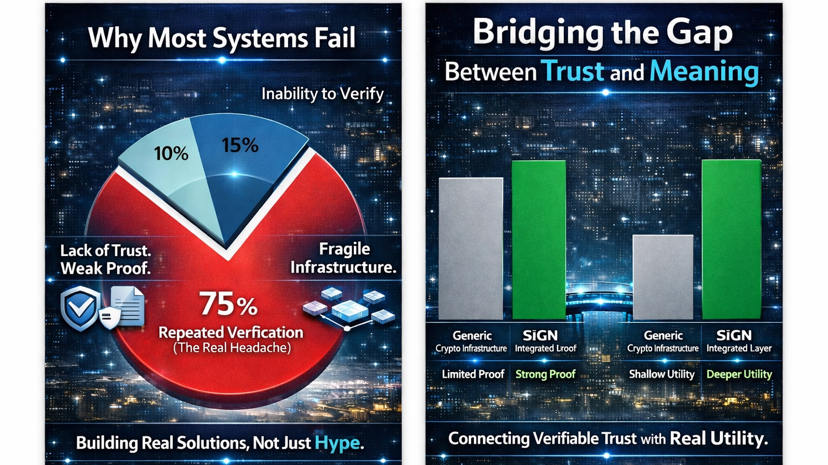
A lot of digital environments still look more advanced on the surface than they really are underneath. Information moves quickly, platforms expand, and participation grows, but the deeper layer often remains fragile. Verification is unclear. Credentials are fragmented. Claims are difficult to check across different systems. Distribution can become messy. Access can become inconsistent. In many cases, the real problem is not the lack of activity. It is the lack of dependable coordination.
That is where Sign starts to feel meaningful.
What makes it stand out is that it is not only concerned with movement. It is concerned with credibility. It is not only about creating digital interactions. It is about making those interactions more reliable, more verifiable, and easier to trust across different environments. To me, that feels far more important than the kind of short term excitement that dominates most of this market. This is also why the project feels more like infrastructure than narrative.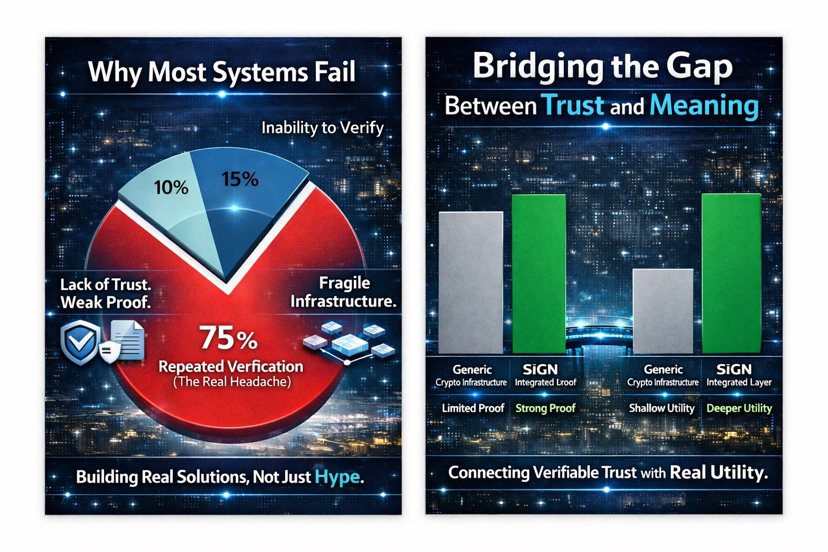
Infrastructure is usually less dramatic. It does not always create instant emotional reactions. It does not always produce the loudest headlines. But it matters because it supports everything that comes after. If the trust layer is weak, the rest of the system eventually feels weak too. If the proof layer is fragmented, the user experience may still look smooth for a while, but the structure underneath remains unstable.
That is why I keep coming back to this project.
It seems to be focused on one of the parts of the digital world that people often ignore until it becomes a problem. Whether the subject is credentials, identity, attestations, or distribution, the same question keeps appearing in different forms. How do we know what is real, what is valid, and what can still be trusted when systems interact across different spaces?
That question is becoming more important, not less.
As digital ecosystems continue to grow, trust cannot remain informal forever. More users, more platforms, more tokenized systems, and more cross platform interactions create more pressure on verification. The larger the network becomes, the more expensive weak coordination becomes. That is exactly why projects working on proof, structure, and digital credibility deserve more attention than they usually get.
To me, Sign feels connected to that future.
It feels less like a project built for one moment and more like a project trying to strengthen a layer that many future systems will eventually need. That does not guarantee success, and it does not remove risk. Crypto always carries uncertainty. Narratives can shift. Markets can turn. Regulation can reshape entire sectors. Execution still matters. All of that is true. But even with those realities in mind, there is still a clear difference between projects that mainly sell excitement and projects that are trying to solve something foundational.
Sign feels much closer to the second group.
Another thing I appreciate is the overall tone of the project. It does not feel disconnected from real utility. It does not feel like it is trying to survive only through visibility. There is a more grounded quality to it. The focus seems closer to function than performance. In a market where many teams want to be seen first and understood later, that difference matters to me.
I also think there is long term value in building around digital proof and structured trust. The internet is full of claims, but not all claims carry the same weight. The systems that become truly useful in the future will likely be the ones that can make information more dependable without making participation harder. That balance is not easy to achieve. It requires more than branding. It requires a real understanding of how systems break when trust is weak and how they improve when verification becomes portable, efficient, and credible.
That is part of what gives this project a stronger impression.
It feels like it understands that the future of digital systems is not only about speed or scale. It is also about whether those systems can hold up under pressure. When participation expands, when value moves across different layers, and when users need more confidence in what they are interacting with, the quality of the trust layer becomes impossible to ignore.
This is where @SignOfficial keeps my attention.
Not because it is the loudest project in the room.
Not because it is trying to force hype.
But because it seems to be building in an area that quietly matters more than most people realize.
There are many projects that know how to create temporary excitement. Far fewer know how to build something that still feels relevant when the market becomes less emotional and more selective. In my view, Sign has that kind of potential. It feels thoughtful. It feels structured. And most importantly, it feels connected to a real need rather than an invented one.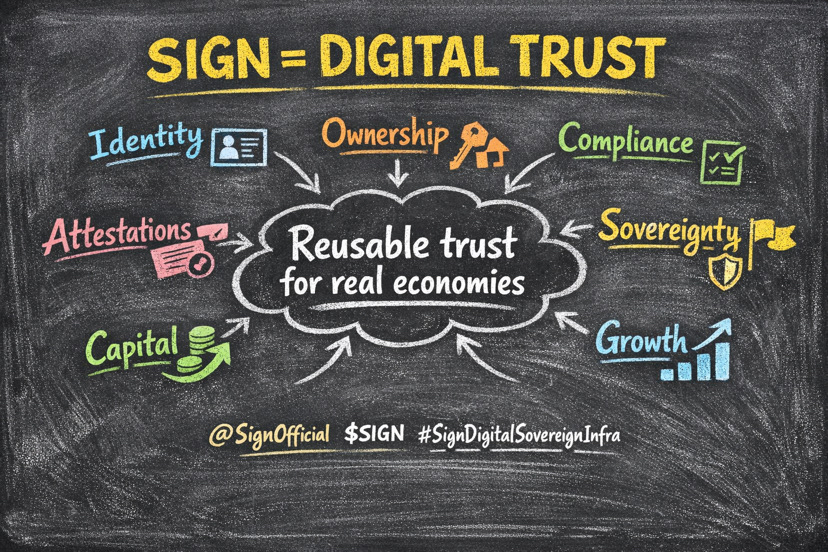
That is why I still find it worth watching.
In a space full of noise, projects like this stand out in a different way. Not through pressure, not through exaggeration, and not through empty performance. They stand out because they seem to be working on something that can actually matter over time.
And honestly, that kind of quiet strength is much harder to ignore than hype.