
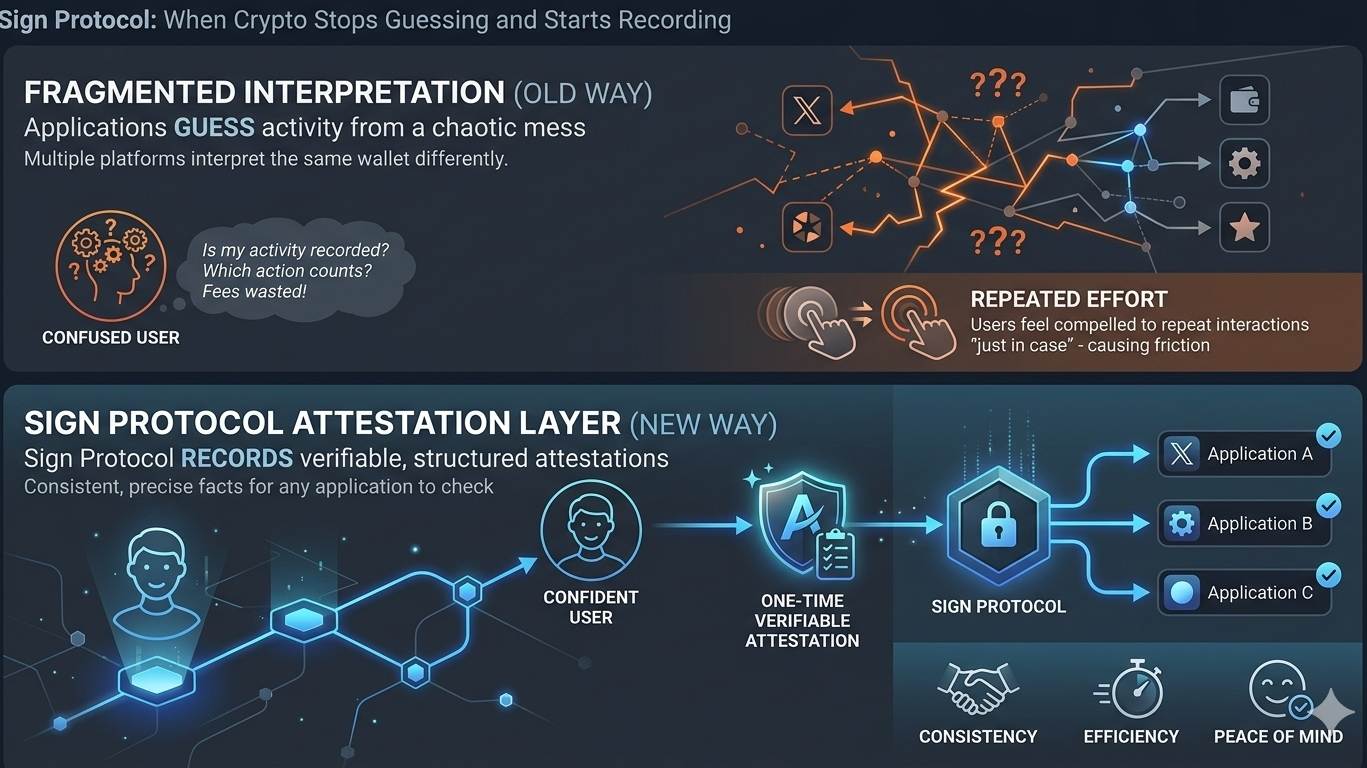
I once sat there with three tabs open—block explorer, some half-broken dashboard, and a Discord thread where everyone sounded way too confident for how little anyone actually knew. Same question everywhere: who qualifies?
Answers? All over the place.
One guy swore it was volume. Another said it was interaction streaks. Someone else claimed they barely did anything and still got in. Meanwhile, I’m scrolling through my own wallet thinking… this isn’t a participation problem. This is a measurement problem.
That’s the part people don’t really say out loud.
We’ve built insanely efficient systems for moving value. But when it comes to deciding who should receive that value, things get weird. Fast.
And this is where Sign Protocol starts to feel less like “infrastructure” and more like a correction.
Most distribution systems today are basically post-event analysis engines. You do stuff, the system later tries to interpret it, and eventually a list comes out. But that list is only as reliable as the logic behind it—and that logic is often hidden, inconsistent, or quietly adjusted.
So what happens? People start gaming uncertainty.
Extra transactions. Repeated interactions. Switching chains just to “cover more ground.” Not because it’s logical—but because it’s unclear what actually counts.
It’s a strange feedback loop. The system is vague, so users behave irrationally to compensate.
Sign breaks that loop by doing something deceptively simple: it defines eligibility before anything happens.
Not after. Not retroactively.
Before.
Using schemas, projects can specify exact conditions—down to contract interactions, timestamps, thresholds. No interpretation layer needed later. Either the condition is met, or it isn’t.
And once it’s met, an attestation gets issued. That’s the key object here.
Not a score. Not a probability.
A record.
Something like: this wallet completed this action under these rules.
That’s it.
Which means when it’s time to distribute rewards, you’re not scraping data and running filters anymore. You’re checking for existence.
Does this wallet have the required attestation?
Yes or no.
That shift sounds minor on paper. In practice, it turns a messy, multi-variable evaluation into a binary check. Almost boring, honestly—but in a good way. Boring systems tend to be reliable.
And reliability is exactly what distribution layers have been missing.
What’s interesting is how this changes incentives on both sides.
For users, it removes that constant second-guessing. You don’t need to over-interact or hedge your activity across platforms. You just follow defined conditions. Once it’s done, it’s done.
For teams, it reduces operational overhead. No last-minute filtering tweaks. No internal debates about edge cases. No awkward explanations when users ask why they were excluded.
Everything is pre-committed.
Now, that doesn’t mean it’s foolproof. A badly designed schema is still… a badly designed schema. You can encode unfair rules just as easily as fair ones. But at least those rules are visible. Auditable. Fixed in advance.
That alone is a big step up from “trust us, we filtered correctly.”
And this isn’t just theory floating around in a whitepaper somewhere. The protocol has already handled millions of attestations and billions in distribution value. Which makes sense—because this is one of the few areas in crypto where precision actually matters more than speed.
Nobody cares if a transfer takes 2 seconds or 5.
They care a lot if they were wrongly excluded.
Zooming out a bit, this model starts to look less like a campaign tool and more like a coordination layer. Once attestations exist, they can be reused across contexts. A proof from one ecosystem can unlock access in another. Participation stops being siloed.
That’s where it gets interesting.
Because instead of every project rebuilding its own eligibility logic from scratch, you start getting shared primitives. Verified actions that carry weight beyond a single use case.
It’s subtle, but it compounds.
And maybe that’s the real takeaway here.
Crypto didn’t struggle with distribution because it lacked data. It struggled because it kept trying to interpret that data after the fact. Different rules, different assumptions, different outcomes.
Sign doesn’t try to interpret better.
It just removes the need to interpret at all.
Which, frankly, feels like something we should’ve done earlier.