
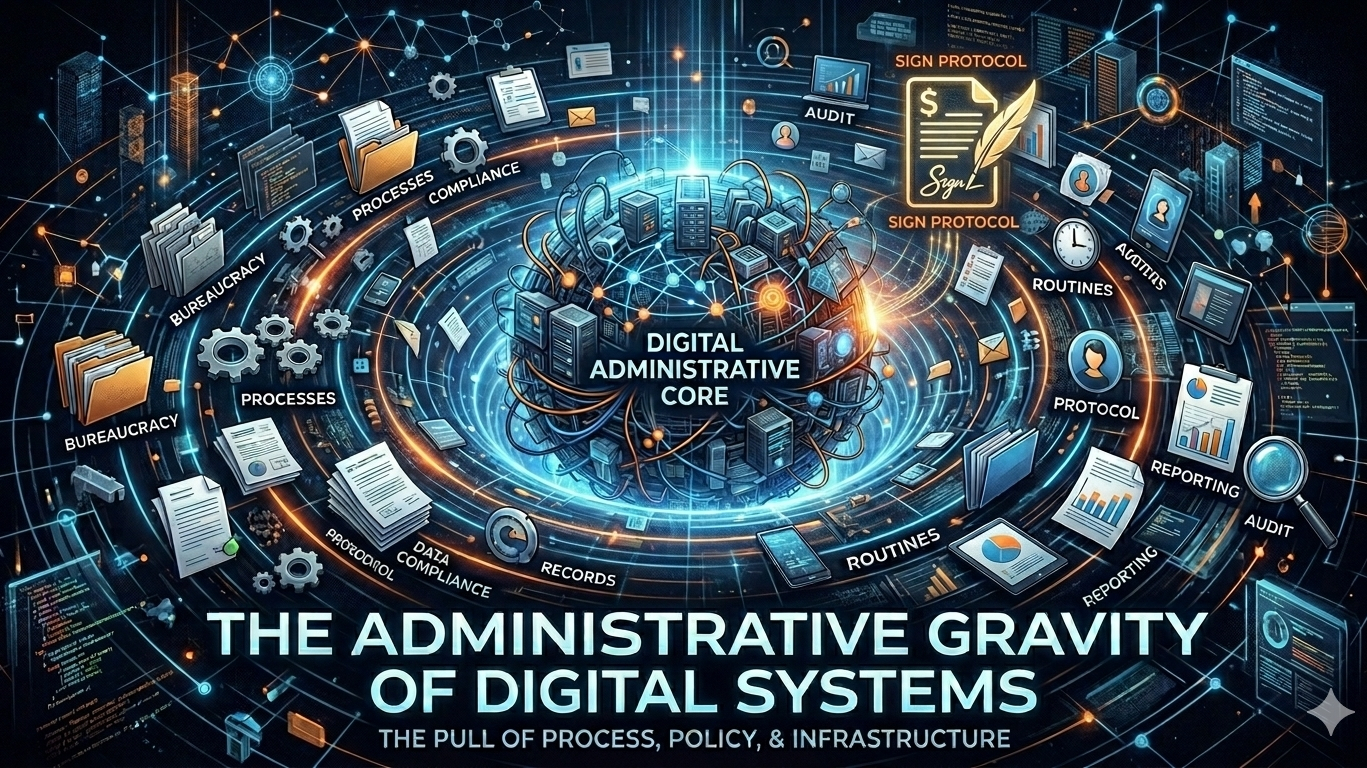

The angle that keeps pulling me back is not technology it is administration. While that might sound dry at first, it gets closer to the real problem than any discussion of throughput or decentralization. Most digital systems work well enough when they are simply recording activity. someone joins, someone buys, someone holds. The data exists, the history is clear and the chain records it all. But the moment a system has to turn that history into a decision, things start to feel heavier. Who qualifies, who gets access, who receives a distribution, and who is excluded? That is where the friction begins.
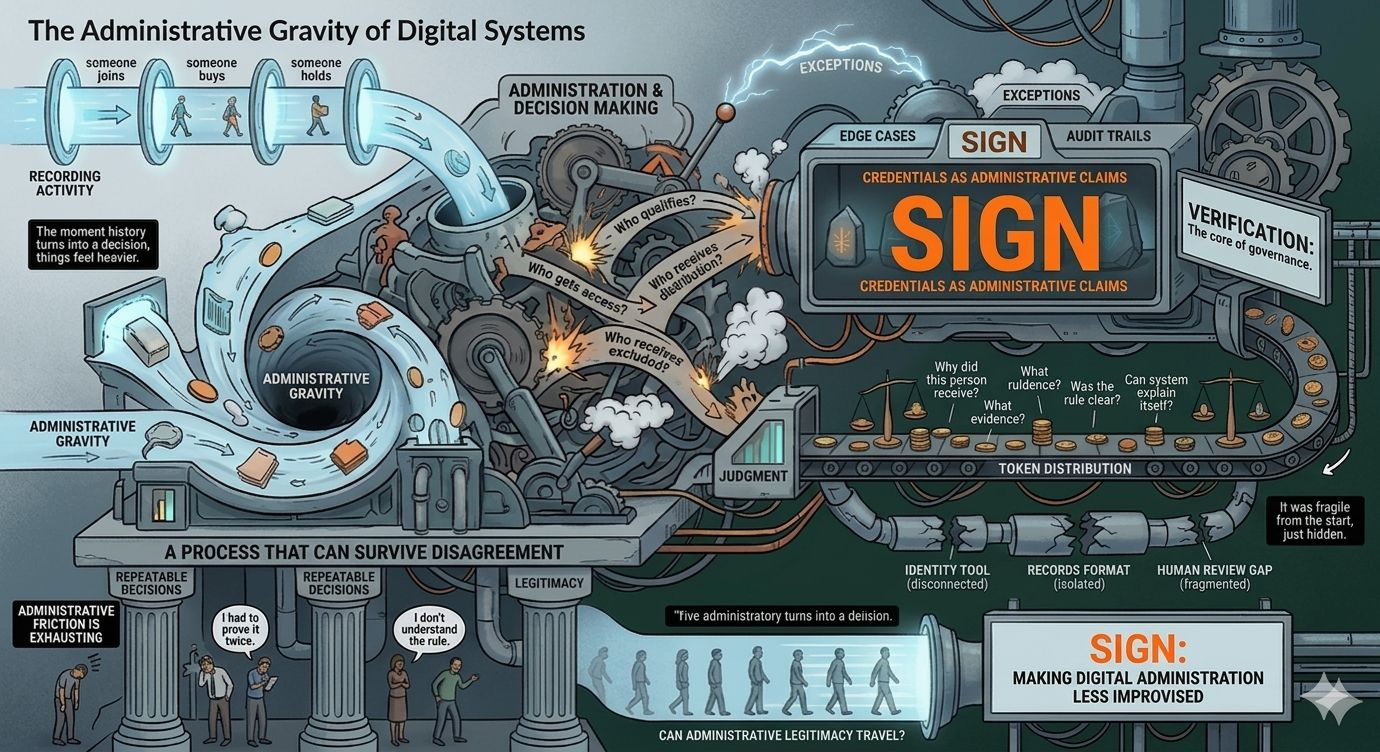
You can usually tell when a system was built more for activity than for administration. It looks smooth right up until a rule has to be enforced. Suddenly, everything depends on edge cases, exceptions, audit trails and all the quiet structures people ignore when they talk about digital systems in the abstract.
This is where something like SIGN starts to matter. A credential is not just a digital object, it is an administrative claim.🔥 It says this person completed something, belongs somewhere or is allowed to be treated in a certain way. Once you understand a credential like that, verification stops being a technical side feature and becomes the core of how a system governs itself.
The same is true for token distribution. At a distance distribution sounds like simple movement sending value from here to there. In practice, however distribution is a judgment wrapped in movement.
Why did this person receive something? What evidence supported that choice? Was the rule clear beforehand and can the system explain itself afterward?
Most systems still handle these layers badly because verification sits in one place while distribution logic sits somewhere else. Identity is handled by one tool, records live in another format and human review is used to fill the gaps. Everyone acts surprised when the process feels fragile, but it was fragile from the start, it just stayed hidden until the system had to make a real decision that someone might question later.
The hard part is not producing data, it is building a process around data that can survive disagreement. 🔥
Administration in this context, is the machinery that allows decisions to be repeated in a way that feels legitimate. It isn’t paperwork for its own sake, it is a way to ensure that people do not need to renegotiate the same facts over and over. There is a deep human layer here, too. Administrative friction is exhausting. People feel it when they have to prove the same thing twice or when they fail to receive something without understanding the rule that excluded them. Better infrastructure does not remove judgment, but it reduces how chaotic that judgment feels.

This is why something like SIGN feels most important in ordinary, procedural situations. Modern digital life now depends on systems making repeatable decisions across contexts they do not fully control. The question changes from "can credentials be verified?" to "can administrative legitimacy travel?" Can a claim hold its shape long enough for a consequence to follow in a way that feels defensible? Most systems do not break when information is created, they break when information has to be turned into a decision that someone else has to live with. Looking at SIGN from this angle reveals an attempt to make digital administration a little less improvised letting recognition and distribution rely less on invisible judgment calls hiding in the background. 🚀This kind of change arrives quietly, almost bureaucratically, long before people realize how many vital outcomes were depending on exactly that.
@SignOfficial #signdigitalsovereigninfra $SIGN #SignDigitalSovereignInfra