
What pulled me toward Sign Protocol was not hype. It was the opposite.
The more time I spent with it, the more I started to respect how calm it felt.
A lot of crypto projects try very hard to look important. They throw complexity in your face, use big language, and almost want you to feel lost so the system seems deeper than it really is. Sign did not feel like that to me. At first, it actually felt almost too clean. Too simple. Like something you could overlook if you were only searching for noise.
But after spending real time with it, I started to see that this kind of simplicity is not weakness. It is usually a sign that someone thought carefully about what should stay hidden and what should stay easy.
That is harder to do than people think.
Some tools are simple because there is not much inside them. Others are simple because the design is doing a lot of work quietly in the background. That second kind is much more interesting. It means the complexity has been handled well enough that it does not spill into every interaction. Instead of making you fight the system, it lets you move through it naturally.
That is where Sign began to stand out for me.
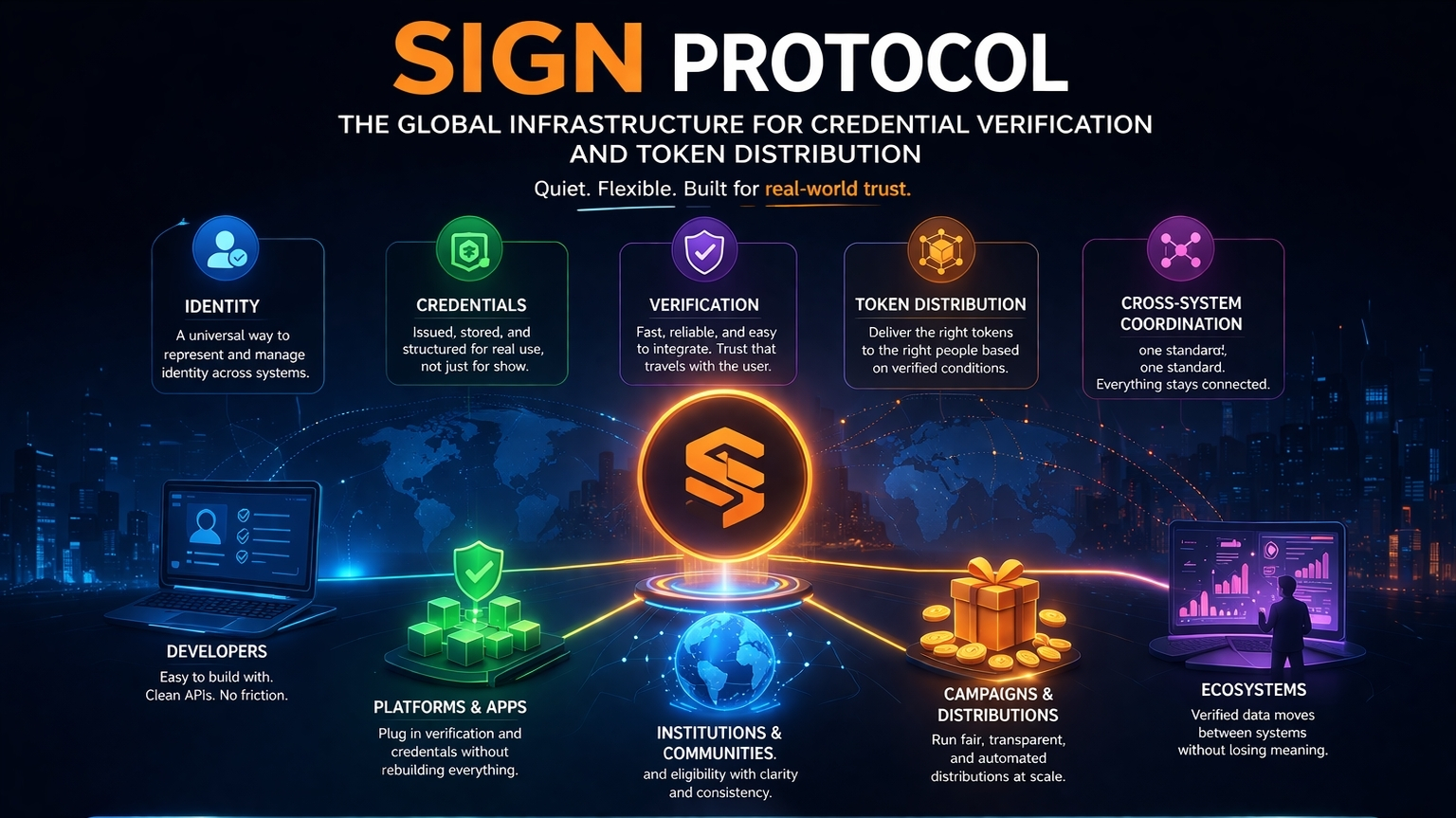
The deeper I looked, the less I saw it as just another protocol and the more I saw it as quiet infrastructure for trust. Not trust as a slogan. Real trust. The kind systems need when they have to verify identity, confirm credentials, check eligibility, handle permissions, or coordinate actions across different environments.
That may sound abstract at first, but it is actually very practical.
So much of digital life depends on verified claims. Someone needs to prove they belong somewhere. Someone needs to show they qualify for something. A system needs to know whether a person, wallet, or entity meets certain conditions. Communities need ways to distribute access or rewards fairly. Institutions need ways to issue and verify information without rebuilding the whole process every single time.
These are normal problems. They are not niche. They are everywhere.
What interested me about Sign is that it seems built for this reality. It does not feel like a product trying to impress from a distance. It feels like a system meant to be used. The focus seems less on showing off and more on making verified information easy to work with.
That difference matters a lot.
It is one thing to create proof. It is another thing to make proof useful.
A credential is not very powerful if it cannot move. A verification does not help much if other systems do not know what to do with it. Infrastructure only becomes meaningful when it can fit into real workflows, real products, and real institutions without creating new layers of pain.
That is what kept making Sign more interesting to me.
It feels flexible in a way that seems practical, not messy. And that is a rare balance. Usually when systems try to support many use cases, they become hard to follow. Or they become so rigid that they only work in one narrow setting. Sign gave me the feeling that it was trying to avoid both problems. It can support identity, credentials, verification, and coordination across different contexts without feeling heavy or confused.
That makes it easier to imagine in the real world.
And honestly, that is where I think many people misread good infrastructure. They expect importance to look dramatic. They expect depth to arrive with obvious complexity. But in practice, some of the strongest systems are the ones that feel almost modest. They do their job so cleanly that people underestimate them at first.
Good infrastructure often works like that.
You do not always notice it immediately. You notice it later, when you realize it keeps fitting into real situations. It keeps solving repeat problems. It keeps reducing friction. It keeps making things easier without needing constant attention.
That is the kind of impression Sign left on me.
Not excitement in the loud sense. Something slower and more convincing than that. A feeling that this may be the sort of system people do not fully appreciate early on because it is not built to entertain them. It is built to work.
And over time, systems that work quietly in the background often matter more than systems that dominate the conversation for a few weeks.
That said, I do not think any trust infrastructure should be looked at carelessly. If a system helps define how identity, credentials, or verification move between environments, then it sits close to real power. Questions naturally follow. Who sets the standards. Who controls the logic. Who decides what counts as a valid proof. How much openness is real, and how much still depends on hidden layers of control.
Those questions matter. They should stay in the picture.
In fact, the cleaner and easier a system feels, the more carefully it deserves to be studied. Smooth design can make adoption easier, but it can also hide where influence sits. So I do not come away from Sign with blind confidence. That would be too easy. I come away with respect, but also with the sense that serious infrastructure should always be watched closely.
To me, that is a healthier response anyway.
Because real respect is not hype. It is not instant praise. It is the feeling that grows when something keeps making sense the longer you sit with it. When the design feels thoughtful. When the usefulness feels real. When the system starts looking less like a pitch and more like a foundation.
That is where I landed with Sign.
It feels like the kind of infrastructure that may not grab everyone right away, but could become more important with time because it solves real coordination problems in a clean and flexible way. It is not loud. It does not need to be. Its value is easier to see in use than in marketing.
And maybe that is the strongest point in its favor.
Some systems try to prove their depth by looking complicated. Others prove it by quietly holding things together.
Sign, at least from where I stand now, feels much closer to the second kind.
And those are usually the systems worth taking seriously for the long run.