
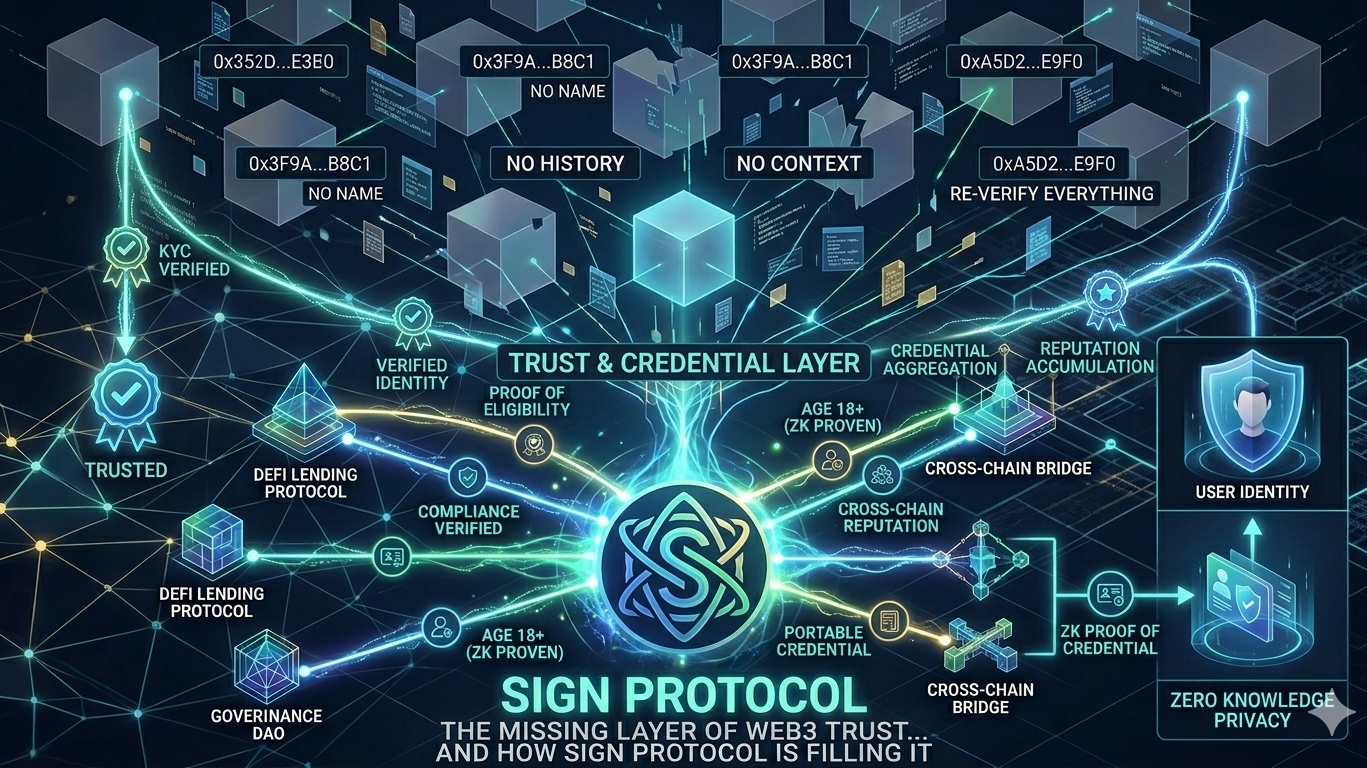
I wasted lots of my precious time in many usless projects. But now @SignOfficial got my attention due to its unique features.
Not consensus. Not execution. Not liquidity. those problems have been worked on obsessively. Entire ecosystems built around solving them. Billions deployed. The infrastructure for moving value is more sophisticated than it's ever been.
But trust? trust never got the same treatment.
I think the gap it leaves is everywhere once you start looking. A user who passed KYC on one platform has to pass it again on the next one. A contributor with years of governance history in one DAO shows up as a blank wallet in another. A protocol trying to verify eligibility for an airdrop has no reliable way to check what a wallet has actually done versus what it's been made to look like it's done. A cross-chain application can't carry any signal about a user from one network to the next.
Every interaction resets. Every credential expires at the boundary. Every reputation is local.
We built a global, permissionless financial system and forgot to build the trust infrastructure that would make it actually function at scale.
Sign protocol is the answer to that oversight.
It's an omni-chain attestation layer. The primitive it introduces is simple but the implications are significant. any entity — a wallet, a contract, a DAO, a protocol, an institution — can issue a verifiable claim about anything. That claim is structured against a schema. It's cryptographically signed. It's readable across every major chain without being anchored to any single one.
I feel the trust doesn't stay local anymore. It travels.
I believe the schema registry is what makes this composable rather than closed. Anyone can define what an attestation should look like. What it's verifying. What fields it contains. What the structure of the claim is. Once that schema exists, anyone can issue attestations against it. Open. Permissionless. Interoperable by design.
When a project building on base can define a schema for contributor reputation. A protocol on arbitrum can read from it. A DAO on polygon can require it as a condition for governance participation. The credential was issued once. the trust it represents moves everywhere.
That's not how identity works today in this space. today it's siloed. Platform-specific. Non-transferable. Sign protocol makes it portable.
I believe the ZK integration deepens the architecture. Selective disclosure through zero-knowledge proofs means the trust layer doesn't have to become a surveillance layer to function. I can prove i passed a compliance check without revealing which one. I can prove i'm eligible without exposing my full history. The proof travels. The data doesn't.
That's a meaningful distinction. Most identity infrastructure in web3 has struggled because users don't want to hand over personal data to decentralized systems they can't fully audit. Sign protocol sidesteps that tension. The credential proves what it needs to prove. Nothing more gets revealed.
The application layer shows this isn't theoretical. ethsign is putting agreement and document attestation on-chain. Tokentable is building verifiable vesting and distribution records. these are products generating real usage, real attestations, real data flowing through the protocol. The infrastructure isn't waiting for adoption. It's already accumulating a record.
I think the sovereign deployment model extends the reach further. Institutions that can't operate on fully public infrastructure — regulated entities, compliance-sensitive environments, enterprise deployments — can run their own sign protocol instances with custom governance while still connecting to the broader attestation ecosystem. That's an architecture decision that opens doors most crypto infrastructure can't reach.
Step back and the picture is clear.
Web3 has spent years building the rails for value transfer. The smart contract layer. The bridging infrastructure. The liquidity protocols. The execution environments. All of it is more capable than it's ever been.
But capability without trust is just complexity. A system where no entity can verify anything about any other entity is a system that can't mature past a certain point. It stays adversarial. It stays anonymous in ways that limit rather than liberate. It stays local when it needs to be global.
Sign protocol is filling the layer that was always missing.
I guess not by forcing identity onto a system that was built to resist it. But by giving the system a way to make verifiable claims that travel, compose, and accumulate without centralizing the data or the authority behind them.
I think the missing layer isn't missing any more.