
I will be honest this thought hit me randomly a few nights ago while I was reading about digital infrastructure and how governments run large systems. I kept thinking about one simple thing:
Trust doesn’t really scale.
It works when systems are small. It works when people know each other or when everything sits inside one organization. But the moment systems start connecting governments, banks, institutions, and millions of people… things get messy.
Suddenly the questions become heavier.
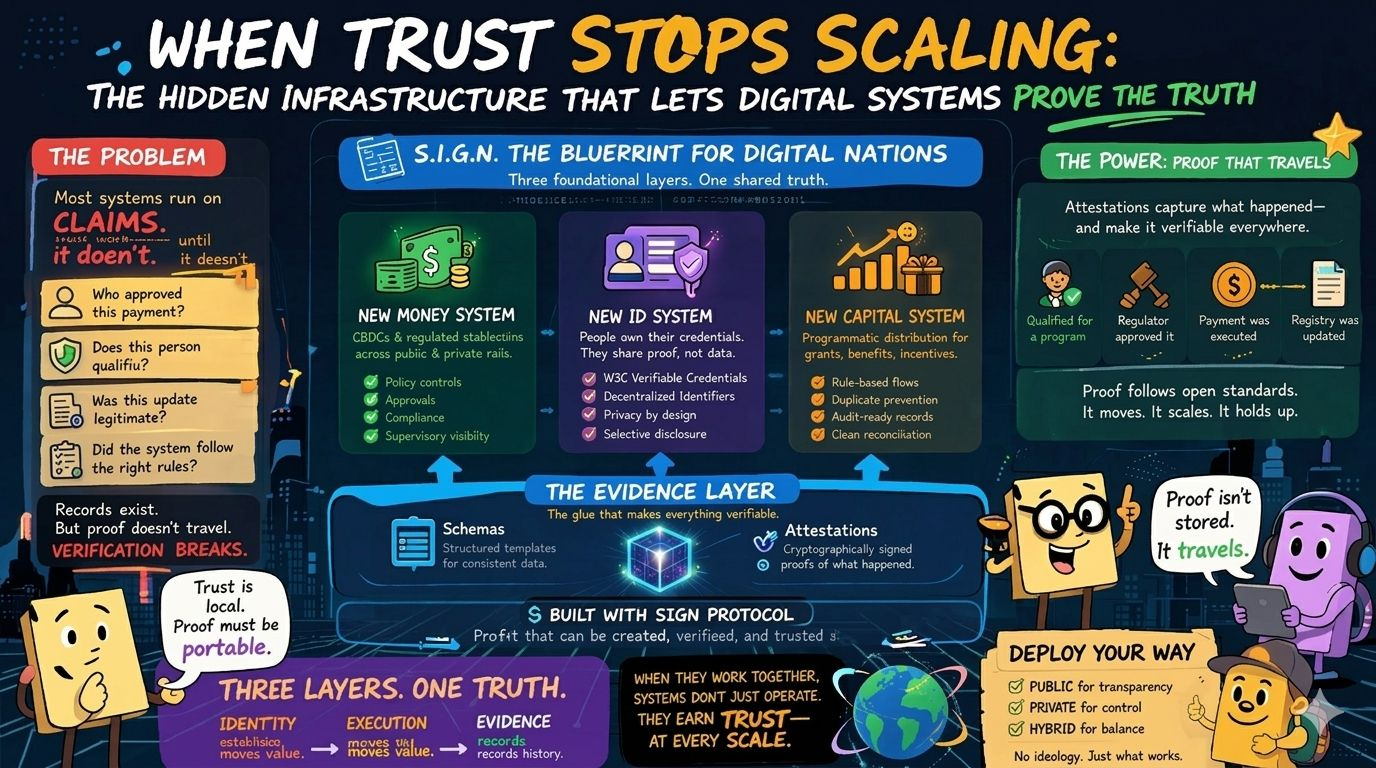
Who actually approved this payment?
Did this person really qualify for that program?
Was that registry update legitimate?
Did the system follow the correct rules?
These aren’t abstract tech questions anymore. These are real-life decisions affecting real people.
And that’s exactly where I started digging deeper into S.I.G.N..
What immediately caught my attention is that S.I.G.N. doesn’t position itself like a normal crypto project or software product. It reads more like a blueprint for national digital infrastructure.
Not hype. Not marketing buzzwords.
More like: “Here’s how systems should work when millions of citizens depend on them.”
And honestly… that angle feels refreshing.
When you strip everything down, most digital systems run on claims.
Someone claims eligibility.
A company claims compliance.
A system claims a transaction was executed.
An institution claims approval.
For years we’ve relied on centralized databases or institutional trust to validate those claims. But once systems start spanning multiple agencies, vendors, and networks, those assumptions become fragile.
I’ve personally seen examples where records existed… but the proof didn’t travel.
One system knew the answer. Another system couldn’t verify it.
That’s where the architecture behind S.I.G.N. started making a lot of sense to me.
It basically connects three foundational layers that almost every modern digital society eventually needs.
The first layer focuses on digital money infrastructure.
With governments exploring CBDCs and regulated stablecoins, digital money isn’t just about faster transactions anymore. It’s about operating within policy frameworks things like limits, approvals, compliance checks, and supervisory visibility.
Money moves… but it moves under rules.
The second layer deals with digital identity, which honestly might be one of the hardest problems in technology.
Most identity systems today rely on centralized databases constantly verifying personal information. That creates privacy concerns and operational friction.
Instead, S.I.G.N. supports standards like W3C Verifiable Credentials and Decentralized Identifiers.
The cool part? People can hold their own credentials and only share proof when necessary.
Not their full data.
Just the verification.
That shift feels small at first… but it changes the entire trust model.
The third layer is something governments deal with constantly: capital distribution.
Think grants, benefits, subsidies, incentive programs basically money flowing to people and organizations through policy-driven programs.
Anyone who has ever looked into these systems knows they’re complicated. Duplicate claims, reconciliation issues, audit challenges… the list goes on.
Programmatic distribution helps bring structure to that chaos. Funds follow clear rules and produce verifiable records of what happened.
But here’s the part that really clicked for me.
All three systems money, identity, and capital eventually rely on the same question:
Can the system prove what happened?
That’s where Sign Protocol comes in.
Instead of storing everything inside isolated databases, systems can create attestations cryptographically signed records confirming that a specific event or statement occurred.
An attestation might confirm:
• a person qualified for a program
• a regulator approved an action
• a payment was executed
• a registry record was updated
These records follow structured templates called schemas, which keep the data consistent and verifiable.
Once created, the proof can travel across systems.
And that’s the part I keep coming back to.
Because in many real-world cases, the problem isn’t that proof doesn’t exist.
The problem is that proof can’t move.
What I appreciate about the philosophy behind S.I.G.N. is that it doesn’t pretend there’s only one way to build infrastructure.
Some deployments will prioritize transparency and operate on public networks. Others will require private environments with strict permissioning. In many cases the real solution will be somewhere in the middle hybrid systems.
No ideology. Just practicality.
The more I think about it, the more I feel like the biggest gap in digital systems isn’t speed or user experience.
It’s evidence.
Identity establishes representation.
Execution moves value.
Evidence records history.
When those three layers work together, systems stop relying purely on trust and start operating on something much stronger.
Verifiable truth.
And honestly… if digital infrastructure is going to shape how societies operate in the future, that layer of truth might be the most important foundation of all.