


A different version of the same person
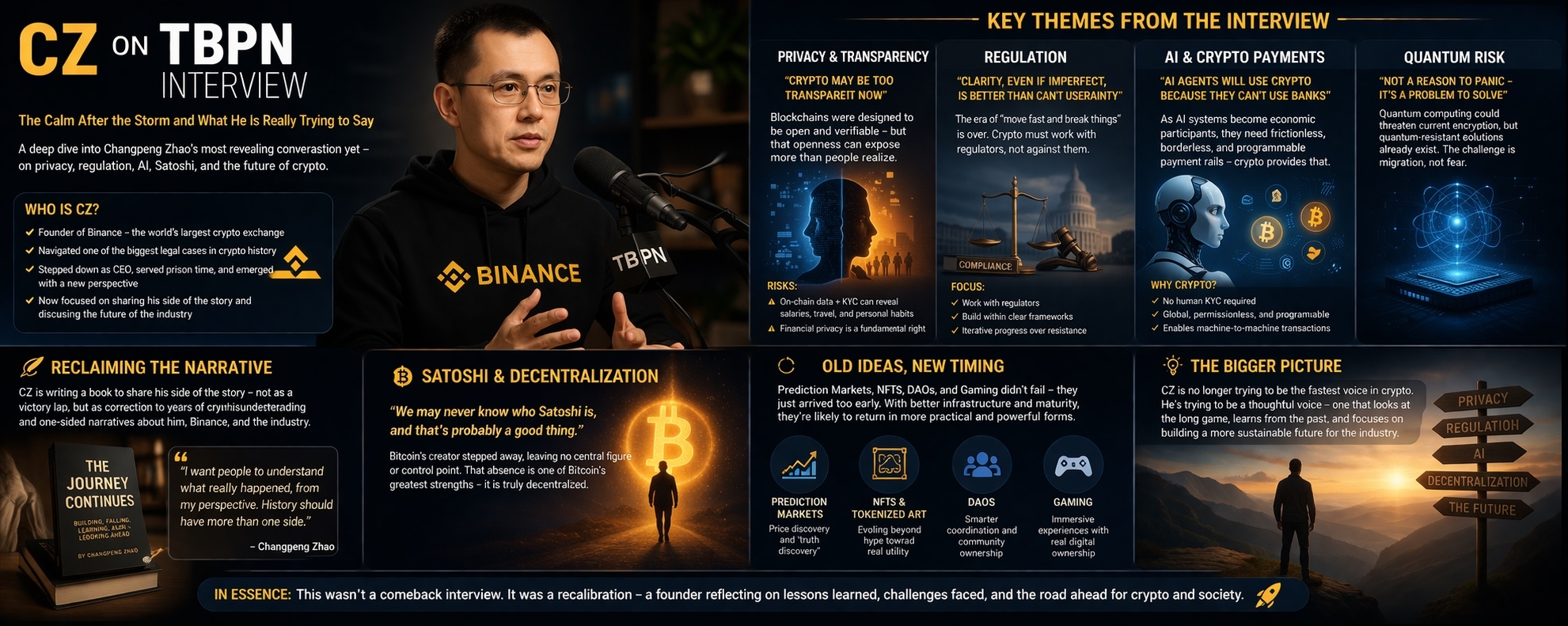
There was a time when Changpeng Zhao spoke like someone racing the market itself, always one step ahead, always moving faster than regulation, competitors, and sometimes even his own narrative, but the version that appeared on TBPN recently felt noticeably different, not weaker or uncertain, just slower in a way that suggests reflection rather than hesitation.
That shift is what makes the interview worth paying attention to, because it is not about one or two statements, it is about how a person who once defined the pace of crypto is now choosing his words as if the pace no longer matters as much as the direction.
This was not an interview, it was a repositioning
The conversation never felt like a typical media appearance designed to generate hype or deliver quick headlines, and it certainly did not feel like the kind of confident performance that founders give when everything is going right, instead it felt like something more controlled, almost like a careful attempt to reshape how the story is told going forward.
After everything that happened around Binance, including the legal pressure, the leadership exit, and the consequences that followed, it would be unrealistic to expect him to ignore the past, so instead he seems to be doing something more strategic, which is to slowly retell it in a way that feels less reactive and more considered.
When he talked about writing a book, it did not come across as a victory narrative or a founder story meant to inspire admiration, it sounded more like someone trying to explain how things looked from the inside, which is a very different intention, and one that usually comes from a place where controlling perception becomes just as important as building products.
The industry is no longer arguing the same problems
One of the more thoughtful parts of the interview came when he addressed how crypto is perceived, because for years the argument was always defensive, focused on proving that the space was not dominated by illicit activity, and while he still pushed back on that idea, what stood out was how he shifted the conversation toward a different concern entirely.
He suggested that the problem is no longer just about anonymity, but about excessive transparency, and that observation carries more weight than it might seem at first, because blockchains were designed to be open systems, yet when that openness is combined with identity layers from exchanges, the result is something that begins to look less like financial freedom and more like a detailed map of personal behavior.
The implication is uncomfortable but difficult to ignore, because it means the same transparency that builds trust can also create exposure, and exposure at scale has consequences that the early narratives around decentralization did not fully account for.
Regulation is no longer something to outrun
There was a time when much of crypto treated regulation as an obstacle that could be avoided with enough speed and creativity, but the tone in this interview suggests that phase is over, or at least no longer sustainable.
He spoke about the importance of clarity, even if that clarity is imperfect, and the way he framed it made it clear that uncertainty is now seen as a greater risk than restriction, which is not something early crypto leaders would have easily admitted.
This shift is not philosophical, it is practical, because the scale of the industry has reached a point where operating in undefined territory is no longer just risky, it is eventually unsustainable, and his perspective now reflects that reality in a way that feels grounded rather than defensive.
Where his thinking still feels ahead is the intersection with ai
The part of the interview that felt closest to his old instinct for future trends came when he discussed artificial intelligence and its relationship with crypto, and here the tone changed slightly, not in intensity, but in clarity.
He argued that if AI systems become active participants in the economy, they will need a way to transact, and traditional financial systems are not designed for that kind of participant, because they rely on human identity verification processes that machines simply cannot fulfill.
In that context, blockchain systems start to make more sense, not as speculative assets, but as infrastructure, because they allow transactions to happen without the same dependency on human-centered verification, which is a subtle but important distinction.
This idea does not feel immediate, but it does feel logical, and that is often how the more durable shifts in technology begin, not as hype, but as necessity.
The quiet acknowledgment behind satoshi
When he spoke about Satoshi Nakamoto, the message itself was familiar, that we may never know who created Bitcoin and that this absence might actually be one of its greatest strengths, but what made it interesting was not the idea, it was who was saying it.
In an industry where most major projects are closely tied to their founders, Bitcoin stands apart because its creator stepped away completely, leaving no central figure to influence its direction, and hearing that point emphasized by someone who once held immense centralized influence within the ecosystem carries a certain weight.
It feels less like a philosophical statement and more like an observation shaped by experience.
Old narratives are returning, but with less noise
He also touched on areas like prediction markets, NFTs, and decentralized organizations, but not with the excitement that defined earlier cycles, instead he spoke about them with a sense of timing, suggesting that these ideas were not wrong, just premature.
That perspective aligns with a pattern that repeats often in technology, where concepts do not disappear after failing to gain traction, they simply wait until the environment is ready to support them properly, and when they return, they tend to do so in more refined and practical forms.
It is a quieter kind of optimism, one that relies less on momentum and more on patience.
What this conversation actually reveals
If there is one thing this interview makes clear, it is that CZ is no longer trying to be the fastest voice in the room, and that might be the most significant change of all.
He is not speaking like someone trying to reclaim dominance or rebuild what was lost, instead he sounds like someone who is adjusting to a different role, one that is less about control and more about interpretation, less about leading the market and more about understanding where it is going.
That does not guarantee that his perspective will define the next phase of crypto, but it does suggest that he intends to remain part of that conversation, not as the central figure he once was, but as someone who has already seen what happens when growth moves faster than structure.