
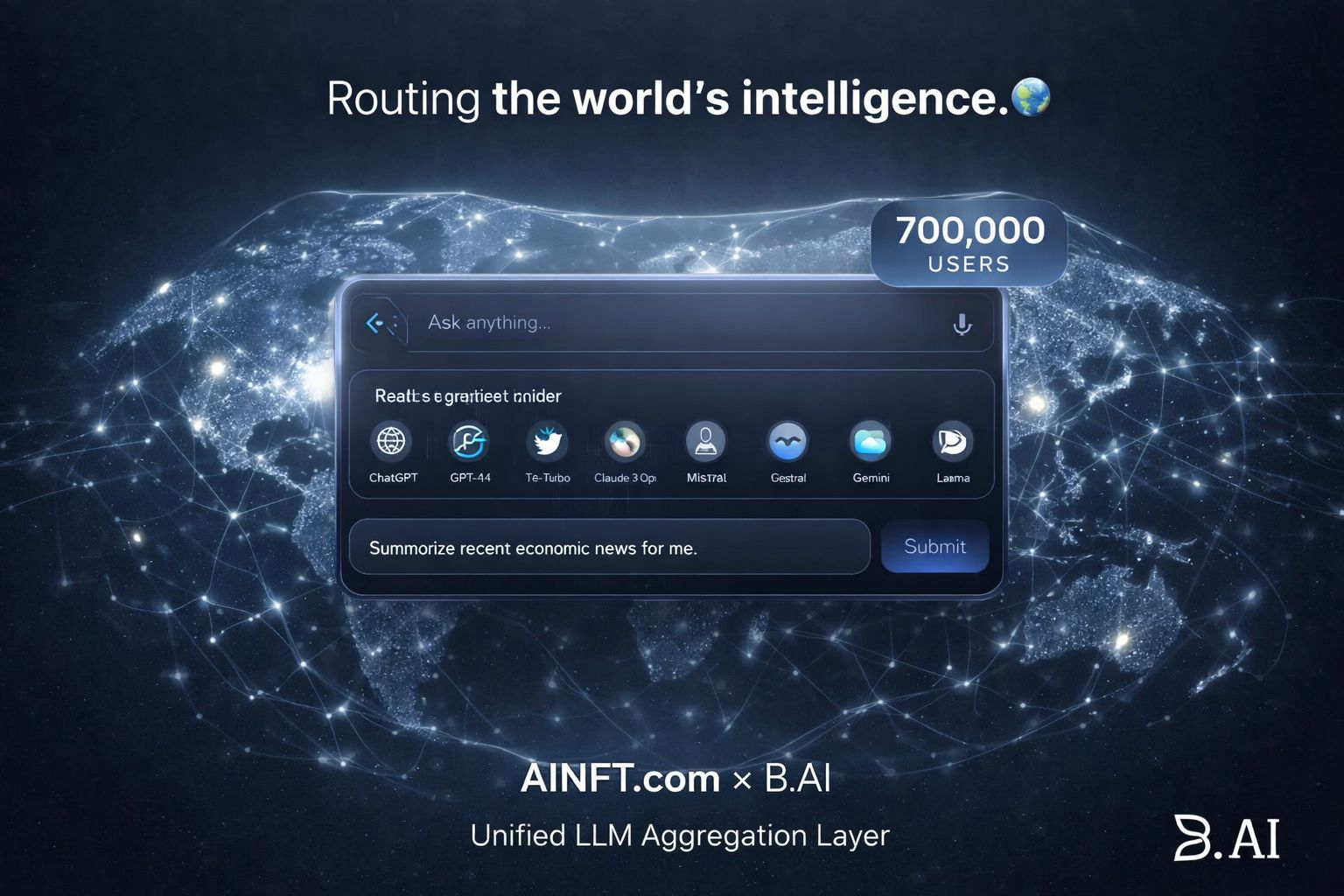
700K users is not just a milestone —
it’s market validation of a structural demand:
Seamless, unified access to intelligence.
1️⃣ WHAT 700K USERS REALLY SIGNALS
This growth reflects more than adoption:
➜ Users don’t want fragmented AI tools
➜ They want one interface, multiple models
➜ They value efficiency over brand loyalty
The conclusion is clear:
Aggregation beats fragmentation.
2️⃣ THE ROLE OF AINFT
As the core application layer:
➜ Aggregates top-tier LLMs into a single access point
➜ Removes friction between different AI ecosystems
➜ Enables borderless AI usage at scale
This is critical because:
Access layer = distribution layer
And distribution defines dominance.
3️⃣ B.AI NETWORK EFFECT IN MOTION
Behind the interface is B.AI:
➜ More users → more requests
➜ More requests → better routing optimization
➜ Better routing → lower cost + higher performance
This creates a compounding loop:
Usage → optimization → better UX → more usage
4️⃣ FROM ACCESS → INFRASTRUCTURE
What starts as a product evolves into infrastructure:
➜ LLM routing becomes intelligence orchestration
➜ Payment layers enable machine-to-machine usage
➜ Agents eventually become autonomous consumers of AI
This is where it connects to the bigger thesis:
AI is not just being used — it’s being operationalized
5️⃣ STRATEGIC IMPLICATION
As aggregation scales:
➜ Individual models become commoditized
➜ Routing layer becomes strategic control point
➜ Platforms like AINFT define how intelligence flows globally
And whoever controls routing:
Controls access to intelligence itself.
6️⃣ FINAL NOTE
“Routing the world’s intelligence” is not a slogan.
It’s an architecture:
➜ Aggregate
➜ Optimize
➜ Distribute
And at scale:
It becomes the default layer between users — and AI.
The next step is inevitable:
From human usage → agent-driven consumption
And when that happens:
The network effect doesn’t just grow —
it compounds exponentially.