
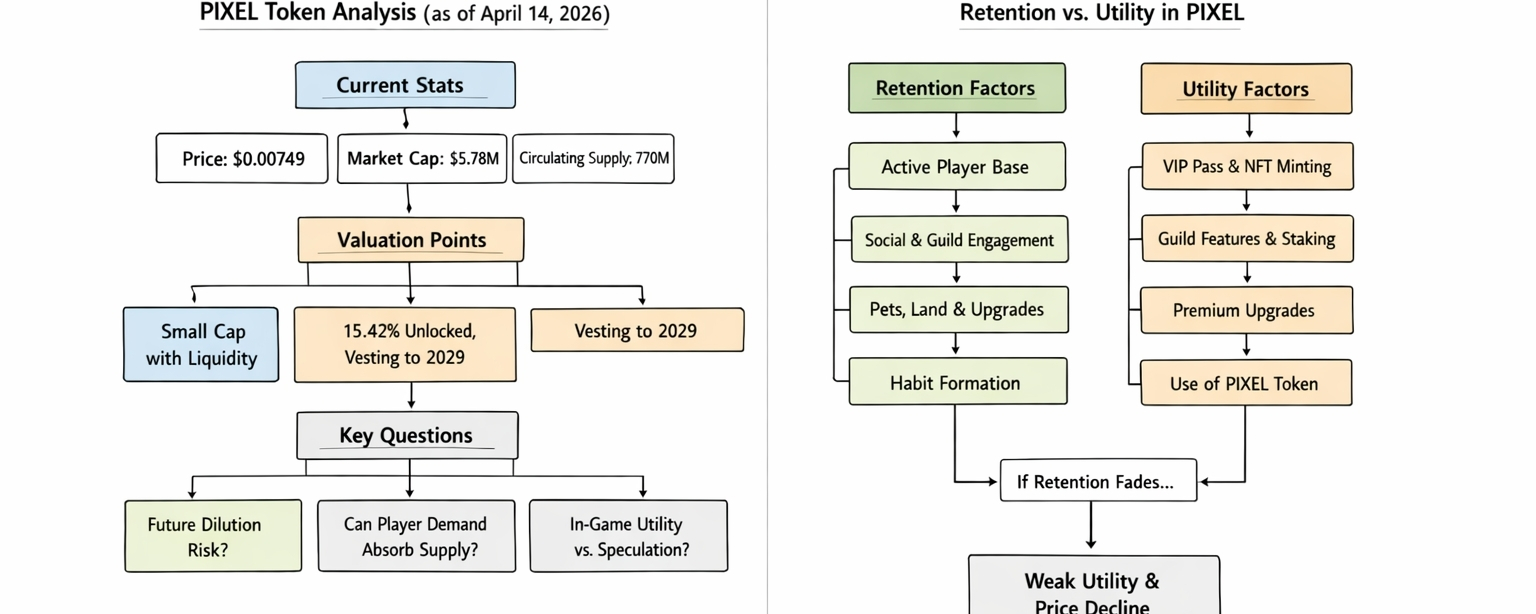
I noticed Pixels again the same way I notice a lot of GameFi names now, not because the chart looked amazing, but because the thing still felt alive when the token didn’t. That matters more than people admit. A lot of Web3 games can create a busy week. Very few create a place players actually want to come back to. Pixels still has that “real world” feel because it is not just a token wrapped around a menu. It’s a social farming game on Ronin with free-to-play access, land, pets, guilds, and a bunch of small loops that make the whole thing feel more like a world you drop into than a reward screen you click through. That difference is subtle on paper, but in practice it changes how I look at the trade. 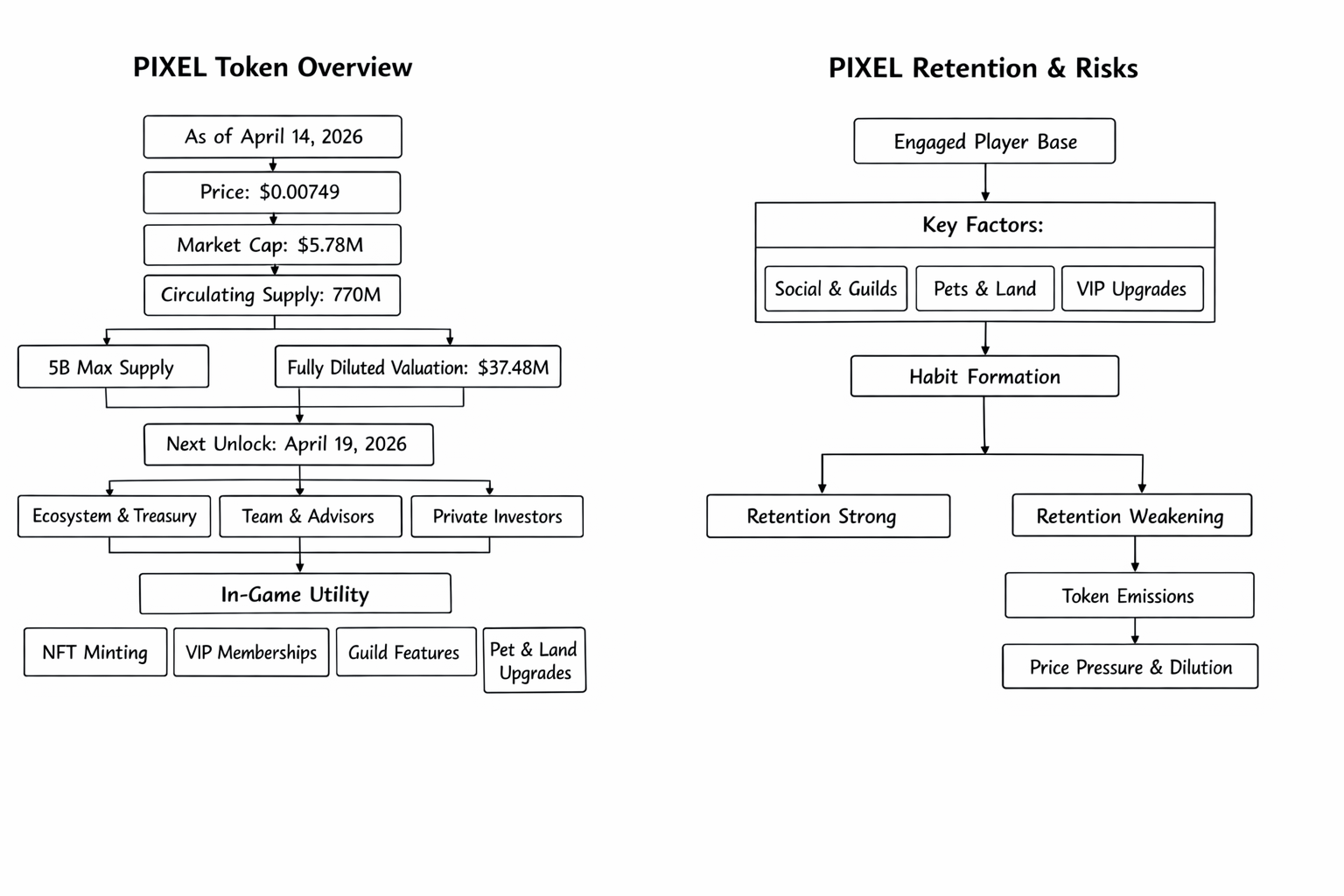 The token is where traders get pulled in, of course. As of April 14, 2026, PIXEL is around $0.00749 with a market cap near $5.78 million, about $15.39 million in 24 hour volume, and roughly 770 million tokens circulating. Fully diluted valuation sits around $37.48 million against a 5 billion max supply. For me, that immediately says two things. First, this is still a very small cap token with enough liquidity to trade, which means it can move hard both ways. Second, the market is valuing the live float much lower than the theoretical fully diluted supply, so dilution is still part of the story whether people want to think about it or not. That dilution point is not some abstract tokenomics lecture. It hits the trade directly. Tokenomist shows about 771.0 million PIXEL unlocked so far, or roughly 15.42% of total supply, with the next unlock scheduled for April 19, 2026. The same source says the vesting runs out to 2029 and includes big buckets for ecosystem rewards, treasury, team, advisors, private sale investors, and launchpool. So even if the game keeps improving, traders still have to ask a boring but important question: can real player demand absorb future supply? That’s the kind of question that kills clean narratives. Now here’s the part I actually like. PIXEL does have real in-game use. Binance Research and CoinGecko both describe it as the native utility and governance token used for premium actions like NFT minting, VIP membership, guild-related features, pet minting, and certain upgrades or perks. That is better than the usual “governance and vibes” setup because at least there is a reason for players to spend the token inside the product. CoinMarketCap also noted that by June 2024, Pixels had peaked at 1.7 million monthly active users and that players had spent more than 15 million PIXEL on VIP coupons over the prior year. For traders, that does not guarantee price appreciation, but it does show there has been real usage rather than purely speculative holding. Still, this is where the Retention Problem shows up, and I think it is the whole story. Token sinks only matter if people keep logging in. A VIP pass has value only if the game loop matters to you next week too. Guild features matter only if communities stick. Pets, land, and upgrades matter only if the world keeps feeling lived in. If the player base starts acting like tourists instead of residents, token utility weakens fast. And when utility weakens while emissions and unlocks continue, price usually ends up carrying that burden. That is why I do not just ask whether Pixels has utility. I ask whether it has habits. There’s a big difference. One thing I find slightly frustrating is that the market sometimes treats all GameFi names as if they deserve the same multiple just because they share a category tag. Pixels is not just a random mini-game with a token slapped on top. It has been building toward a broader platform idea too, with the main site now framing Pixels as a place where users can build games that integrate digital collectibles and where communities come to life. Chapter 2 is live, staking is part of the pitch, and the project is clearly trying to extend beyond a simple farming loop. That gives it more substance than a lot of dead-end GameFi experiments. But substance alone is not enough when the token is already down 99.3% from its March 2024 all-time high of $1.02. That chart tells you the market has already punished early optimism very hard. So the bull case is pretty straightforward. You have a game that still has recognizable product identity, actual token utility, decent trading liquidity relative to its tiny market cap, and a valuation that is small enough to re-rate hard if engagement genuinely improves. The bear case is just as real. Supply overhang is still there, the genre has a bad history with retention, and once players stop finding the world interesting, the token can turn into a leak no feature update can patch quickly. For me, PIXEL is worth watching right now, but only as a retention trade disguised as a gaming token. Don’t just watch candles. Watch whether the world still feels inhabited. That’s the whole bet.

مقالة
Why PIXELS Feels More Like a Real World Than Most Web3 Games
إخلاء المسؤولية: تتضمن آراء أطراف خارجية. ليست نصيحةً مالية. يُمكن أن تحتوي على مُحتوى مُمول. اطلع على الشروط والأحكام.