
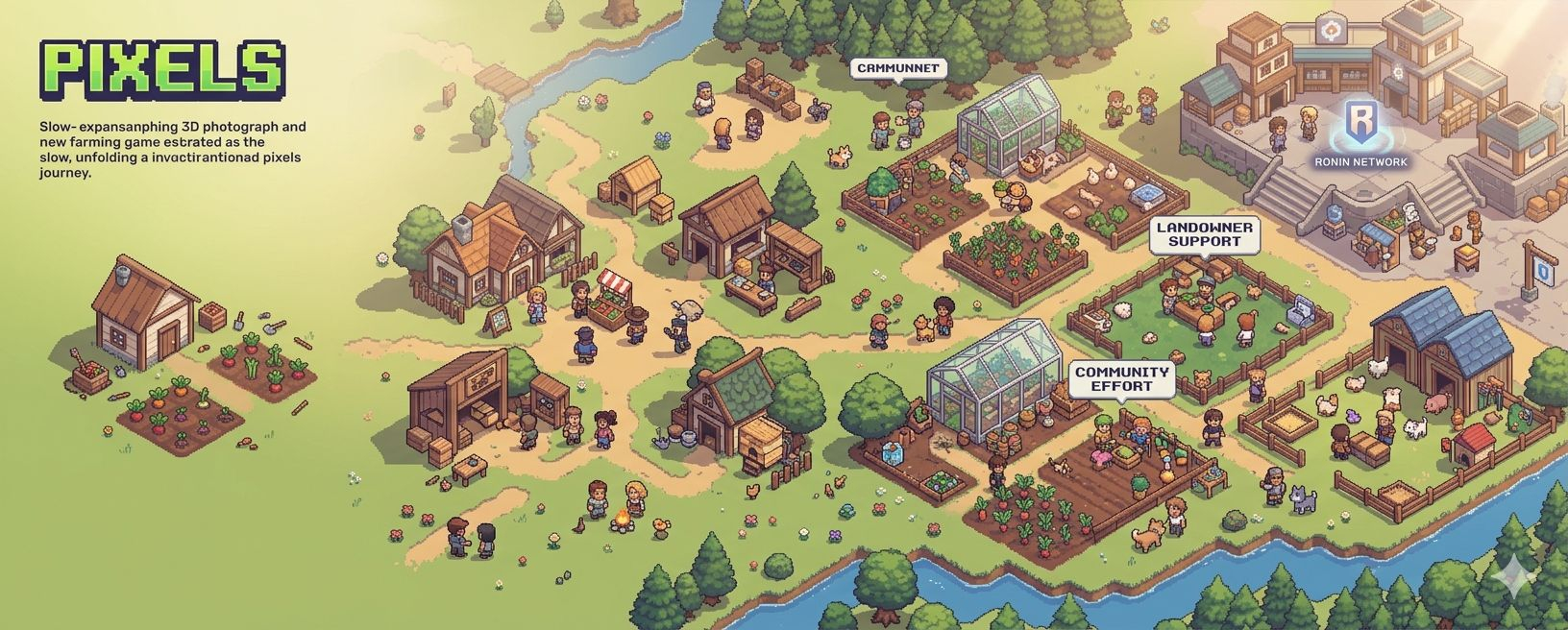

The first time you open Pixels, nothing about it feels overwhelming.
There’s no dramatic intro, no complex dashboard, no pressure to understand ten different systems at once. You’re dropped into a simple pixel world with a small patch of land, a few tools, and a pretty obvious goal: start farming.
And for a while, that’s all it is.
You plant crops. You water them. You wait. You harvest.
It’s calm. Almost too calm.
But if you stick around a little longer, something interesting happens. The game begins to open up—not all at once, but in small, steady layers. What started as a basic farming loop slowly turns into something that feels more alive, more connected, and surprisingly thoughtful.
It Doesn’t Rush You—and That’s Rare
One of the first things you notice about Pixels is how patient it is.
Most games, especially in Web3, try to hook you immediately. They throw rewards, systems, and mechanics at you in the first few minutes. Pixels takes the opposite approach.
It gives you space.
You’re not pushed into making big decisions early on. You’re not forced to optimize everything. You just play at your own pace, figuring things out naturally.
And that pacing matters more than it seems.
Because as you keep going, the game quietly starts adding depth. You unlock new areas, discover different activities, and begin to understand that your time and resources actually have weight.
It’s not just about farming anymore—it’s about how you choose to play.
The World Feels More Social Than It Looks
At first glance, Pixels feels like a solo experience.
But that impression doesn’t last long.
The moment you start interacting with other players—whether directly or indirectly—you realize the game is built around shared systems. Land, resources, progression… a lot of it connects people in subtle ways.
Take land, for example.
Not everyone owns it. And that’s not a limitation—it’s part of the design.
Players without land can still work, earn, and progress by using someone else’s space. Meanwhile, landowners benefit from having active players contributing to their plots.
It creates a quiet kind of cooperation. No loud matchmaking. No forced teamwork. Just a system where people naturally rely on each other.
And over time, that makes the world feel less like a game and more like a small ecosystem.
Land Ownership Feels Practical, Not Speculative
In many blockchain-based games, owning land feels like holding a collectible—something you keep because it might become valuable.
Pixels approaches it differently.
Here, land actually changes your day-to-day experience.
You get more room to build, more control over how things are organized, and better opportunities to produce resources. It’s not just about having land—it’s about what you do with it.
And interestingly, it doesn’t isolate you from others. If anything, it pulls you deeper into the community, because your land can support other players too.
So instead of feeling like a static asset, it feels more like a working part of the world.
The Economy Is Still Evolving—and That’s a Good Thing
Let’s be honest: most “play-to-earn” systems struggled because they focused too much on rewards and not enough on balance.
Pixels doesn’t pretend to have solved everything from day one.
Instead, it’s been adjusting its systems over time.
Earlier versions leaned more heavily on repetitive earning loops. Newer updates are shifting toward more structured tasks, varied activities, and less dependence on simply farming and selling.
You can feel that transition while playing. Some parts are still being refined, but the direction is clear: make the economy support the gameplay, not the other way around.
And that mindset makes a difference.
It Runs Smoothly—Which You Don’t Always Appreciate Until It Doesn’t
A lot of Web3 games struggle with basic usability. Slow transactions, confusing wallets, unnecessary friction—it can break immersion quickly.
Pixels avoids most of that by building on the Ronin Network.
What that means in practice is simple: things work the way you expect them to.
You log in, you play, your actions go through quickly. There’s no constant reminder that you’re interacting with blockchain infrastructure.
And honestly, that’s exactly how it should be.
Progress Feels Subtle, But Meaningful
Pixels doesn’t rely on big, dramatic upgrades to keep you interested.
Instead, it focuses on small improvements that make your experience smoother over time.
Better tools. More efficient actions. Helpful companions.
Even something like pets—something that could easily be cosmetic—ends up having real utility. They make tasks easier, expand what you can do, and add a layer of convenience that you notice immediately.
It’s a quiet kind of progression, but it works.
Because instead of chasing big milestones, you start appreciating the little changes that make everything flow better.
You Build a Presence, Not Just a Character
Another detail that stands out over time is how the game treats player identity.
It’s not just about what you own or how much you’ve earned.
It’s also about how you interact with the world.
Your activity, your consistency, your involvement—all of it contributes to how the game sees you. And while it’s not overly strict, it creates a sense that your behavior actually matters.
That’s something a lot of online games have lost.
In Pixels, it quietly comes back.
So What Makes Pixels Stick?
If you try to break it down, Pixels doesn’t rely on any single feature to stand out.
It’s not the best-looking game.
It’s not the most complex.
It’s not the most competitive.
But it does something many games fail to do—it feels comfortable to return to.
There’s always something small to do. Something to improve. Something to check in on.
And because it doesn’t demand constant attention, it becomes easy to fit into your routine.
Final Thoughts: A Game That Grows With You
Pixels isn’t trying to impress you instantly.
It’s not loud. It’s not aggressive. It doesn’t promise overnight rewards or endless excitement.
What it offers instead is something slower, more steady.
A world you can ease into.
A system you can understand over time.
A community you gradually become part of.
And somehow, that approach works.
Because the longer you spend in Pixels, the more it starts to feel less like something you’re testing—and more like something you’re building.
Not in a dramatic, life-changing way.
Just in that quiet, satisfying way where you log in, do a few things, and leave knowing you made a little progress.
And then, without thinking too much about it… you come back again tomorrow.