

JP Morgan issued a tactical buy signal on the S&P 500 on April 13, 2026, after a -5.2% pullback from its recent high, which the bank’s equity strategy team, led by Mislav Matejka, views as a historically reliable entry point within a bull market.
This signal follows a geopolitical shock from the U.S.-Israel conflict with Iran, which caused an -8% drop in the index before a partial recovery. Matejka’s note frames the pullback as a buying opportunity, noting that Q1 2026 earnings growth estimates increased to 13.9% as of April 10, up from 12.7%.
The technical basis for the call includes oversold RSI readings across S&P 500 constituents and robust corporate buyback activity from major tech and financial firms, which helps absorb selling pressure during downturns.
JPMORGAN: BUY THE DIP, V-SHAPED REBOUND LIKELY JPMorgan Chase says investors should buy market pullbacks, arguing conditions support another V-shaped recovery despite geopolitical risks. Strategist Mislav Matejka notes volatility may persist, but a 3–12 month horizon favors… pic.twitter.com/lWOXJYnm35
— *Walter Bloomberg (@DeItaone) April 13, 2026
Technical Rationale: Oversold RSI and the 5% Dip Playbook
The JP Morgan RSI signal indicates a tactical reset in the current market, particularly when multiple index constituents fall below 30. Historically, this has marked buy opportunities during geopolitical selloffs, with 5–10% drawdowns leading to average recovery times that benefit investors who add exposure amid uncertainty.
Matejka suggests that investors with a 3-to-12-month horizon should seize the current weakness to buy in, reflecting a buy-the-dip strategy commonly seen in past corrections.
While the bank maintains a year-end S&P 500 price target based on a soft-landing scenario bolstered by AI-driven productivity, some bears argue that the RSI reset has not yet been fully realized, citing an inadequate resolution of geopolitical risks.
Conversely, bulls point to improving earnings revisions since the conflict began as a more reliable sign of stability. Analysts like Morgan Stanley’s Michael Wilson view the situation as a mid-cycle correction rather than the onset of a bear market, a sentiment echoed by Goldman Sachs, which acknowledges short-term risks but sees a low probability of a full bear market.
 SOURCE: TradingView JP Morgan Buyback Support: The Structural Bid Beneath the Market
The second pillar of J.P. Morgan’s argument is the mechanical support provided by corporate repurchase programs, which operate largely independent of sentiment cycles.
When prices decline, companies executing active buyback authorizations find their capital going further per share, an incentive that concentrates repurchase activity precisely during the kind of 5–8% drawdowns the S&P 500 has just experienced.
A recent example of the scale this can reach: Qualcomm’s $20Bn buyback authorization illustrates how mega-cap repurchase programs create persistent demand that compresses downside in pullbacks.
DISCOVER: Best Crypto Presales in 2026
The buyback dynamic is not without its limits. Repurchase programs can be paused by management discretion, suspended during earnings blackout windows, or scaled back if credit conditions tighten, none of which J.P. Morgan treats as base-case risks in the current environment.
The bank’s retail flow data adds a complicating nuance: weekly retail purchases decelerated approximately 30% during the conflict, with ETF inflows softening sharply, signaling that the buy-the-dip impulse among individual investors has not yet fully re-engaged.
That gap between institutional and retail participation, if it closes, could provide an additional demand layer on top of corporate buybacks as confidence in de-escalation builds.
S&P 500 Snapshot: Price Action and Key Metrics as of April 13, 2026
BREAKING FED WILL INJECT $40,462,000,000.00 INTO THE MARKETS OVER THE NEXT FEW WEEKS! THEY'RE OFFICIALLY CONTINUING QE AND TURNING THE MONEY PRINTER BACK ON! GIGA BULLISH FOR MARKETS! pic.twitter.com/6W0sBgLncA
— Wimar.X (@DefiWimar) April 14, 2026
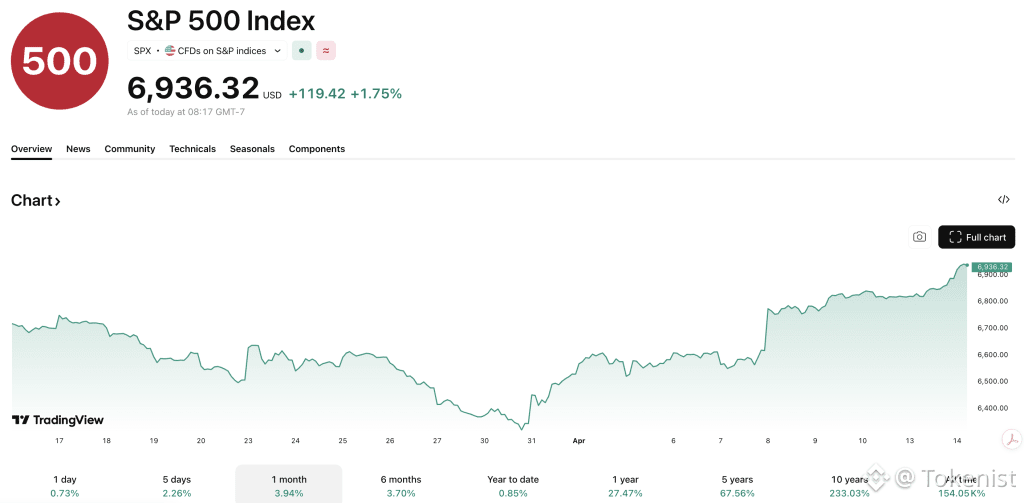
As of April 13, 2026, the S&P 500 has rebounded nearly 8% from a seven-month low in March, but is still down 5.2% from its previous high, remaining in pullback territory without confirming a correction.
On Monday, the index advanced modestly despite the lack of a ceasefire in U.S.-Iran talks, suggesting the market is pricing in a de-escalation scenario. SPY opened down 0.68%, with QQQ down 0.55% and DIA down 0.83%, indicating cautious positioning.
JP Morgan notes a significant divergence between U.S. equities and international markets, with Europe’s STOXX 600 dropping over 11% during the conflict and the MSCI Emerging Markets Index entering correction territory, highlighting the safe-haven appeal of U.S. large-cap stocks.
The valuation premium of the Magnificent Seven has decreased, with the forward price-to-earnings ratio falling to 1.2x the S&P 500 from 1.7x. Additionally, the rise in crude oil prices, WTI up to $93 per barrel and Brent up to $96.1, remains a key factor that could influence inflation expectations and complicate J.P. Morgan’s soft-landing thesis.
EXPLORE: Best Meme Coins to Buy Right Now
Disclaimer: The author does not hold or have a position in any securities discussed in the article. All stock prices were quoted at the time of writing.
The post JP Morgan Says ‘Buy the Dip’ as S&P 500 Hits 5% Pullback Threshold appeared first on Tokenist.