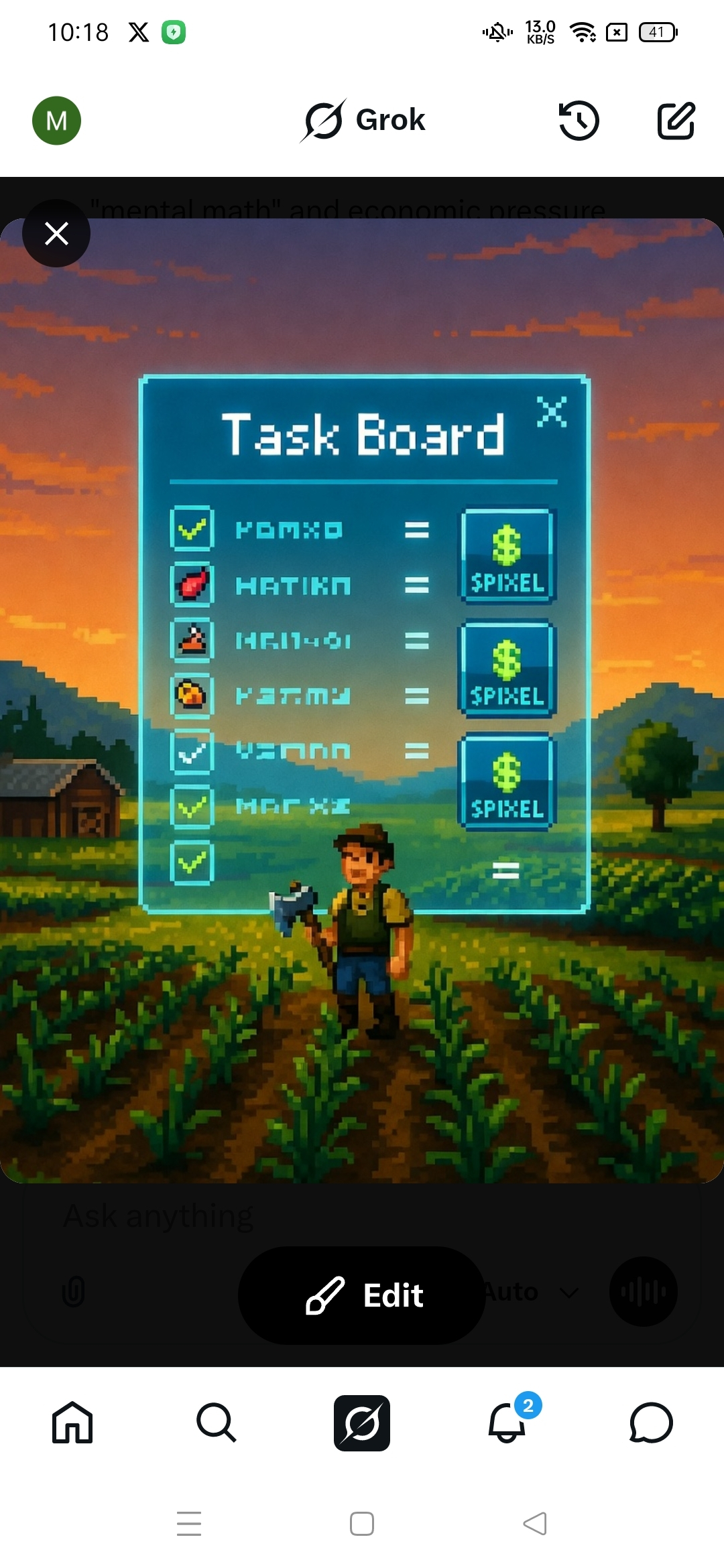
I fired up the game expecting a relaxed round of planting, wandering the fields and maybe some deliberately silly economic decisions just because a farming sim should let you goof off without guilt. Not every login needs to feel like a shift at the factory.
That plan lasted about thirty seconds.I glanced at the Task Board before even stepping onto my plot. One requested crafted item caught my eye the kind I could mostly assemble from my own resources, except for that one stubborn ingredient I was short on.
Suddenly the whole session pivoted. No more “what feels fun tonight?” It became inventory math, market price checks and quiet calculations about whether the reward justified the hassle.
That single menu reshaped everything.The Task Board in Pixels isn’t just a list of optional chores. It’s the main pipeline for earning Pixel tokens the only reliable way to pull real value out of the game. Hazel hands out orders that refresh regularly mixing coin rewards with occasional Pixel payouts. On paper, it gives structure.
In practice it quietly ranks which activities matter and which ones don’t.
The rest of the world your crops, your wandering, your little decorative touches starts orbiting around whatever the board is paying for right now.
I’m not here to complain about optimization. Games naturally push players toward efficient paths; that’s how we learn them. What feels off in Pixels is how one central menu decides which outputs get treated as “real” work while everything else fades into background noise.
You stop asking what you want to do and start asking what will clear for rewards.It’s a small shift with a big chill.Take an ordinary task: deliver a crafted good built from farmable materials plus one scarce input. You could ignore it and do your own thing, sure. But once you’ve tasted the Pixel flow, skipping feels like leaving money on the table. So you pivot. You check your storage. You weigh gathering versus buying on the market. You run the mental spreadsheet: Does this still pay out after transaction friction?
Would stronger land make this trivial instead of a time sink?
Suddenly your axe swings not because the world called you, but because the board did.The same effort, different emotional weight.
Land ownership exposes the hierarchy without ever saying it out loud. A basic plot turns the same task into a grind extra trips, tighter margins, more friction between login and payout. Better land smooths the sourcing, boosts yields, and lets you clear the order with less sweat.
The task stays identical on the menu, but the lived experience changes dramatically. What feels like a quick hand-in for one player becomes an evening eaten by shortages for another.
VIP layers on more of that quiet difference. Higher tiers reduce energy costs on submissions, grant easier board access straight from the HUD and improve your odds of seeing those valuable Pixel tasks in the first place. It’s not cartoonish pay-to-win where everything locks behind a wall. It’s subtler:
one player glides through the same board with fewer rough edges while another fights extra drag. Same game on the surface, noticeably cleaner lane underneath.Social systems morph too. Guilds stop feeling purely like hangouts and start operating as friction-removal networks shared resources tips on cheap inputs coordinated crafting runs.
A helpful contact becomes more than a friend; sometimes they’re the missing ingredient that saves you a market run. Community turns functional in a very specific, production-oriented way.
None of this kills the charm outright. You can still roam, decorate plant random crops or waste time on low-value rituals that just feel nice. The world remains open. The bruise is that those activities start feeling like side quests nice extras but no longer the main event.
The board pays first, so everything else rearranges itself around it.Pixels needs something like this. Loose reward systems in Web3 games have a well-known ending: players discover the cleanest extraction loop, a few optimize it into an industrial process, and the broader economy turns to mush without strong filters and sinks.
The Task Board acts as discipline a recognition layer that keeps incentives from collapsing. It rewards engagement while trying to prevent the usual death spiral.That survival logic makes sense. It also leaves fingerprints.
Every other system now reveals itself as leverage against the board. Stronger land reduces the pain of matching its demands. VIP softens the edges. Fluid trading or good social connections cut out bottlenecks. Even your free time in the pixelated fields starts reading differently because the serious layer isn’t the farm anymore. It’s whatever Hazel is willing to count tonight.
I still log in planning to farm casually. Then the board highlights an output my current setup handles awkwardly, and the familiar mental math kicks in:
gather, buy, skip.. or force it and resent the detour. The map feels smaller, funneled toward one menu.
Pixels keeps its light, approachable art and vibe, which helps it work for a lot of players. But the honest first stop isn’t the soil. It’s the board.And once that pattern settles in, the relationship to play changes.
You’re no longer primarily deciding what you feel like doing in this charming little world. You’re checking what the system is ready to reward this session. It’s effective design for longevity, maybe even necessary. It’s also a colder contract with your evenings than the cozy branding suggests. The fields are still there. They’re just no longer the boss of the night.