
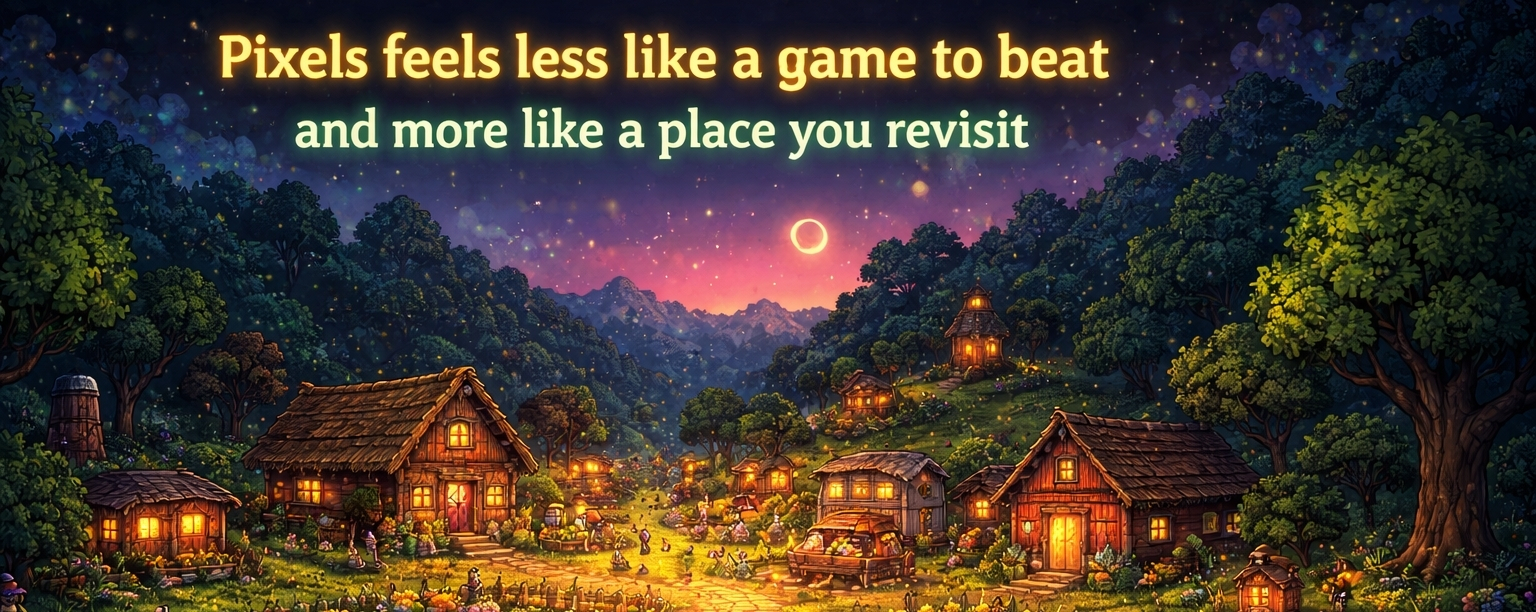
There’s something a little funny about the way Pixels stayed in my head.
Not in a dramatic way. I didn’t have some big moment with it. No instant obsession. No thought like this is the future of gaming. It was smaller than that. I opened it, spent some time inside it, left, and then caught myself thinking about it later for reasons I couldn’t fully explain.
Maybe that’s the thing.
A lot of games, especially anything tied to Web3, arrive with too much weight on them. Too many words. Too much meaning attached before you even touch the thing. You hear about ownership, economies, ecosystems, infrastructure. All of that may be true. But sometimes it gets in the way of something more basic, which is whether being there feels good or not.
With Pixels, what hit me first was the softness of it.
You drop into this open world and it doesn’t shove itself at you. There’s farming, exploration, gathering, building. A casual rhythm to it. You move around, check on things, figure things out slowly. Nothing about it feels desperate for your attention. And I liked that more than I expected to.
It reminded me of a certain kind of older online game experience. Not because it looks old or plays like some exact memory, but because of that loose feeling of being in a world instead of being pushed through a system. You can farm for a while. Wander. Bump into people. Get distracted. Come back to what you were doing. It all feels a bit unforced.
That matters.
Especially now, when so much digital stuff feels like it has been engineered to keep poking at you. Do this next. Claim this. Upgrade that. Don’t fall behind. Pixels has some of that, of course. Every game does. But it doesn’t feel like the entire point. Most of the time it just feels like a place you can spend time in.
And I think that’s why the Ronin part works better here than it might in something more aggressive.
Yes, Pixels is powered by the Ronin Network. Yes, it sits inside that Web3 space where ownership and player economies are part of the appeal. But when I think about the game, that’s not the first thing that comes to mind. I think about the land. The routine of checking crops. The odd calm of moving through a bright little world where not everything needs to be urgent.
The tech is there, but it stays in the background.
Honestly, that’s probably the best compliment I can give it.
Because when the “Web3” part becomes the loudest part, I usually lose interest. It starts feeling like I’m being handed a pitch instead of a game. Pixels mostly avoids that feeling. It lets the game part breathe first. The farming, the collecting, the small acts of making something and returning to it later. That comes before the bigger conversation, and I think that order matters more than people admit.
There’s also something human about the scale of it.
It doesn’t feel built around heroic fantasy. You’re not there to save a collapsing universe or defeat some impossible evil. You’re planting things. Trading. Exploring. Piecing together a sense of place. That smaller scale gives it a kind of warmth. It leaves room for attachment to build in quiet ways.
You notice it after a while.
Your farm starts to feel familiar. Not valuable, exactly. Familiar. You know where things are. You develop little habits. Maybe you organize things in a way that only makes sense to you. Maybe you keep checking on an area you like for no reason other than you like it. That’s the sort of attachment games often pretend to create through big storytelling moments, but sometimes it happens more naturally through repetition and space.
Pixels understands that better than I expected.
It’s not perfect. I don’t think it needs to be. In some ways the slight looseness of it helps. It still feels like a world that’s evolving, still being shaped by the people inside it and by the systems underneath it. There’s a kind of unfinished energy to that. Not messy in a bad way. Just open. Still becoming itself.
And maybe that’s what makes it interesting as a Web3 game, if I have to call it that.
Not that it proves some grand thesis. Not that it loudly announces a new era. Just that it shows a softer version of what this space can be. Less obsessed with spectacle. Less interested in turning every moment into an argument. More willing to let people log in, spend time, make something small, and leave with a faint sense that it mattered a little.
That feeling is easy to overlook because it doesn’t sound impressive when you say it out loud.
But I think it’s real.
A lot of people are still trying to figure out what blockchain-based games are supposed to feel like. Maybe they’re looking for scale, complexity, stronger incentives, bigger systems. Maybe all of that will matter. But there’s also something to be said for a game that simply feels livable. A game you can return to without needing a reason that sounds clever.
That’s where Pixels got me.
Not with hype. Not with theory. Just with the low, steady feeling of wanting to go back and see how things were doing there.
Which, when I think about it, is probably enough.
