
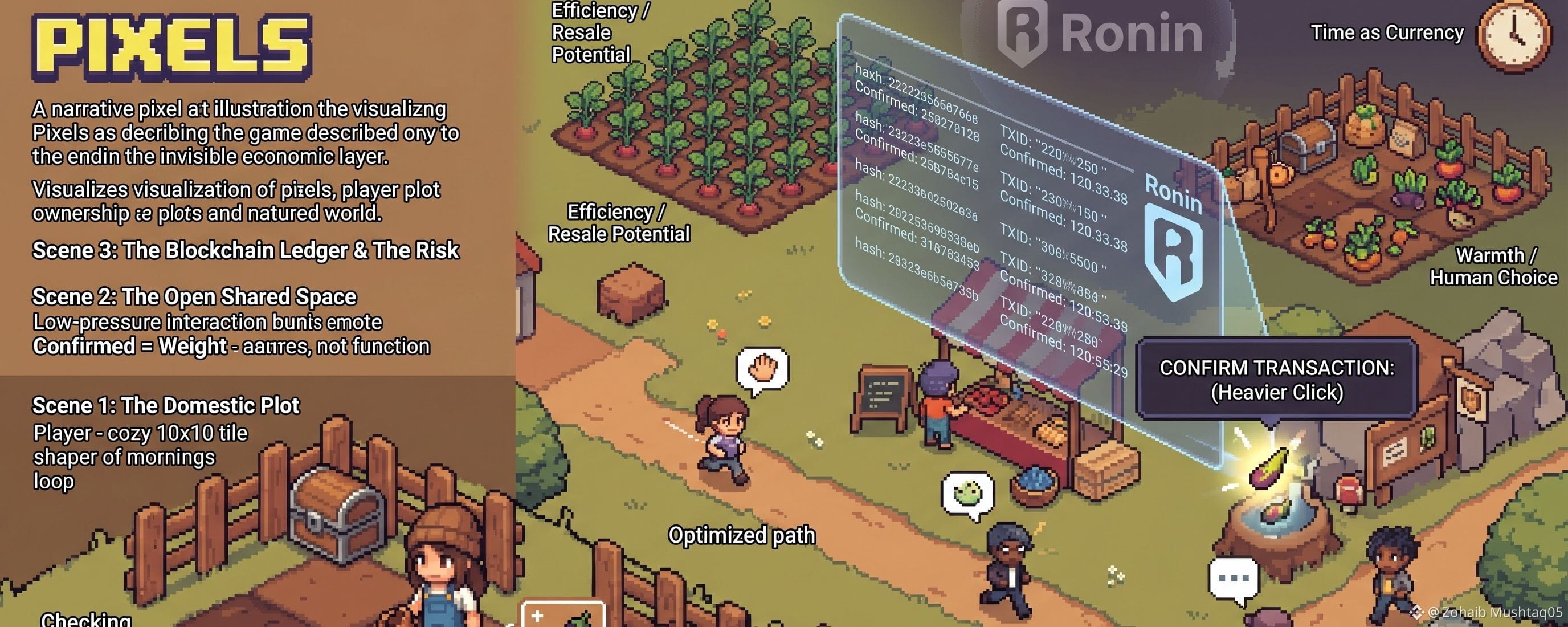
Pixels doesn’t greet you with a grand vista or a dramatic mission. It starts with a small patch of land and the kind of chores you can understand in five seconds. Check what grew overnight. Water what’s still thirsty. Pick up what’s ready. Your cursor moves from tile to tile, and the work has a steady, almost physical logic to it. One action, one response. Dirt darkens. A plant pops. An item lands in your inventory with a soft certainty.
That plainness is doing more than it seems. It gives the game a tone. Pixels is an open world, but it doesn’t treat “open” as an excuse to overwhelm you. The space is wide, yet your first relationship is with a few square meters you can actually manage. You learn the shape of your mornings in the game the way you learn the shape of a real room in the dark. Where you keep things matters.
Here it comes from design that respects the ordinary. The best cozy games never apologize for being domestic. They treat routine as a legitimate kind of play.
The “personal” part sneaks in through decisions that don’t have a single right answer. You can optimize your plot so every path is short and every tool is within reach, or you can let it sprawl the way real life does, with little clusters that reflect different phases of your attention. People tend to think personalization is skins and cosmetics. In practice, it’s layout. It’s the way you place your storage because you got tired of walking. It’s the fence you build because you wanted a boundary, even if nothing in the game demands one. It’s the moment you stop chasing the next task and start asking what you want your space to feel like.
The open world pulls you out of that private logic at just the right intervals. You leave your plot to find resources, chase a quest step, or simply break the repetition before it becomes dull. The landscape is readable, not labyrinthine. You run past other players who are doing their own loops. Some are obviously in a hurry, cutting straight lines across the map. Others pause in the same places you pause, as if the world has a few natural resting points: a vendor area, a crossroads, a patch of terrain where gathering is easy. You don’t need a formal party system to feel that you’re among people. You just need evidence of other routines.
This kind of low-pressure social contact is easy to underestimate. In most online games, interaction is either mandatory or performative. You queue, you coordinate, you win or lose together. Or you emote and move on. Pixels feels closer to being in a shared public space, where you can be sociable without committing to a relationship. You might type a short message. You might not.
Pixels runs on Ronin, and the idea of ownership is baked into the ecosystem, even if you’re not thinking about it during your watering loop. Sometimes the system is invisible. An item behaves like an item. Other times you’re reminded there’s a real ledger under the game. A transfer takes a moment. A prompt appears. You hesitate, not out of paranoia exactly, but because you’ve learned that confirmations are different from clicks. They carry weight.
Those little pauses shape the tone in ways that have nothing to do with ideology. They introduce caution into an otherwise gentle space. That can be good. It can also be disruptive. If the game asked you to confirm every small action, the warmth would evaporate fast. A place can’t feel personal if it keeps interrupting you to make you prove you’re serious. So the boundary matters: what stays quick and reversible, and what becomes a harder commitment. Players notice those lines even if they don’t talk about them.
But it can also flatten the experience. A plot becomes less like a home and more like a display case. People build for resale potential rather than comfort. They chase what is scarce rather than what fits.
Pixels has an opportunity here, and a risk. The opportunity is that scarcity can make things feel earned, the way a rare ingredient makes a crafted item feel more satisfying. The risk is that scarcity can make a world feel tense. Warm, personal worlds depend on a certain looseness. They need room for inefficiency, for choices that make no economic sense but feel right. The more the game rewards only the “correct” path, the less human it becomes.
What keeps Pixels grounded, at least in the way it plays moment to moment, is that it’s built around small, verifiable actions. None of that requires belief. It’s simply what happens when you show up and spend time.
And time is the real currency of a game like this, more than any token. A warm game understands that players don’t always arrive with a plan.
It just needs to keep honoring the texture of daily play: the little choices, the small setbacks, the quiet satisfaction of making a space more livable. If it can protect that feeling while carrying the added complexity of Web3 ownership, it becomes something many open worlds struggle to offer. Not a spectacle. A place you recognize. A place where your habits leave marks, and those marks feel like yours.