
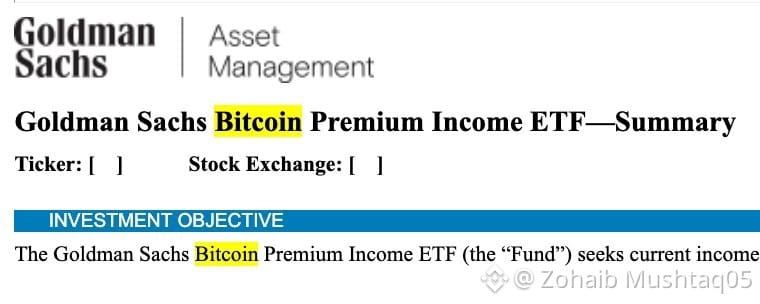
If you spend time around markets, you get used to the way big news often arrives in small packaging. A filing. A few pages of legal language. A name that sounds like it was built by committee. That’s why reports that Goldman Sachs has filed for a “Bitcoin Premium Income ETF” land the way they do. Not with fireworks, but with a quiet signal: this is another step in turning Bitcoin exposure into something that fits inside the habits and constraints of traditional portfolios.
The phrase “premium income” does a lot of work. In plain terms, it usually points to an options strategy—most often some version of covered calls—designed to convert volatility into periodic distributions. The mechanic is simple enough to describe. You hold the underlying exposure and sell call options against it. If Bitcoin stays flat or rises slowly, the option premium you collect can show up as income. If Bitcoin rips higher, you’ve likely sold away some of that upside. You get paid for accepting a ceiling.
That trade is not new. Equity markets have been running it for decades. In the ETF world, it’s become a familiar format: “income” funds that hold an index and systematically sell options. The sales pitch, when people get sloppy, is that it “pays you while you wait.” The truth is more specific. It pays you because you are taking the other side of someone else’s desire for upside exposure. You’re monetizing demand for convexity. And you’re doing it in a market where the underlying can move fast enough to make yesterday’s assumptions feel naïve.
Bitcoin is an especially sharp instrument for this because volatility is not an occasional visitor; it’s part of the architecture. That’s attractive to anyone in the business of selling options. Higher implied volatility tends to mean richer premiums, all else equal. But “richer” doesn’t mean “free.” Those premiums are compensation for risk you can’t diversify away with a clever spreadsheet. When Bitcoin gaps, it doesn’t always do it politely.
So why would a bank like Goldman bother packaging this into an ETF? Because the demand is there, and the wrapper matters. Many investors don’t want to open a crypto exchange account, manage keys, worry about custody, or explain to a compliance department why they’re wiring money to a platform with a Cayman address. An ETF sits in the same account as everything else. It can be bought through the same brokerage screen, held in the same retirement account, monitored by the same risk system. It turns a strange exposure into a familiar one.
There’s also a subtler shift happening in how Wall Street talks about Bitcoin. The conversation has moved from “Is it real?” to “What’s the right way to hold it?” That doesn’t mean the asset has become safer. It means the financial system is getting better at absorbing it. The center of gravity moves from ideology to implementation: custody arrangements, margin requirements, authorized participants, daily NAV mechanics, options liquidity, tax treatment, distribution schedules. All the unglamorous details that decide whether a product works in practice.
A premium-income structure adds another layer of detail that retail investors often miss. The distribution you receive is not the same thing as interest in a savings account. It may include option premiums, which can be influenced by volatility, positioning, and timing. It may involve returning capital in some periods, depending on how the fund is structured and how the underlying moves. It will almost certainly create a different pattern of returns than simply holding Bitcoin. Sideways markets can look surprisingly good. Strong bull runs can feel frustrating. Violent down moves can still hurt, because the premium only cushions so much.
This is where the name “Bitcoin Premium Income” can mislead if you read it quickly. Bitcoin doesn’t generate income the way a business generates cash flow. Any “income” here is engineered. It is a consequence of trading activity and risk transfer. That isn’t a moral critique; it’s just what it is. The product is selling a specific shape of exposure: less upside participation in exchange for more consistent cash distributions, subject to the realities of a market that doesn’t respect consistency.
Goldman’s involvement, if confirmed, also tells you something about where the competitive pressure is. Once spot Bitcoin ETFs became a standard instrument in the U.S., the next fight was never going to be only about fees. It was going to be about variations: buffered products, managed volatility, target income, defined outcome structures—ways to make Bitcoin exposure palatable to investors who are curious but cautious, or who have mandates that don’t allow them to hold something that can fall 20% in a week without explanation.
There’s an almost domestic scene behind this: advisors in offices, looking at client statements, trying to answer a question that is both simple and loaded. “Can we get some Bitcoin exposure, but not make my account feel like a roller coaster?” An options overlay is one answer. Not a perfect one. But a familiar one.
The other reality is that these products tend to do well when the story of the market changes. In periods when prices churn, when investors feel tired, when the high-volatility thrill looks less fun than it did six months ago, “income” suddenly sounds responsible. In strong momentum markets, it can feel like a constraint. The product doesn’t change. The investor’s emotional relationship to it does.
None of this tells you whether such an ETF is good or bad. It tells you what kind of bet it is. It’s a bet that Bitcoin will remain volatile enough to keep option premiums meaningful, but not so explosive that capped upside becomes a constant regret. It’s a bet that investors will value smoother-looking distributions over the raw exposure of holding the asset outright. It’s a bet that the infrastructure—liquidity, market makers, options markets tied to Bitcoin-linked instruments—will support systematic trading at scale without too much slippage or tracking error.
And it’s also, inevitably, a bet on attention. Bitcoin’s price is a headline factory. A bank doesn’t file for a product like this because it expects the public to stop caring. It files because it expects the demand to persist, and because it sees a way to sell a different version of the same risk—one that can be described in the language of portfolios rather than the language of prophecy.
If there is a single honest takeaway, it’s this: the financial system is getting better at turning Bitcoin into products that feel normal. That normalization doesn’t remove the underlying uncertainty. It just moves it into new shapes. The wrapper gets smoother. The risk stays sharp.