The Web3 gaming sector is still developing quickly, but at its core, there is still one fundamental question:
Is this growth genuinely sustainable, or is it just another cycle driven by hype?
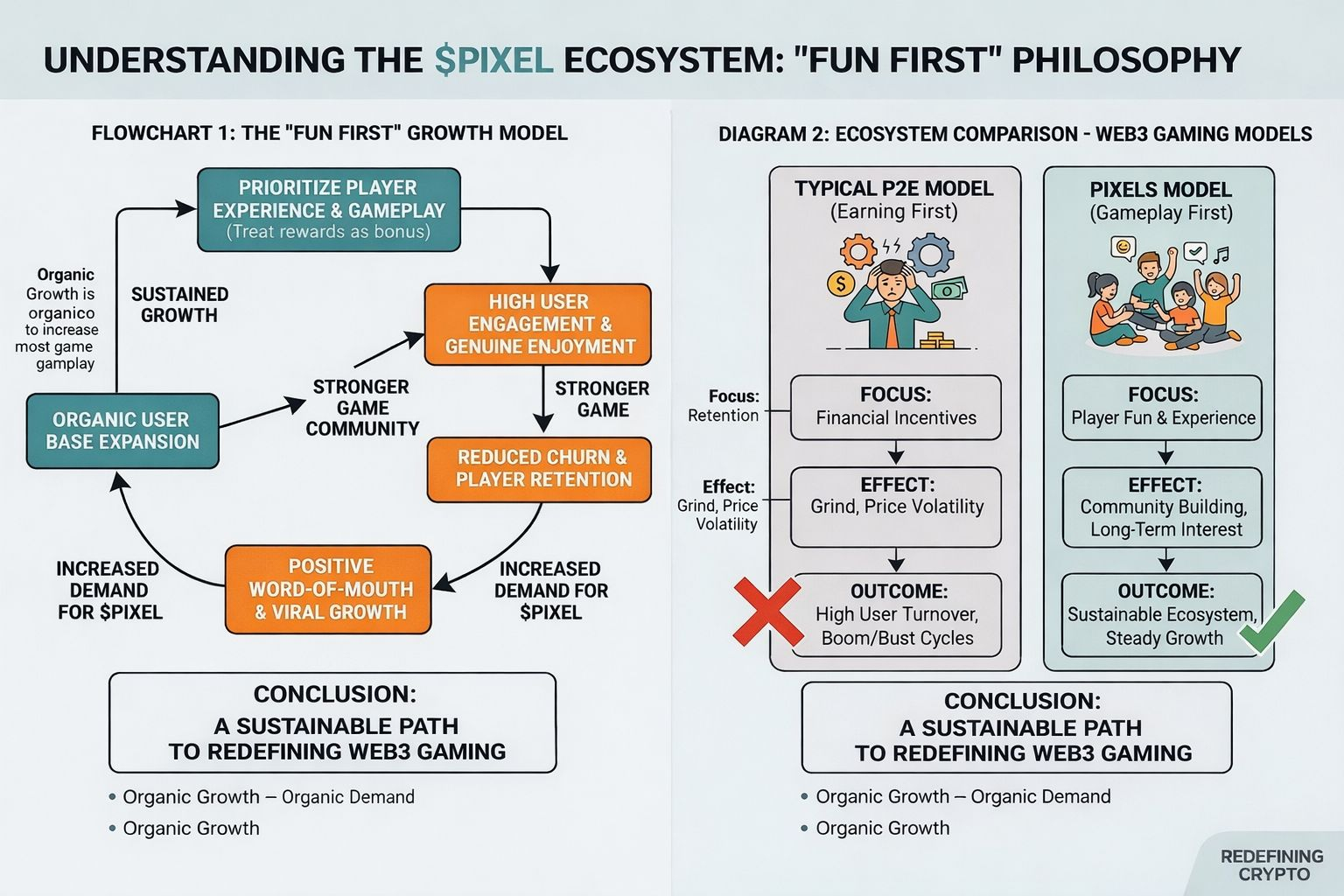
The "play-to-earn" model has been widely adopted by GameFi projects in recent years. Although early adoption and incentives quickly attracted users, many ecosystems struggled to sustain engagement once token pressure increased or rewards decreased. User retention consequently frequently fell precipitously.
Utility-driven Web3 gaming is now the industry's more mature direction as a result.
1. Actual Use Outside of Speculation
Utility in Web3 gaming shouldn't be restricted to speculation or trading. When a token has true utility, it is intricately woven into the gameplay.
This comprises:
actively utilizing in-game features
Providing support for progression systems
driving the game's internal economy
One example of this change is PIXEL, where the token is increasingly seen as an ecosystem utility as opposed to merely a speculative asset.
2. The most important thing is to put the player first.
One crucial element will determine Web3 gaming's success:
Beyond monetary rewards, do players genuinely enjoy the game?
A satisfying gaming experience consists of:
Interesting gameplay features
Clearly defined systems of progression
Community involvement and social interaction
Significant accomplishments and awards
No incentive system can maintain long-term retention without entertaining gameplay. Although they may come for prizes, players only stay for the experience.
Pixels is an approach that puts players first, concentrating on creating an ecosystem where gameplay value and engagement take precedence over transient speculation.
3. Sustainable Reward Systems Are Necessary
Reward inflation has been one of GameFi's main problems. Many early systems gave users large initial rewards but were unable to sustain economic equilibrium over time.
Unsustainable models frequently result in:
Quick reward fatigue
Pressure on token value
Farming practices that are short-term rather than long-term
The following must be guaranteed by a sustainable system:
In-game activities are linked to rewards.
Long-term involvement is encouraged.
The in-game economy is still flexible and well-balanced.
With this strategy, GameFi becomes a long-term digital economy rather than a passing fad.
In conclusion
The loudest and most anticipated projects won't be the only ones that shape Web3 gaming in the future. Those who create genuine systems with enduring value and significant player engagement will own it.
Projects such as $PIXEL demonstrate an early transition in the industry from ecosystems driven by speculation to gaming environments driven by utility and experience.
If this trend continues, GameFi's next phase will focus on creating sustainable digital economies where gaming becomes the primary value, rather than just making money.