
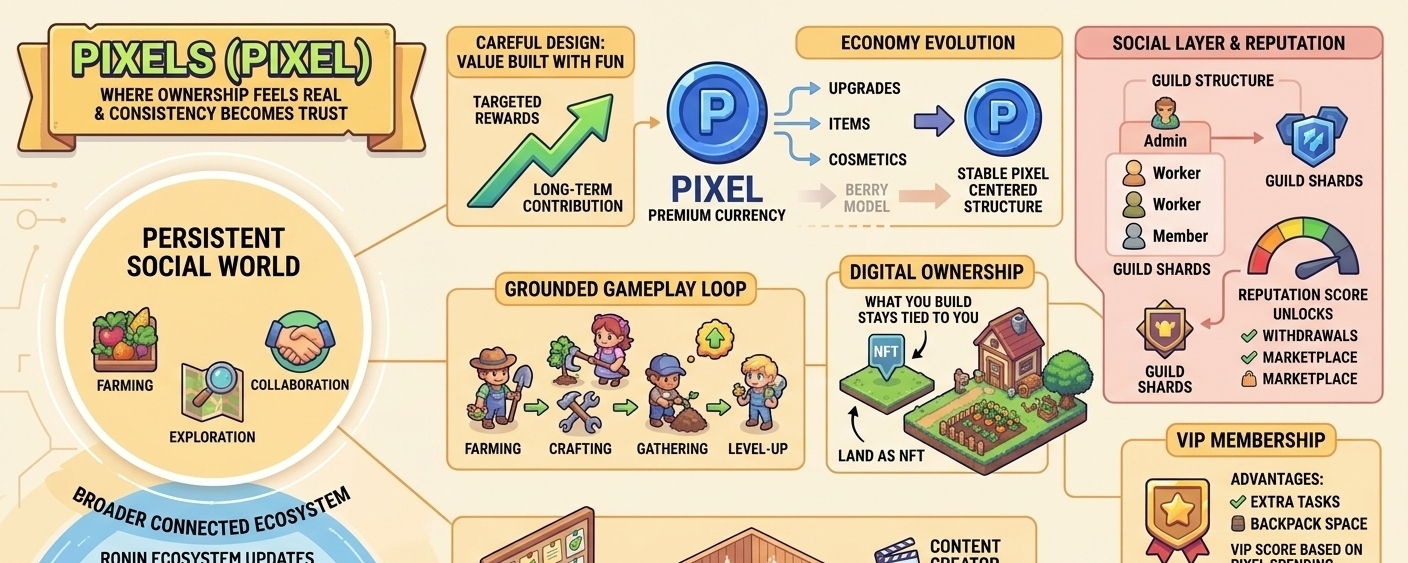
Pixels (PIXEL) is not something I approach the same way I approach most on chain systems. I don’t open it looking for efficiency, and I don’t stay in it expecting immediate returns. I spend time with it differently, and over time I’ve realized that this difference is not accidental. It reflects a deeper response to patterns I’ve seen repeat across cycles.
I have watched capital move too quickly in this space. I have seen how systems reward speed, punish patience, and quietly train people to act against their own long-term interest. In many DeFi environments, I don’t feel like I’m making decisions. I feel like I’m reacting. There is always a reason to move, always a reason to reposition, always a reason to exit before someone else does. Pixels interrupts that rhythm, and I notice it almost immediately.
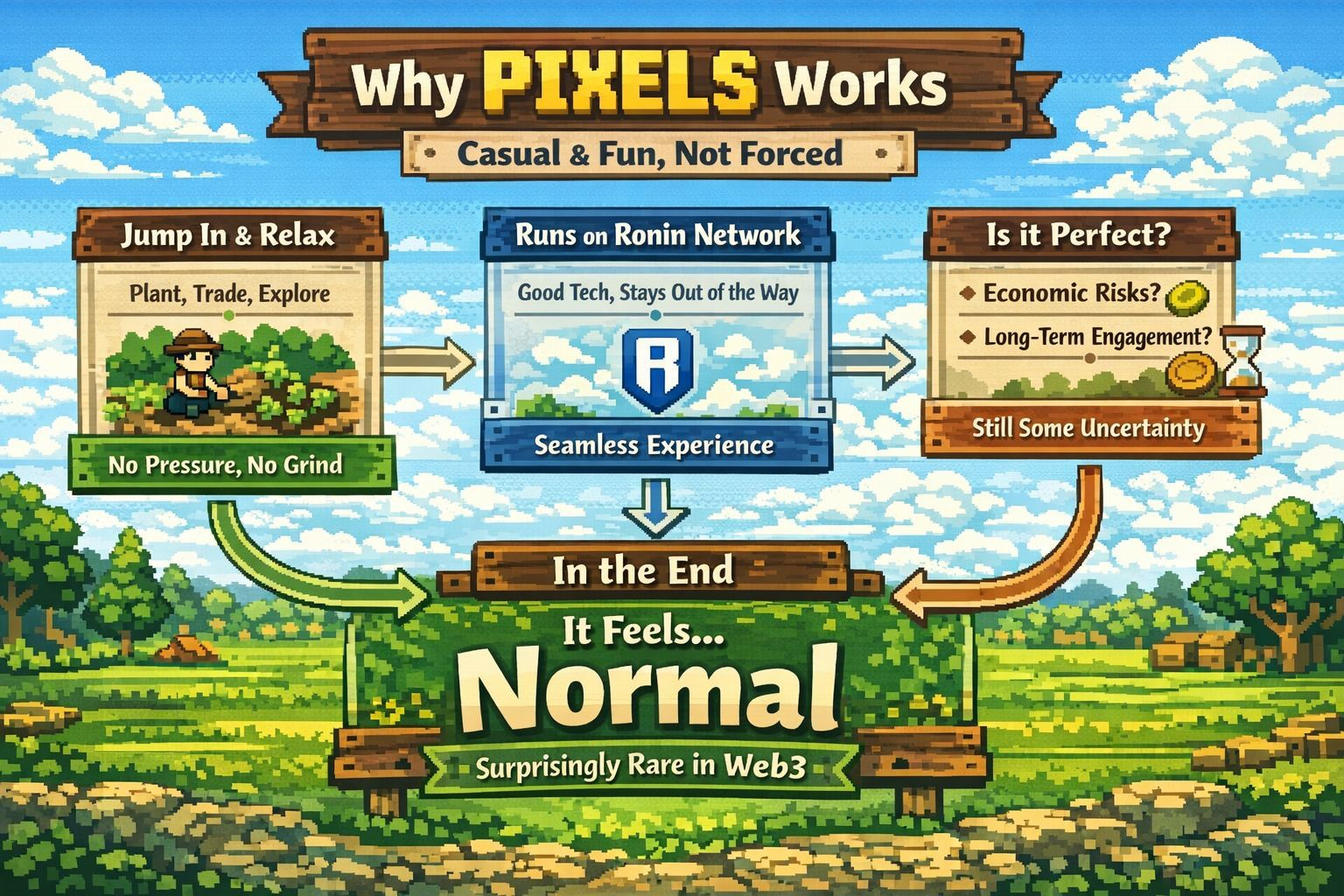
When I spend time inside it, I am not pushed to optimize every second. That might sound simple, but I’ve learned that most systems don’t allow that kind of breathing room. Idle capital is treated as failure. Participation is measured in outputs, not presence. I’ve been in enough protocols to know how this ends. It leads to overextension. It leads to users committing more than they understand, chasing returns they don’t fully trust, and exiting under pressure when conditions shift.
In Pixels, I see a different structure forming. I don’t feel the same urgency to extract value immediately. Instead, I find myself accumulating progress in ways that don’t translate directly into short-term liquidity. At first, I questioned this. I wondered if it was just a delay mechanism, another way of stretching out emissions. But the longer I stay, the more I see that it changes how I behave. I am less reactive. I am less likely to sell into weakness because my position is not defined only by a token balance.
Still, I don’t ignore the risks. I’ve learned not to confuse slower systems with safer ones. The pressure doesn’t disappear. It shifts. When rewards exist, they eventually meet the market. I’ve seen this play out too many times to overlook it. Emissions build quietly, and for a while, everything feels stable. Then liquidity conditions change, and the accumulated pressure becomes visible all at once. Pixels is not outside this cycle. It simply stretches the timeline.
I also notice something else that feels familiar in a different way. Routine starts to take over. I log in, I perform actions, I progress. At some point, I ask myself whether I am still acting with intention or just following a loop. This is not unique to Pixels, but it becomes more visible here because the system is built around repetition. I’ve learned that repetition can create a sense of commitment that is hard to separate from actual belief. I have stayed in systems longer than I should have simply because I felt invested in the process, not because the fundamentals still made sense.
That is where I try to stay careful. I remind myself that time spent is not the same as value created. Pixels makes this tension clearer. It shows me how easily engagement can become inertia. I don’t see this as a flaw of the system alone. I see it as a reflection of how people interact with structured environments. When actions are rewarded consistently, questioning those actions becomes harder.
Governance is another area where my expectations remain grounded. I have participated in enough governance systems to know how they evolve. At the beginning, there is energy. People vote, discuss, and shape outcomes. Over time, participation narrows. Decisions concentrate. Fatigue sets in. In a system like Pixels, where engagement is high at the gameplay level, it is easy to assume that governance will remain active. I don’t make that assumption. I separate playing from deciding. They require different motivations, and I rarely see both sustained at scale.
When I think about growth, I don’t rely on projections. I’ve seen too many growth models that look strong on paper and collapse under real conditions. Pixels can attract users. That part is visible. What I watch more closely is what happens when growth slows. I’ve learned that every system looks stable when new participants are entering. The real test begins when that flow becomes inconsistent. Internal economies are forced to stand on their own, and that is where weaknesses appear.
I ask myself simple questions. If fewer new players arrive, does the system still feel worth participating in? If rewards decrease, does the activity remain meaningful? If liquidity tightens, does the token hold its place, or does it follow the same path I’ve seen elsewhere? I don’t expect perfect answers, but I pay attention to how the system responds over time.
One thing I keep coming back to is how Pixels reframes my understanding of participation. It removes some of the immediate financial pressure and replaces it with a slower accumulation of effort and presence. That shift reveals something important. When I am not being rushed, I make different choices. I hold longer. I observe more. I react less. This doesn’t guarantee better outcomes, but it changes the conditions under which decisions are made.
At the same time, I remain aware that no system escapes market reality. External forces still apply. Liquidity still matters. Sentiment still shifts. Pixels exists within the same broader environment as every other on-chain project. It cannot isolate itself from those dynamics, no matter how different its internal structure feels.
What it can do, and what I think it already does, is highlight the behaviors that most systems hide. It shows me how much of what I do in DeFi is shaped by incentives rather than conviction. It shows me how easily I adapt to pressure without questioning it. And it gives me a space where that pressure is reduced enough for me to notice it.

I don’t see Pixels as a solution to the problems I’ve encountered in DeFi. I see it as a lens. It slows things down just enough for patterns to become visible. It doesn’t remove risk, and it doesn’t eliminate inefficiency. But it rearranges them in a way that makes them easier to study.
In the long run, that is why it matters to me. Not because I expect it to outperform or dominate, but because it changes how I observe the system as a whole. It reminds me that pace influences behavior, and behavior shapes outcomes more than most models account for. When I step away from urgency, I see things I usually miss.
