I didn’t expect to spend this much time thinking about PIXEL.Honestly,I almost ignored it at first.I’ve seen enough Web3 games to feel like I already know how the story goes.There’s usually a phase where everything looks active people farming, trading,talking about rewards and then slowly,almost quietly,the energy fades.Not because the game disappears,but because the reason to stay does.
That’s been my default lens for a while.I don’t go into these systems asking what’s new anymore.I usually ask how long the incentives can hold.And more often than not, that ends up being the only thing holding anything together.
So when I looked at Pixels,I wasn’t expecting to find something fundamentally different. But I did notice something that made me stop and look a bit longer.It wasn’t a specific feature or mechanic it was the way the system seemed to position participation itself.It didn’t feel entirely centered on “come here and earn.” It felt more like it was trying to shape how people engage over time.
That might sound like a small distinction,but it changed how I thought about it.Instead of asking what someone can get out of it,I started asking what kind of behavior the system is actually encouraging.And more importantly,what kind of behavior it can sustain.
That question tends to expose a lot.Because if I’m being honest,most Web3 games don’t fail because people lose interest immediately.They fail because the kind of participation they attract isn’t built to last.If the system rewards simple,repeatable actions with no real depth,then people will naturally optimize for that.They’ll do the minimum required to get the maximum return.And once that return drops,so does their reason to stay.
At that point,it’s not really a game anymore it’s just a temporary loop that people move through.
What Pixels seems to be trying whether intentionally or just through iteration is to push against that pattern a little.The structure of the system suggests that not all participation is equal.Spending time farming, trading,or interacting isn’t just about volume; it’s supposed to connect to something within the world itself.At least,that’s the idea.
I wouldn’t say it fully succeeds at that.But it does feel like it’s aiming in a different direction.
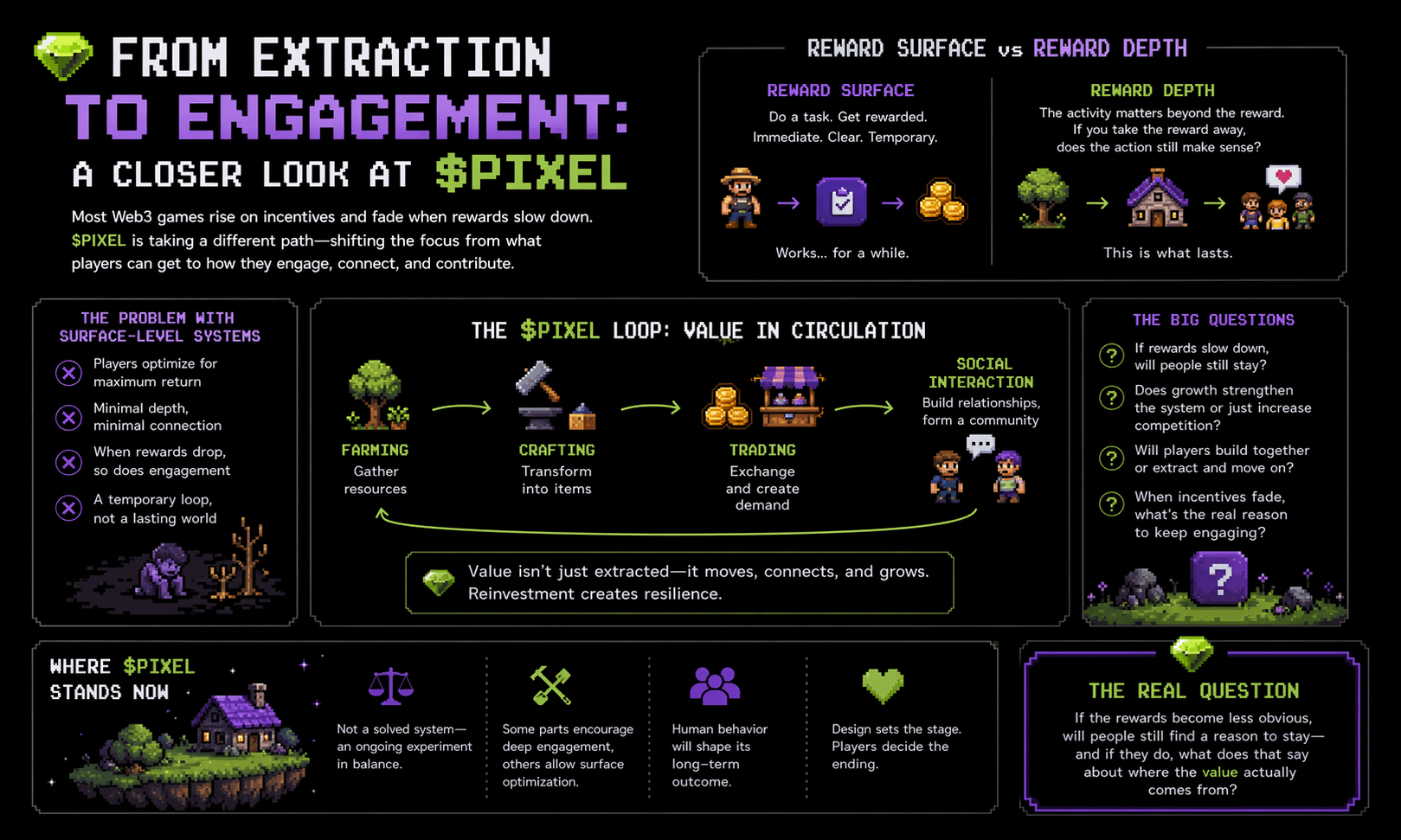
While thinking about this,I found myself coming back to a simple way of looking at these systems:the difference between what I’d call reward surface and reward depth. Most systems operate on the surface.You show up,do a task,and get rewarded.It’s immediate and clear,and it works at least for a while.
But depth is something else.Depth is when the activity itself starts to matter beyond the reward.If you take the reward away,does the action still make sense? Does it still connect to something?If not,then the system is probably more fragile than it looks.
Looking at PIXEL through that lens,I started to see why it held my attention a bit longer than I expected.The loops aren’t just linear. Farming feeds into crafting,crafting connects to trading,and trading pushes players toward interacting with each other.It creates a kind of circulation where value isn’t just taken out it moves around.
That doesn’t mean people won’t try to extract from it.Of course they will.That’s part of the environment these systems exist in.But when the structure encourages reinvestment even indirectly it changes the dynamic slightly.It gives the system a chance,at least,to hold together longer than something built purely on emissions.
Still,that’s where things get uncertain.
Because it’s one thing to design loops that can sustain themselves,and another thing to see if they actually do when conditions change.What happens if rewards slow down? Do people keep playing because the system still feels worth engaging with,or do they leave because the incentives aren’t strong enough anymore?
And what happens as more people join?Do they add to the system in a meaningful way, or do they just increase competition for the same rewards?That’s where a lot of these models start to strain when growth doesn’t translate into stronger foundations.
There’s also the human side of it,which is harder to predict.No matter how carefully something is designed,it’s still shaped by how people choose to use it.If most players treat it as a short term opportunity,the system starts to reflect that.Everything becomes faster,more transactional,less connected.
But if enough people stick around and actually engage with it if they trade,build, interact,and reinvest then the system starts to feel different.It becomes less about extracting value and more about participating in something that evolves over time.

Right now,Pixels feels like it’s sitting somewhere in between those two outcomes. It hasn’t fully escaped the usual patterns,but it hasn’t completely fallen into them either. You can see the tension in how it functions. Some parts push toward deeper engagement,while others still allow for surface level optimization.
I don’t think that’s a flaw as much as it is a reality of where these systems are right now. It’s difficult to design something that resists extraction without also limiting accessibility. And finding that balance isn’t straightforward.
So I don’t look at PIXEL as a solved system.If anything, it feels more like an ongoing attempt to figure out whether gameplay and value can actually support each other without one undermining the other.
And maybe that’s why it’s interesting to watch.
Because in the end,the question isn’t just about design it’s about behavior.It’s about what people choose to do when they’re given the option to either build within a system or simply take from it.
And over time,that choice tends to shape everything else.
So the real question is:if the rewards become less obvious,will people still find a reason to stay and if they do,what does that say about where the value actually comes from?