
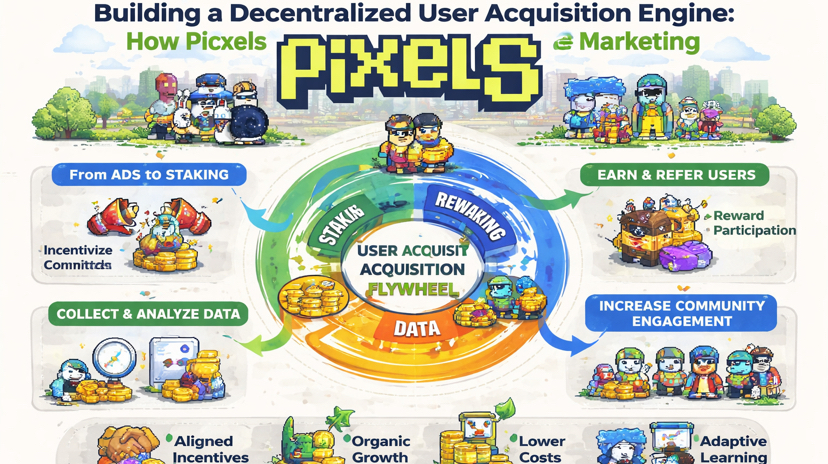

What i keep coming back to with Pixels is not the game itself, but the shift in what the game is becoming. In most of the gaming industry, user acquisition has long been treated as a separate discipline: buy attention, convert installs, optimize retention and repeat. It is a familiar machine, expensive and increasingly fragile. Pixels points to a different model. It suggest that acquisition does not have to sit outside the product as an advertising function. It can be built into the ecosystem itself.
That is a meaningful departure.
The deeper idea here is not simply that a blockchain game uses tokens or staking. Many projects do that. The more interesting move is that Pixels frames user acquisition as a networked system, one that can be powered by aligned incentives rather than centralized ad spend.#pixel
In practice that means the platform is not only trying to attract users. It is trying to turn participation into a growth mechanism.
Pixels as a Decentralized UA Solution
Pixels began with the kind of accessible, social, farming-game identity that makes a project easy to approach and easy to underestimate. But over time, it became clear that the more important story was not just gameplay. It was the architecture beneath it. Pixels started to look less like a single title and more like a distribution layer for engagement.
That matters because the gaming industry has a stubborn dependence on paid acquisition. Even the best games often live or die by advertising efficiency, platform access, and the constant pressure to lower CAC while preserving LTV. The problem is not just cost. It is control. Traditional UA relies on intermediaries that own the audience relationship, shape targeting, and collect most of the data value.
Pixels challenges that structure by treating acquisition as something closer to an ecosystem function.And That is a very different question. And once you ask it seriously, everything changes.
The Shift from Ads to Staking
The most interesting part of the Pixels model is the way staking can stand in for traditional paid marketing. In the old model, a studio spends money to purchase attention. In the Pixels model, value is committed into the ecosystem and then used to support growth through incentives. The logic is not “buy reach.” It is “build alignment.”
That distinction is easy to miss, but it is fundamental. Staking is not just a financial activity here. It is a behavioral signal.That commitment can then be translated into promotional energy, referral behavior, community participation, or other forms of active distribution.
I think this is where the model becomes more than a token design exercise. Traditional ads are transactional. They create exposure, but not ownership. Staking changes the emotional shape of acquisition. Users are no longer passive targets of marketing; they become participants in a growth loop. That is powerful, but it is also more demanding. The system has to justify that commitment with real utility and visible feedback.
Because once people are asked to stake, they are no longer merely consumers. They are co-financers of momentum.
The role of reward spend in acquiring new userss…
Reward spend is where the theory meets the behavior. In a conventional acquisition model, spend is front-loaded into advertising channels, with the hope that acquired users eventually become profitable. In a decentralized model like Pixels, reward spend can work more like an incentive budget distributed across the ecosystem to stimulate both retention and acquisition.
This is a subtle but important difference. Reward spend is not just about paying people to stay. It is about creating conditions under which users feel that participation has consequence. If the rewards are meaningful, they can encourage deeper engagement, repeat activity, and a stronger sense of progression. If they are tied to referrals, social sharing, or staking participation, they can also help bring in new users without relying on external ad platforms.
What i finwd compelling here is that reward spend can be more measurable than brand marketing and more organic than direct paid ads. It can be tuned. It can be redirected. It can be attached to behaviors the ecosystem actually cares about. That makes it more strategic than a broad awareness campaign, because the spend is not just visibility. it is behavior design.
Still there is no free lunch. Reward-driven acquisition has its own risks. Poorly designed incentives can attract mercenary users, create short-term extraction, or inflate growth metrics without producing durable engagement. The challenge is not to spend rewards aggressively. The challenge is to make them intelligent. A good reward system does not simply pay for activity. It filters for quality, persistence, and network value.
The real strength of Pixels lies in the flywheel effect. Staking brings commitment. Rewards stimulate participation. Participation generates data. And that data improves the next cycle of growth.
This is where the model becomes strategically elegant. In traditional UA, data is often fragmented across ad networks, attribution tools, and platform dashboards. The game publisher sees only part of the picture, and often after the fact. In a decentralized system, by contrast, the ecosystem can observe what kinds of incentives drive retention, what kinds of users respond to staking, where community energy is strongest, and which pathways lead to deeper engagement.
That data is not just operational. It is structural. It tells the platform how to refine the economy, how to shape incentives, and how to identify the kinds of users most likely to contribute to long-term growth. In effect acquisition becomes a learning system. i think that is the deepest promise here. Pixels is not merely using rewards to acquire users. It is using the act of acquisition to improve itself. Each cycle of participation leaves behind information. Each incentive experiment teaches the system something about behavior. Over time, that can produce a more adaptive and efficient growth engine than a static ad budget ever could.
Broader Implications for the Gaming Industry.
The broader significance of Pixels is that it hints at a future where user acquisition is no longer a purely outsourced function. That matters not only for Web3 games, but for gaming more generally. The industry has spent years optimizing media buying, attribution and conversion funnels. Pixels suggests an alternative path: make acquisition endogenous to the product and the community.
That idea could reshape how both Web3 and traditional studios think about distribution. In Web3, it offers a model where community participation is not ornamental but operational. In traditional gaming, it points to a future where loyalty, referral, and economic participation might be more directly connected to growth than paid traffic alone. The technology stack may differ, but the logic is transferable: incentives can become infrastructure.
Ofcourse not every game should become a financialized network. That would be a mistake. Games still need artistry, world-building, and emotional design. A growth engine is not a substitute for a compelling experience. But Pixels is useful precisely because it does not pretend otherwise. It takes a practical problem, user acquissstion, and asks whether the industry can solve it with a tighter connection between incenteve and participation.
That is a serious idea. And it is one worth watching closely.
What stands out to me is that Pixels is not just trying to attract players; it is trying to redesign the economics of attention. That is a much harder task than running ads, but it may also be the more durable one. In a market where distribution costs keep rising and user loyalty remains fragiLe systems that can convert participation into acquisition may end up mattering more than the games that simply spend to be seen.
In that sense, Pixels is less a marketing experiment than a structural one. It asks whether a game can become its own growth network. Not by forcing virality, but by making alignment the engine. Not by buying attention, but by earning participation. That is a more disciplined kind of ambition, and perhaps a more realistic one for the next phase of gaming.