
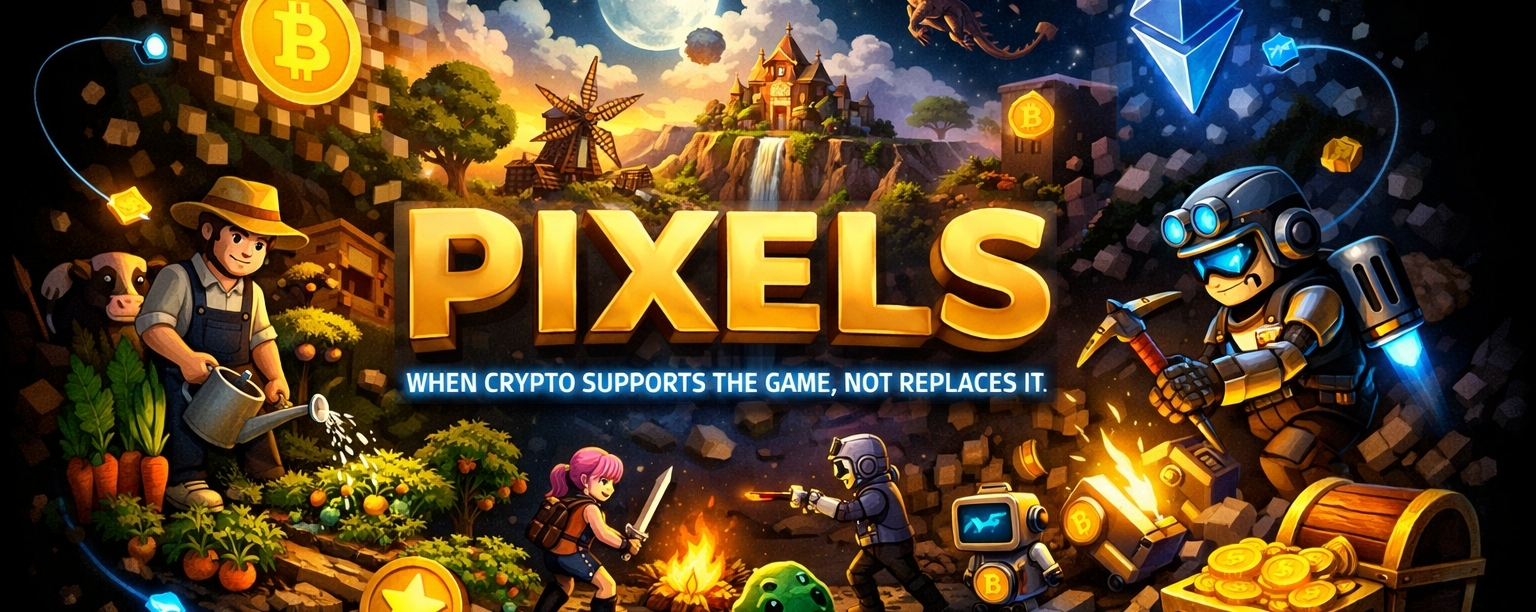
A lot of Web3 games don’t really feel like games first.
You can tell. Pretty quickly, usually.
There’s this strange weight to them. Not because they’re complicated in a smart way. More because everything feels loaded too early. The assets matter before the world does. The economy is already standing there waiting for you before you’ve had a chance to care about anything inside it. So even when the art is decent, even when the systems are big, something feels off. You’re not stepping into a place. You’re stepping into a model.
That gap matters more than people admit.
Because once you feel that a game wants something from you before it gives you a reason to stay, it becomes hard to relax inside it. You stop wandering. You stop attaching naturally. Your brain moves somewhere else. Into calculation. Into distance.
Pixels avoids a lot of that.
Not perfectly. Nothing does. But enough that you notice it.
It doesn’t arrive like a pitch. It doesn’t feel like it’s dragging you toward some larger argument about digital ownership or the future of online economies. It just starts where games are supposed to start — with presence. With small actions. Repetition. A rhythm you fall into before you fully think about it.
That part matters.
Because crypto, on its own, has always been better at structure than feeling. It can verify. It can record. It can let things move between people without some central gatekeeper standing in the middle. It can make digital ownership feel less temporary. Less fake. Those are real strengths. But they are still just strengths of infrastructure. They are not atmosphere. They are not charm. They are not the reason somebody logs back in at night without being told to.
And I think Pixels understands that in a way a lot of projects never did.
It doesn’t ask crypto to create the emotional core. It lets crypto handle the parts crypto is actually good at, then leaves the rest to the game.
That sounds obvious when you say it plainly, but apparently it isn’t. Because so many Web3 games kept making the same mistake. They treated blockchain like the main attraction. Like ownership itself was enough to make something meaningful. Like if players could trade an item, that item had suddenly become interesting.
But that’s never really how people work.
People don’t care just because something is ownable. They care because they spent time with it. Because it became part of a routine. Because it picked up a little memory along the way. Ownership only means something after attachment. Not before.
Pixels gets closer to that order.
You farm a bit. Move around. Check things. Come back later. The loop is simple, maybe even plain if you look at it too directly, but plain is not the same as empty. Some experiences don’t need to overwhelm you to become sticky. They just need to make enough sense that you return without arguing with yourself about it.
And then somewhere after that — not at the beginning, which is important — the Web3 layer starts to feel relevant.
Not exciting in some loud, market-driven way. Just appropriate.
Like yes, it actually does make sense that certain things here can belong to you. It makes sense that they can exist a little beyond the game’s internal walls. It makes sense that the value of time spent inside a world doesn’t have to remain completely trapped there. Not because every action should become financial, but because persistence sometimes deepens meaning when it’s handled gently.
That’s really the difference.
Pixels uses crypto like support beams, not fireworks.
Most Web3 games wanted you to stare at the beams. They wanted the technology to feel visible every second. You were always meant to notice it, admire it, think about what it enabled, what it proved, what it might become. And in doing that, they broke the illusion of play. They kept pulling you out of the world just to remind you how the world was built.
Pixels is better when it forgets to do that.
Or maybe when it intentionally refuses.
Either way, it creates more breathing room. And breathing room is rare in this space. So much of crypto has been shaped by urgency — urgency to explain, to monetize, to justify itself, to prove it deserves attention. That pressure leaks into design. You can feel when a product is trying to validate its own existence in real time.
Pixels doesn’t feel free of that completely, but it feels less trapped by it.
It understands that not everything has to be squeezed for maximum extraction the moment a player arrives. Not every mechanic needs a yield story. Not every object needs to whisper liquidity into your ear. Sometimes a game becomes more believable when it leaves a few things alone.
That restraint does a lot.
It makes the world feel less transactional. Or at least less immediately transactional. Which changes the player too. You stop approaching everything like a decision tree. You let some moments stay small. And small things are often where attachment starts. Not in spectacle. In repetition. In familiarity. In the almost forgettable act of returning.
That’s probably why Pixels works better as a Web3 game than a lot of louder, more ambitious projects ever did.
It knows crypto is not the feeling.
It’s the frame. The rails underneath. The system that helps certain parts persist and move and hold shape. Useful, yes. Important, maybe. But still underneath. Still secondary to whether the actual experience feels worth inhabiting.
That’s where a lot of projects got confused. They thought the chain was the magic. But the chain is not the magic. The chain is just the part that keeps certain promises intact.
The magic, if it happens at all, has to happen somewhere else first.
In the mood.
In the habit.
In the sense that a world is asking you to stay, not perform.
Pixels feels closer to that understanding than most.
Not because it reinvents everything.
Because it doesn’t try to.
And honestly, that might be the smartest thing about it.
