
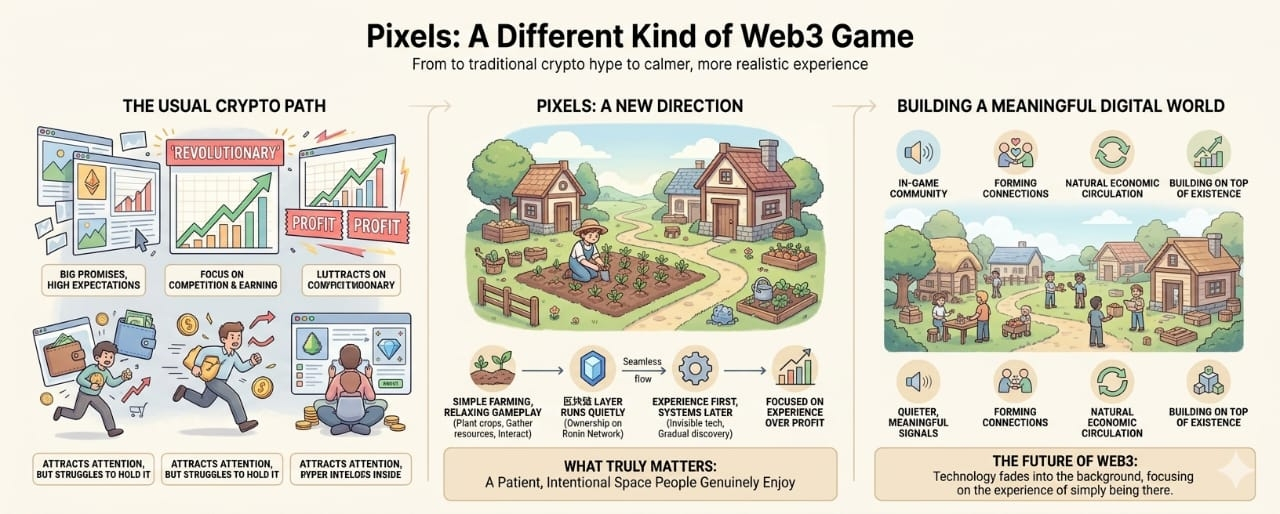
If you spend enough time around crypto, a certain pattern becomes hard to ignore. Projects often arrive with big promises and even bigger expectations. Everything is framed as revolutionary, fast-growing, and financially rewarding. Games are no exception. They usually focus on competition, rare assets, and earning potential, as if excitement and profit are enough to sustain long-term interest.
But after a while, I noticed something feels missing in many of these experiences. They are designed to attract attention, not to hold it. People may join quickly, but they don’t always stay. It made me start thinking that maybe the problem isn’t the technology itself, but how it’s being used. Games are not just systems of incentives. They are places people return to because they feel calm, familiar, and meaningful in small ways.
That is where Pixels begins to feel different, even if it doesn’t try to announce itself loudly.
At first glance, Pixels looks like a simple farming game. You plant crops, gather resources, walk around, and interact with other players. There is no pressure, no urgency, and no overwhelming complexity. It feels closer to the kind of games people play to relax rather than to compete. And that simplicity is not accidental.
Underneath this calm surface, there is a blockchain layer running quietly in the background. The game is built on the Ronin Network, which allows players to actually own certain in-game items and assets. But what stood out to me is how invisible this layer feels at the beginning. You don’t need to understand wallets or tokens to start playing. You can just enter the world and exist in it.
I started thinking about how rare that approach is in Web3. Most projects expect users to understand the system before they experience it. Pixels seems to reverse that. It lets you experience the world first, and only later do you begin to notice the systems supporting it.
The way the system is built reflects that same mindset. Not everything is pushed onto the blockchain. That would slow things down and make the experience frustrating. Instead, only the parts that truly matter, like ownership of assets or economic interactions, are recorded on-chain. The rest stays off-chain to keep the game smooth and responsive.
It becomes clear that this is a deliberate design choice. They are not trying to prove how “on-chain” they can be. They are trying to protect the player experience while still giving real meaning to ownership. Choosing Ronin also supports this direction, since it is designed specifically for gaming, with faster transactions and lower costs.
Then there is the PIXEL token, which sits quietly at the center of everything. It is used within the game for transactions, upgrades, and participation. Players earn it through their actions and spend it back into the same world. On paper, this sounds like a standard game economy, but I noticed something subtle here.
The token is not pushed as the main attraction. It exists as part of the environment rather than the reason for it. That distinction matters more than it seems. If players come only to earn, they tend to leave when earnings slow down. But if they come because they enjoy the experience, the economy becomes something that supports their activity instead of controlling it.
Still, I couldn’t help but wonder how fragile that balance might be. Every token-based system faces the same tension. If too many people focus on extracting value, the system can lose its sense of purpose. So the long-term health of Pixels depends on whether it can keep players engaged beyond just financial incentives.
When you zoom out, Pixels fits into a larger shift happening in Web3. We are seeing a move toward digital spaces where ownership, identity, and interaction come together. It is not about finance alone anymore. It is about how people exist and coordinate in shared virtual environments.
Pixels explores this idea in a very grounded way. It doesn’t try to be everything at once. It focuses on creating a space where people can gather, build, and participate in a simple economy. And in doing so, it touches on a deeper question about the future of online communities. What happens when people actually own parts of the worlds they spend time in?
Of course, the path forward is not without challenges. Adoption is still a major hurdle. Even with a simplified experience, many users are unfamiliar with blockchain concepts. I wondered how many players fully understand what they own, or how that ownership works. There is always a risk that the deeper value remains hidden, or worse, misunderstood.
Token economics is another area that requires constant balance. External market forces can influence behavior inside the game. If the token price rises or falls too sharply, it can shift player motivations in ways that are hard to control.
There is also the broader uncertainty around regulation. As games start to include real economic layers, the distinction between entertainment and financial systems becomes less clear. That uncertainty can shape how these projects evolve over time.
So when thinking about success, it doesn’t feel right to measure it only through price or short-term growth. The real indicators are quieter. Are players returning regularly? Are they forming connections? Is the in-game economy circulating naturally? Are people building on top of what already exists?
These are slower signals, but they are more meaningful. They show whether the world being built actually matters to the people inside it.
At the same time, there are limits that cannot be ignored. The casual nature of Pixels may not appeal to everyone. Some players want depth, competition, or high-stakes gameplay. Others may remain skeptical of anything connected to blockchain, no matter how well it is designed.
There is also the possibility that the blockchain layer does not add enough visible value. If players do not feel the difference, they may question why it exists at all.
And then there is the reality of market cycles. Crypto projects often move with the broader environment. Even thoughtful ideas can struggle during periods of low interest or negative sentiment.
In the end, what stayed with me about Pixels is not any single feature, but the overall direction it represents. It doesn’t try to overwhelm or impress. It feels patient. It feels intentional.
I noticed that the experience unfolds slowly. You start by doing simple things, and over time, you begin to see the deeper structure underneath. That gradual discovery feels closer to how real systems are understood, not forced, but revealed.
Maybe that is the more important idea here. The future of Web3 might not be built through intensity or constant noise. It might grow through quiet, well-designed spaces that people genuinely enjoy being part of.
If that is the case, then Pixels is not just a game. It is a small but meaningful step toward a different kind of digital world, one where technology fades into the background, and what remains is the experience of simply being there.
