
I was closing a late position when I tabbed over to the Ronin explorer and caught it: a steady trickle of $PIXEL staking claims and reward distributions hitting the contract at 0x7eae20d11ef8c779433eb24503def900b9d28ad7. Nothing viral, no single whale move that makes the timeline explode. Just dozens of small-to-mid wallets, players and land holders pulling their share from the multi-game pools. The timestamp was April 14, around 02:17 UTC. That single on-chain snapshot stayed with me because it wasn’t hype. It was proof the Ronin Network is quietly accelerating the growth of Pixels player-owned economies in real time. Low fees mean every in-game loop—planting, harvesting, trading land plots—actually lands on-chain without bleeding users dry.
Last month I did something I rarely do anymore: I logged into Pixels myself for a full session. No screenshots for clout, just farming a few plots like any new player. On Polygon it used to sting; here on Ronin the gas for every berry withdrawal and marketplace flip was basically zero. I watched my tiny stack of PIXEL grow without the usual tax. That frictionless feel is the first gear in what I keep calling the three quiet gears: Ronin’s speed keeps the gameplay alive, the PIXEL staking pools turn passive holders into ecosystem participants, and the cross-game reward flow (Pixels into Forgotten Runiverse, into whatever comes next) keeps the flywheel spinning. You feel it in the numbers too—daily active wallets climbing past 120k while Ronin itself handles the volume without a single congestion spike.
honestly the part that still bugs me
The part that still bugs me is how invisible this acceleration feels to most watchers. Market chatter loves the PIXEL price swings, yet the real story is on-chain behavior most people never scroll down to see. New players grind free-to-play Coins for weeks, then finally bridge or earn enough PIXEL to buy a plot or stake into a game pool. Veterans with early land NFTs compound effortlessly because Ronin lets them move assets at pennies. It’s not fair in the classic sense, but it is working. The network’s design rewards retention over speculation, and right now that’s translating into sustained activity even as broader gaming tokens cool off. I caught myself rereading the explorer logs at 3 AM, wondering if we’re watching the same quiet pattern that once lifted Axie—only this time the tokenomics feel less extractive.
3:42 AM and this finally clicked
3:42 AM and this finally clicked… or wait, actually it had been staring me in the face. Ronin isn’t just hosting Pixels. It’s optimizing the entire loop so that player-owned economies stop feeling like a marketing line and start behaving like infrastructure. The PIXEL on-chain rewards shift rewards actual usage—staking power scales with land ownership and time in-game, not just bag size. Two timely examples hit different: first, the surge in marketplace volume for farm plots without the usual gas wars you see on Ethereum L1 games; second, the way smaller guilds are now pooling PIXEL into shared validators and seeing real monthly payouts. Both only possible because Ronin’s block times and fees let micro-transactions happen at scale.
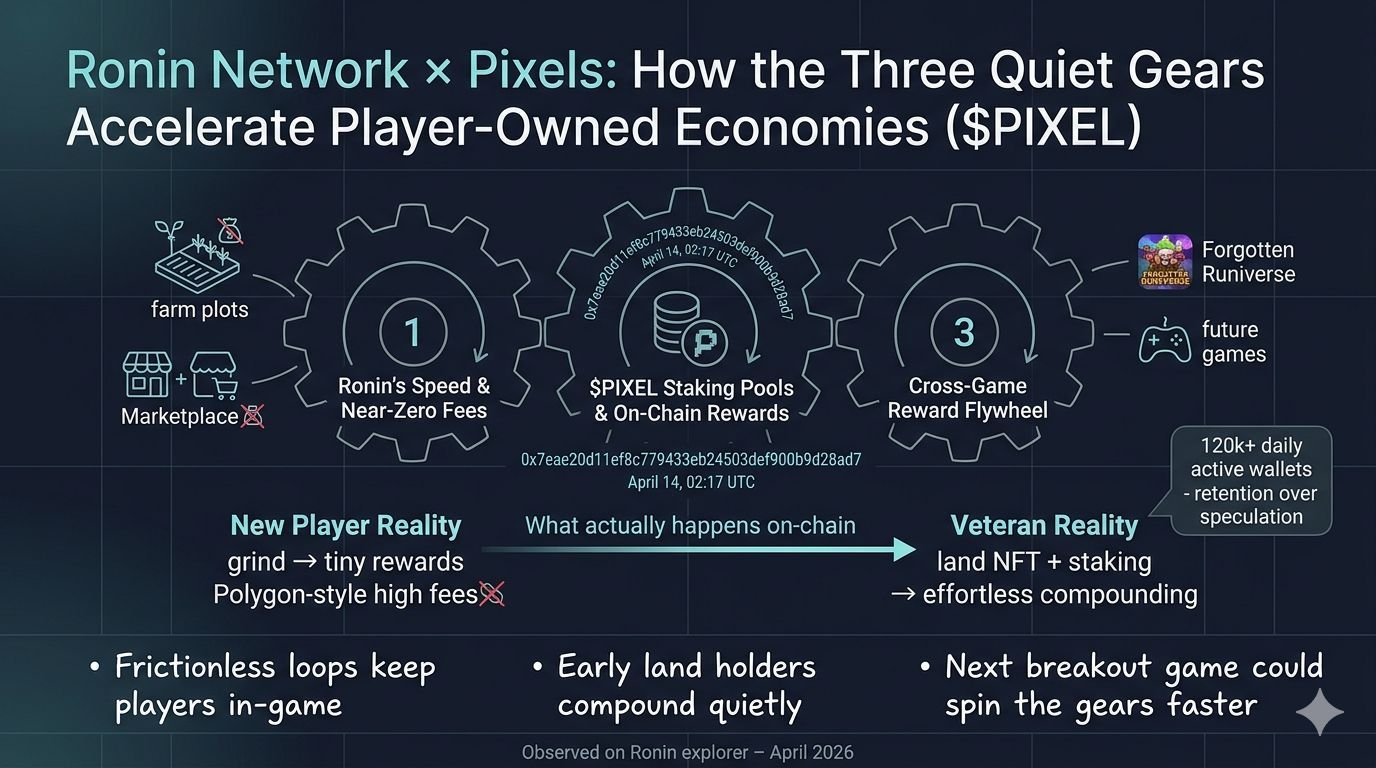
I’m not blind to the risks. Token distribution still leans toward early participants, and if the next wave of games doesn’t bring fresh liquidity the flywheel could slow. Still, the strategist in me keeps circling back to the same forward reflections. Ronin’s path to full Ethereum L2 alignment could pull in deeper liquidity without breaking the gaming UX that’s already winning. More builders will notice the retention numbers and spin up their own titles on the same chain. And the PIXEL staking model might quietly become the default for any serious player-owned economy that wants to survive past the first hype cycle.
What happens when the next breakout game lands on this same stack and the three gears start turning even faster?
@Pixels #pixel $PIXEL