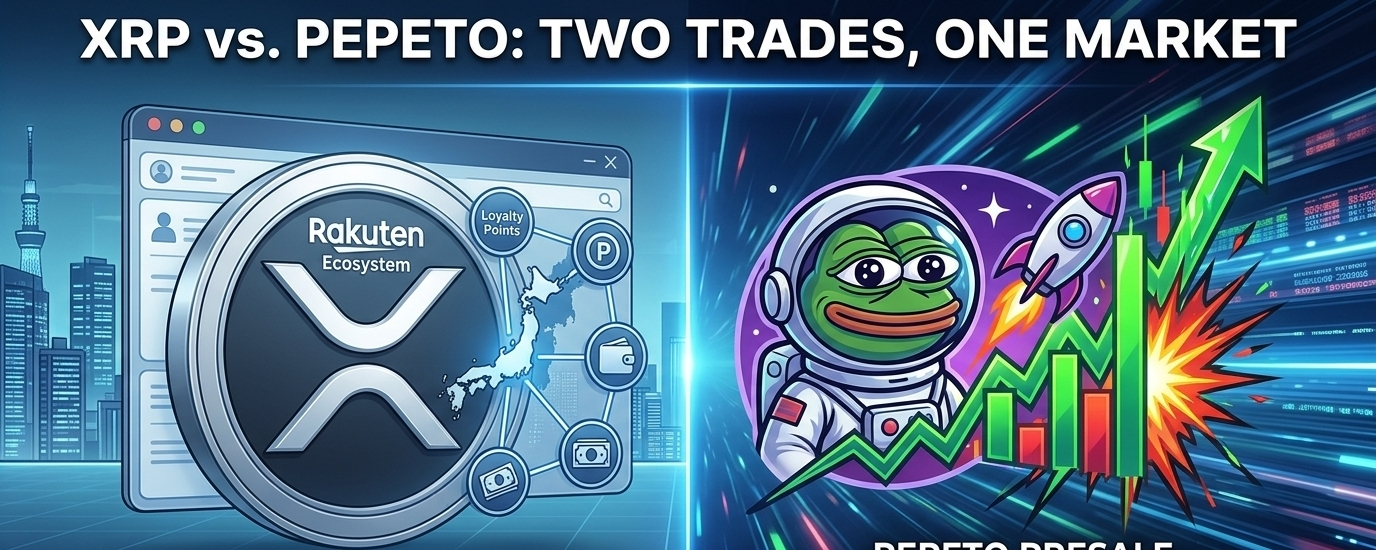

I started watching XRP a bit closer again when the Rakuten update came out, because this one actually feels bigger than the usual recycled “adoption” headline. Starting April 15, Rakuten Wallet began letting users buy XRP with Rakuten Points, hold it in the wallet, and convert it into Rakuten Cash for spending across Rakuten’s payment ecosystem. The number getting attention is the potential reach: around 44 million users and roughly 5 million merchant touchpoints in Japan. That does not guarantee instant usage, but it does give XRP something traders always say they want to see and rarely get at scale: a real consumer lane.
That’s why this matters to me more than a random partnership post. XRP has spent years trading on the idea of cross-border utility and payment relevance, but markets usually want proof that the story can move closer to actual retail behavior. Rakuten is at least the kind of platform where that conversation makes sense. It is one thing to say a token could be useful for payments. It is another thing when a major consumer ecosystem gives people a direct path from loyalty points to XRP to spendable value.
Price-wise, XRP is sitting around $1.39 right now, with a market cap near $85.8 billion and 24 hour volume around $2.8 billion. So yes, the asset is liquid enough to respond when a real narrative shows up, but it is also already large enough that it will not move like a tiny mid-cap on one news cycle alone. That is the part newer traders sometimes miss. A headline can improve sentiment fast, but for a large-cap coin to reprice cleanly, the market usually needs repeated confirmation, stronger positioning, and the sense that the story has follow-through.
My near-term read is pretty simple. If buyers keep treating Rakuten as the start of a broader payments rerating, XRP can keep grinding higher and test that $1.45 to $1.60 zone. That would not be a crazy move at all from here. But if this turns into just another headline everyone quotes for two days and then forgets, XRP could easily stay stuck in a range while the market waits for the next catalyst. Access is bullish. Habit is what matters more. Forty-four million possible users sounds huge, but what the market will eventually care about is how many of them actually use the rail.
Then there is the Pepeto part of the story, and honestly this is where I get more cautious. The presale is being promoted heavily right now, and recent release-driven coverage says Pepeto has raised about $9.05 million. Maybe that gets traders excited, and sure, presales can pull speculative attention in a hot market. But this is not the same quality of catalyst as Rakuten opening a real retail lane for XRP. Most of the Pepeto numbers being circulated right now are coming from press releases and sponsored-style coverage, so I would treat them as promotional claims first, not hard conviction signals.
That creates an interesting split for traders. XRP is the slower, bigger, more credibility-driven setup here. Pepeto is the faster, riskier, narrative-heavy presale trade that can attract attention simply because people are always hunting the next explosive multiple. One has a real-world distribution angle. The other has early-stage speculation working in its favor. Those are not the same trade even if content creators keep putting them in the same headline.
So my view is this: XRP looks more interesting here if you believe the Rakuten move is the beginning of a stronger retail utility narrative in Japan. Pepeto might keep drawing clicks because presale markets love momentum stories. But if I am choosing which one has the cleaner foundation today, it is still XRP.
The real question now is not whether Rakuten makes for a bullish headline. It clearly does. The real question is whether this becomes behavior, because that is where price stories stop being temporary and start getting repriced for real.