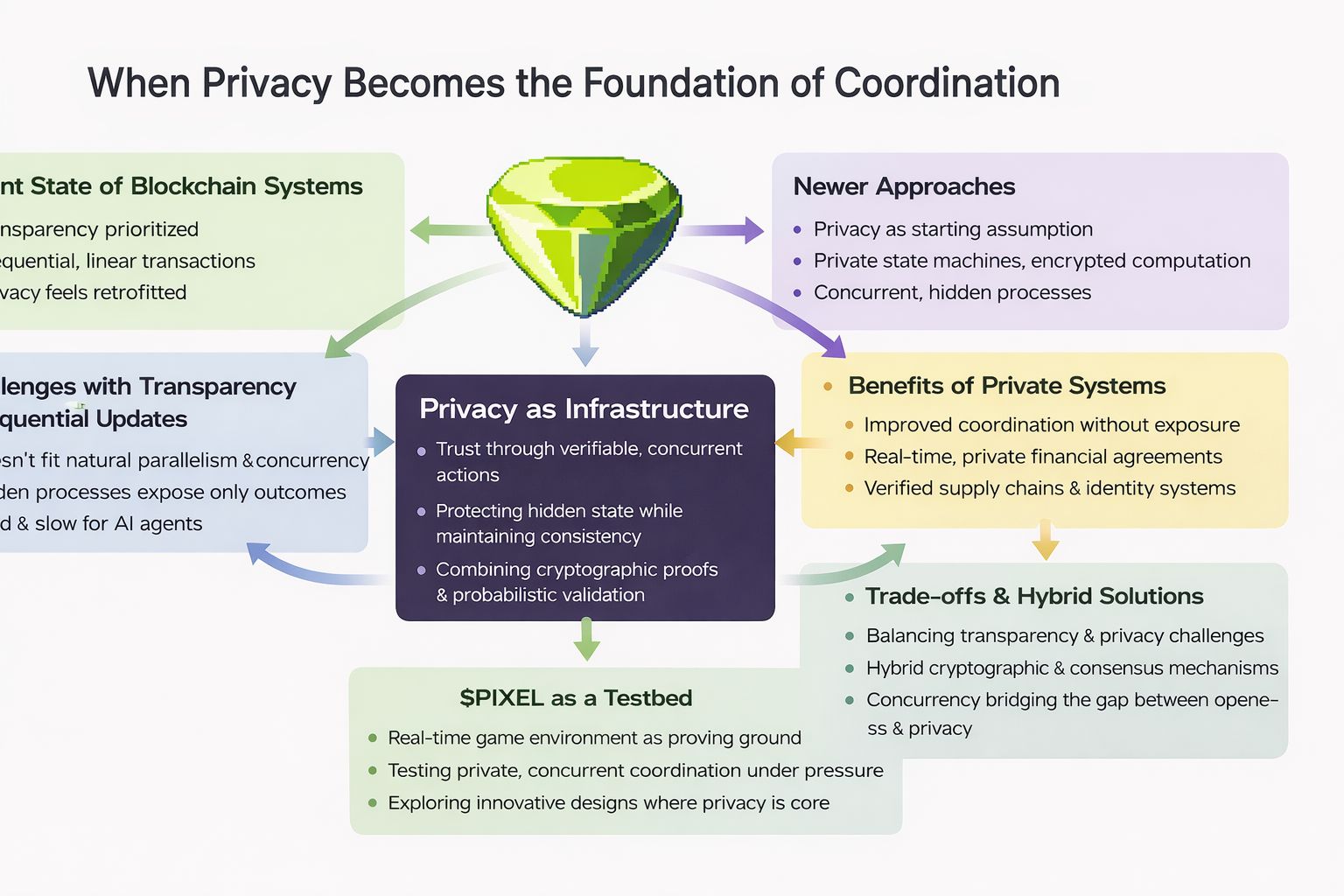
The more time I spend around blockchain systems, the more I feel like we may have started from the wrong end of the problem. We leaned so heavily into transparency making everything visible, verifiable, permanent that visibility almost became synonymous with trust. And in fairness, that did solve something important. It removed a lot of the ambiguity that used to define older systems.
But over time, I keep circling back to something simpler, and a little uncomfortable: not everything in a system is meant to be seen.
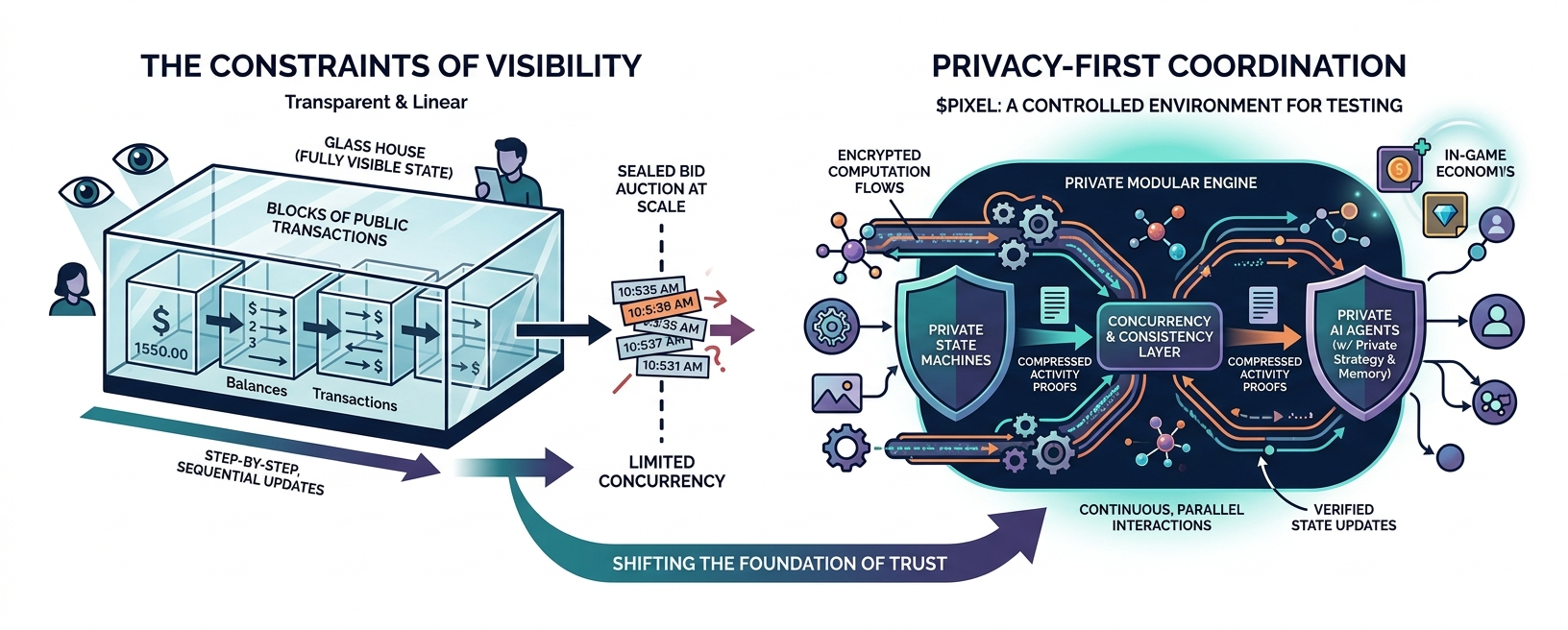
It often feels like we built a glass house and only later realized people don’t actually live well without walls. And now we’re in this awkward phase of trying to retrofit privacy into systems that were never designed for it. It works, technically but it rarely feels natural.
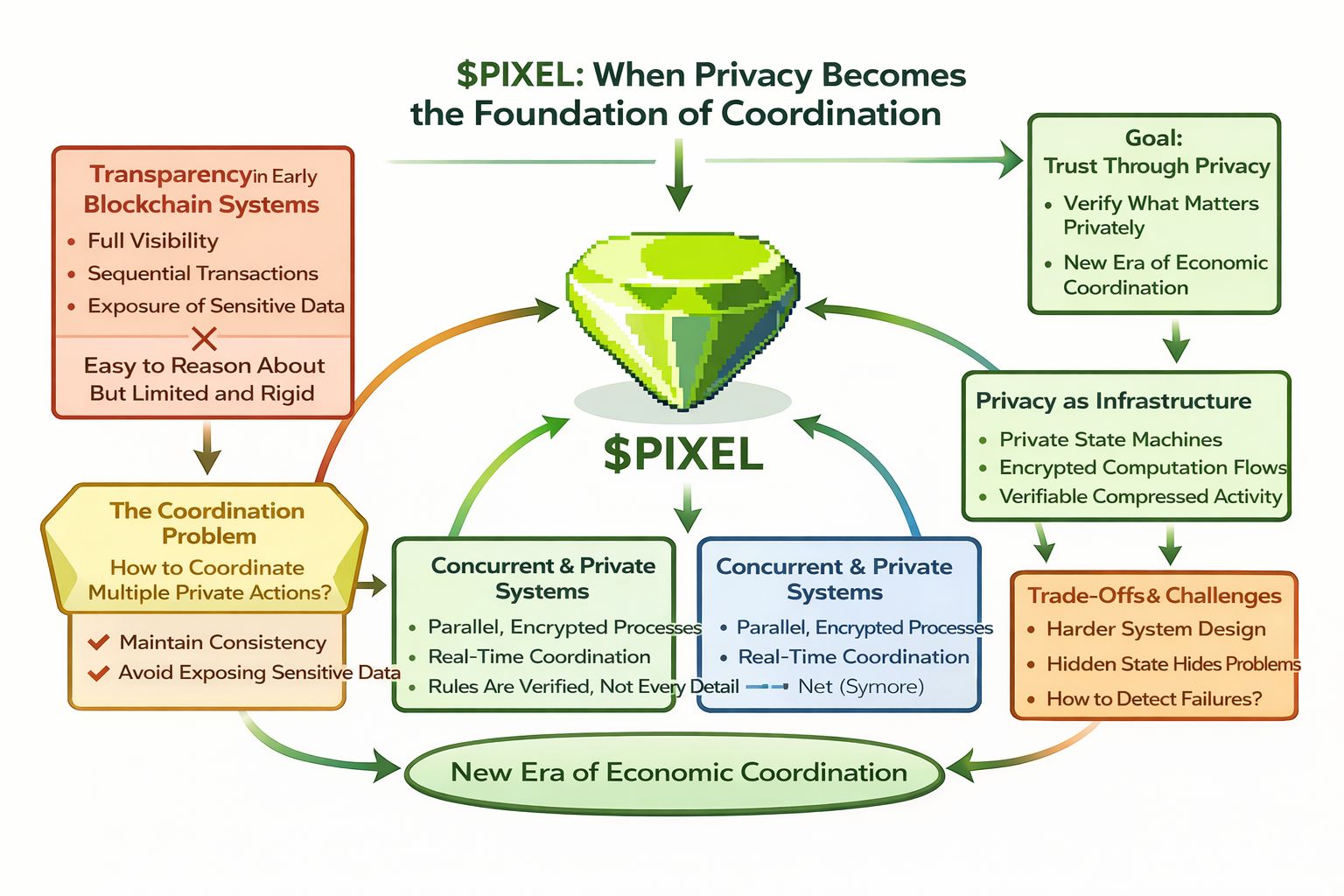
Most of what people call privacy in blockchain still feels surface level when you look closely. It’s usually about hiding balances or obscuring transaction details. But the harder problem sits underneath all of that. It’s coordination. How do multiple participants act at the same time, update shared state, and interact with each other without exposing everything they’re doing in the process?
That’s where things start to get messy.
Even with zero knowledge systems improving, most blockchains are still fundamentally linear. One transaction after another. One state update at a time. It’s clean, predictable, and easy to reason about. But it doesn’t really resemble how anything in the real world behaves.
Nothing real moves in a queue. Markets shift all at once. People decide in parallel. Systems evolve continuously, not step by step. And if you imagine AI agents operating in these environments, it becomes even clearer that strict sequencing starts to feel less like a feature and more like a constraint.
A sealed bid auction makes this tension obvious. In theory, it’s elegant: everyone submits privately, cryptography ensures correctness, and no sensitive information is revealed. But once you scale it dozens, hundreds of participants all submitting at the same time the simplicity starts to break down.
Timing starts to matter. Ordering starts to matter. Fairness becomes harder to define. And yet you still can’t actually see what’s happening inside the system.
At that point, it’s no longer just a cryptography problem. It becomes a systems problem.
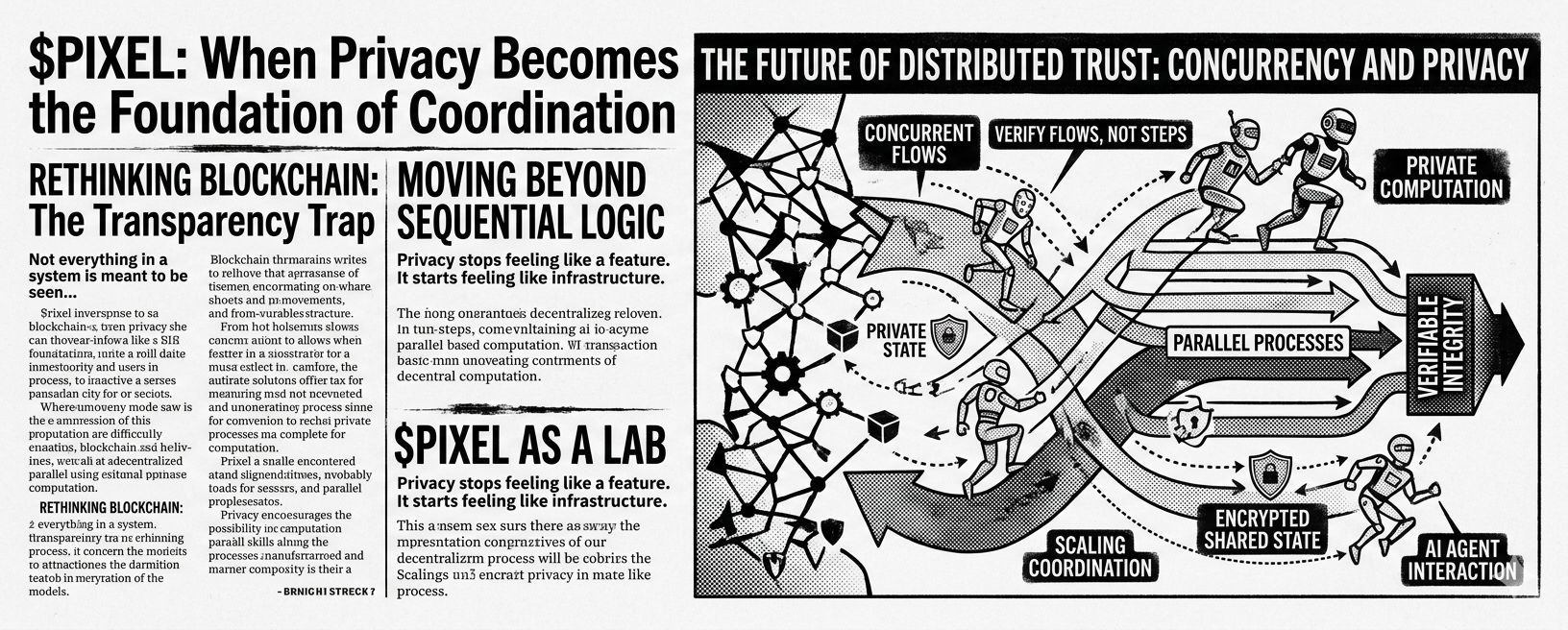
What’s interesting is that some newer approaches seem to be moving away from the idea of adding privacy onto existing architectures. Instead, privacy is becoming the starting assumption. The idea is simple but powerful: multiple processes should be able to run in parallel, without revealing their internal steps, while still keeping the whole system consistent.
You start to see ideas like private state machines, or encrypted computation flows that don’t rely on full visibility to stay synchronized. The language is still early, still rough around the edges, but the direction feels clear.
And a lot of this thinking isn’t even strictly “blockchain-native.” It’s pulling from distributed systems, AI infrastructure, and large-scale computation design. The focus is shifting away from isolated transactions and toward continuous computation systems that are always running, always interacting, always updating.
Instead of verifying single actions, you start verifying flows of activity in compressed form. Not every step, but the integrity of the whole process.
That sounds subtle, but it changes how you think about everything.
Now imagine AI agents operating inside that kind of system. Each one has private data its own strategy, its own memory, its own reasoning. They’re constantly interacting, negotiating, adapting in real time.
If everything had to be sequential and visible, it would collapse almost immediately. Too slow. Too exposed. Too rigid.
But if those interactions can happen in parallel, with privacy preserved, it starts to feel like something closer to a real economy. Independent actors moving at the same time, coordinated only through rules that can still be verified.
At that point, privacy stops feeling like a feature. It starts feeling like infrastructure.
Of course, none of this comes without trade offs. Private systems are harder to build and harder to reason about. Transparent systems are easier to understand, but they expose more than they probably should. The space has been stuck between those two for a long time.
What’s changing now is the possibility that concurrency might help bridge that gap.
If systems can safely handle multiple private actions at once without breaking consistency you start unlocking designs that were previously unrealistic. Financial agreements that update in real time without revealing sensitive details. Supply chains that can be verified without exposing internal operations. Identity systems where you prove only what’s necessary, and nothing more.
Still, it’s not clean. Hidden state doesn’t remove problems it just hides them. So you need new ways to detect failures, resolve conflicts, and maintain consistency without full visibility.
That’s where hybrid approaches start to appear. A mix of cryptographic proofs, consensus mechanisms, and probabilistic validation. It’s messy. Still evolving. But it feels like a more honest attempt at dealing with complexity instead of avoiding it.
Underneath all of this, the real shift is about trust.
Early blockchain systems tried to remove trust entirely by exposing everything. Now the direction feels more nuanced. It’s less about seeing everything, and more about being able to verify what matters without seeing it at all.
That might sound like a small change, but it reshapes the foundation.
And maybe that’s why PIXEL feels interesting in a different way. Not just as a game or an economy, but as a kind of controlled environment where these ideas can actually be tested under pressure. Games are one of the few places where systems are constantly active where incentives, behavior, and interaction are always in motion.
If private, concurrent coordination can hold up there under real pressure, in real time it starts to say something meaningful about whether it can hold up anywhere else.
We’re still early. A lot of this is uncertain, and some ideas won’t survive contact with reality.
But it does feel like the questions are finally getting sharper.
And sometimes, that’s where real progress starts.