
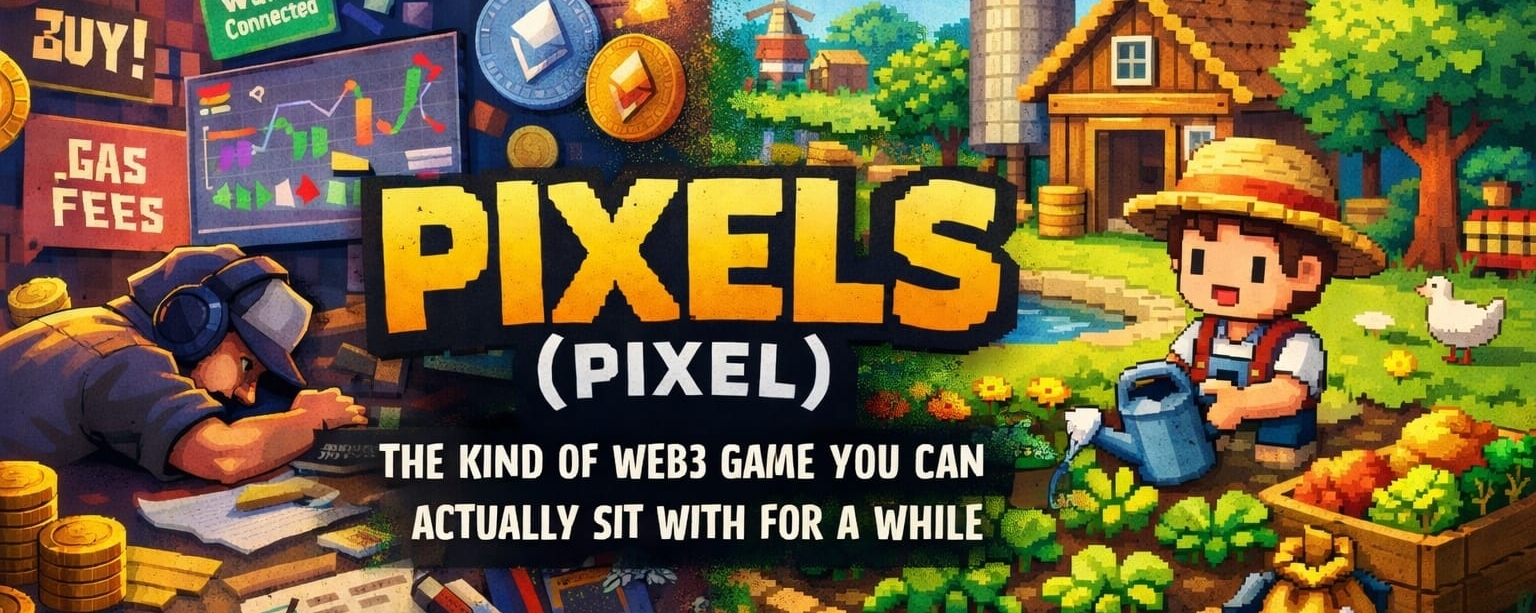
I’ll be honest, most Web3 games lose me almost immediately. Not because I hate the idea of blockchain in games or because I think every project in the space is fake, but because so many of them feel like they were built by people who forgot one basic thing: if it isn’t fun to play, then none of the extra stuff matters. I do not care how clever the token system is. I do not care how many features are listed on the roadmap. I do not care how many times someone says “community-driven” or “player-owned economy” if the actual experience of logging in feels dry, confusing, or annoying. That has been the problem for a long time. Too many of these games feel like they want credit for existing near crypto, not for being good games.
That’s why Pixels stands out a little more than I expected it to.
Not because it’s perfect. It isn’t. Not because it changes everything. It doesn’t. And definitely not because it suddenly makes all the usual Web3 problems disappear. They’re still there. You can still feel them if you spend enough time with it. But Pixels does something that sounds small and obvious until you realize how rare it is in this space: it actually lets you play the game before it starts reminding you about the system around it.
That matters more than people think.
When you first get into Pixels, the strongest feeling is not pressure. It’s not confusion either. It’s curiosity. The world is simple, colorful, light, easy to move through. You walk around, you farm, you gather, you explore, and for a while it feels like the game is asking almost nothing from you except attention. That’s refreshing. It feels relaxed in a way that most Web3 games never even attempt. So many of them show up already tense, already trying to impress you with economies and mechanics and ownership models. Pixels feels calmer than that. It starts with the basics. You plant something. You water it. You collect resources. You figure things out by doing them.
And honestly, that’s probably why it works.
The farming loop is simple, but simple is not always a bad thing. A lot of games get stuck trying to prove how deep they are, and in the process they forget how satisfying repetition can be when it’s done right. Pixels understands that better than most. There’s a rhythm to it. A quiet loop. Plant, wait, harvest, move, gather, repeat. It should feel boring on paper, but in practice it has that low-pressure, slightly addictive quality that cozy games usually aim for. Not dramatic. Not flashy. Just steady. You settle into it without noticing. One task becomes three. Then ten. Then suddenly more time has passed than you meant to spend.
That’s not some magic trick. It’s just good pacing.
The visual style helps a lot too. The pixel art gives the whole game a soft, familiar feeling. It doesn’t try to look expensive. It doesn’t beg for attention with overdesigned effects or some huge cinematic identity. It looks like a world you can drop into without effort. There’s warmth in that. The farms, the land, the little movements, the overall atmosphere — it all feels built to support the gameplay instead of distract from it. It’s easy on the eyes. Easy on the brain. That kind of visual restraint is underrated, especially now when so many games mistake clutter for detail.
And then there’s the social side, which is there without becoming a burden. You see other players around. You know you’re sharing a space. The world has movement and life because other people are in it, but it doesn’t constantly force interaction. That’s a smart choice. Some players want community. Some players just want to be left alone while still feeling like the world is populated. Pixels manages that balance pretty well. You’re not trapped in silence, but you’re not drowning in noise either. It feels lived-in without feeling crowded.
That said, none of this erases the bigger tension sitting underneath the game.
Because no matter how calm Pixels feels on the surface, it still exists inside the Web3 frame. It still carries that extra layer. You can ignore it at first, maybe even for a good while, but eventually it creeps back into your thoughts. That’s the thing about these games. The economy is never fully gone. The value conversation is never really gone. Even if the game doesn’t shove it at you, the awareness sits in the background. You start asking questions. Should I hold this item? Should I sell it? Is this resource useful, or valuable, or both? Am I just playing, or am I falling behind because I’m not taking the economy seriously enough? That shift happens slowly, but once it starts, the mood changes.
And that’s where Pixels becomes more complicated.
Because part of what makes it appealing is how easy it is to treat it like a chill game. But part of what defines it as a Web3 game is that it wants to be more than that. It wants ownership to matter. It wants digital assets to mean something. It wants the player’s time and activity to connect with a broader economy. On paper, that sounds exciting. In reality, it can create a weird split in the player experience. One part of you wants to log in, farm a bit, wander around, and leave happy. Another part starts wondering whether you’re playing inefficiently. Whether you should be doing more. Whether relaxing is secretly the wrong strategy.
That is where so many Web3 games fail, and Pixels doesn’t fully escape it either.
The more time you spend around games like this, the more you notice a divide between players. Some people are there for the atmosphere, the routine, the world. Others are there to optimize. To scale. To turn every mechanic into output. And you can’t even blame them, because the structure of the game makes that mindset possible. Maybe even rewards it. But it does change the feeling of the space. The cozy farming fantasy gets a little shaky when you realize some players are not really treating it like a fantasy at all. They’re managing systems. Running loops. Thinking in terms of advantage. Once that becomes visible, it becomes part of the experience whether you want it or not.
Still, I think Pixels deserves credit for not letting that side completely take over the first impression.
That’s important. First impressions shape trust. And trust is a huge issue in the Web3 gaming space. A lot of players arrive with their guard up now, and for good reason. They’ve seen too many projects promise freedom and fun and ownership, only to deliver grind, friction, and hype with nothing solid underneath. Pixels feels more grounded than that. It doesn’t seem desperate to prove itself every second. It feels more comfortable being a game. That alone makes it easier to spend time with.
The Ronin Network also plays a real role in why the experience feels smoother than people might expect. A big reason many blockchain games become unbearable is not even the idea behind them, but the practical friction. Slow actions. Weird wallet moments. Constant reminders that a technical process is happening behind every interaction. If that layer is clumsy, the illusion breaks fast. Pixels benefits from being on infrastructure that generally makes things feel lighter and less annoying. That doesn’t make the whole concept disappear, but it reduces the amount of irritation between the player and the game. And in this kind of game, that matters a lot. Convenience is not a bonus here. It’s survival.
What I find most interesting about Pixels is that it seems to understand something that a lot of projects still don’t: players do not wake up hoping to be impressed by an economy. They wake up hoping to enjoy themselves. If a system supports that, great. If it interrupts that, it becomes the enemy. Pixels feels like one of the few Web3 games that at least understands the order of things. Fun first. Friction later, if it absolutely has to exist. It sounds like a tiny design principle, but it changes everything.
And yet, even while saying all that, I keep coming back to the same doubt.
Can a game like this stay this way?
That’s the real question. Not whether Pixels is better than a lot of Web3 games right now. I think it clearly is. The harder question is whether it can hold that identity as the stakes get bigger, as more players enter, as economies grow, as optimization becomes more intense, and as the pressure to expand systems inevitably rises. Cozy games survive on mood, on rhythm, on comfort. Economies survive on movement, demand, efficiency, and competition. Sometimes those things can exist together. Sometimes they can’t. And if that balance slips too far in one direction, the whole experience changes.
That’s why some of the praise for Pixels needs to stay cautious. The game works best when it feels light. When it feels playable. When it feels like something you can return to without preparing for a second job. The moment it loses that, it loses the best thing about itself. Because the strongest compliment I can give Pixels is not that it’s ambitious or revolutionary or deeply strategic. It’s that I can log in, spend time there, and not immediately feel drained. That should not be rare, but in this category it absolutely is.
There’s also something worth saying about how the game feels emotionally, which sounds dramatic until you realize games are emotional even when they’re simple. Pixels has a softness to it. A steadiness. It’s the kind of game that feels better when you don’t rush it. That may be why it lands more naturally than a lot of its competitors. Instead of trying to create excitement through noise, it creates attachment through routine. And routine is powerful. A world doesn’t always become memorable because it shocks you. Sometimes it becomes memorable because it quietly becomes part of your day. That’s a harder thing to build.
Maybe that’s why people stick with games like this even when they can clearly see the flaws. The flaws are there. The grind can become repetitive. The economy can become distracting. The gap between casual players and deeply invested players can make the world feel uneven. The whole Web3 layer can still produce that annoying background feeling that you are never fully outside the system. All of that is true. But there is still enough game here, enough atmosphere, enough ease, to make those flaws feel like tensions rather than total dealbreakers.
And that’s probably the most honest way to describe Pixels.
It is not some miracle. It does not magically fix the problems of Web3 gaming. It does not completely separate itself from the same patterns that wear people out. But it gets closer than most to something that feels normal, playable, and human. It feels like a game made by people who understood that if players are going to stay, they need a reason beyond speculation. They need comfort. They need flow. They need a world that isn’t constantly interrupting itself to explain why it matters.
Pixels, at its best, gives them that.
And maybe that’s why it stays in your head a little longer than you expect. Not because it overwhelms you. Not because it blows your mind. But because in a space full of games that feel like chores wrapped in promises, this one at least remembers that people came here to play.