
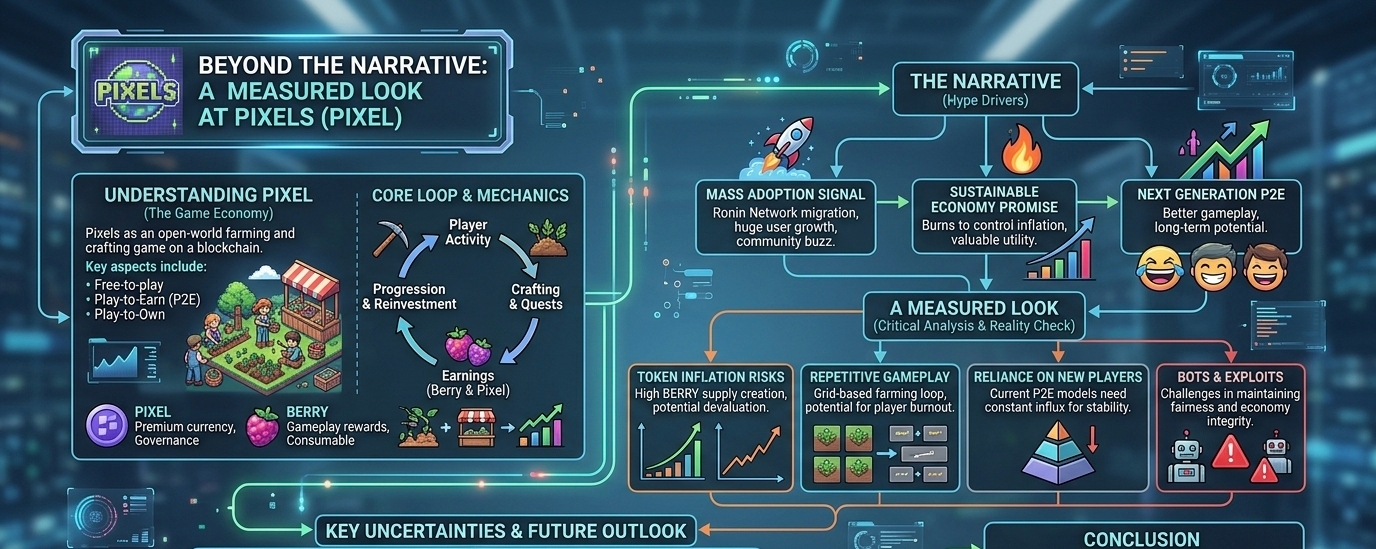

It’s difficult to approach any new Web3 project without a layer of skepticism shaped by the past few years. The space has produced a steady stream of ideas that sounded plausible in isolation but struggled when exposed to actual user behavior. Many projects promised ownership, interoperability, or digital economies that would rival real ones. Most ended up revealing a simpler truth: people don’t engage with systems just because they are on-chain. They engage when something is genuinely enjoyable, useful, or necessary. Against that backdrop, a project like Pixels deserves less attention for what it says it is, and more for whether it holds up under ordinary conditions.
At a glance, Pixels presents itself as a social farming game with Web3 elements layered in. Strip that down, and the question becomes fairly basic: is this solving a real problem, or is it introducing blockchain into a space that already works reasonably well without it? Farming and social simulation games have existed for years in Web2 environments, and they’ve already solved for accessibility, retention, and monetization in ways that millions of users accept. The friction in those systems—lack of ownership, platform control, limited asset portability—is often highlighted by Web3 projects as a problem. But it’s worth asking how many players actually experience that friction as meaningful. For most, these constraints are invisible or simply part of the trade-off for convenience.
The deeper issue here is not farming mechanics or virtual economies—it’s trust and value persistence. Web3 games often argue that by putting assets on-chain, they give players real ownership. But ownership only matters if the asset retains value outside the closed loop of the game itself. If the economy depends entirely on new players entering, or on speculative demand rather than intrinsic utility, then “ownership” becomes a fragile concept. It’s not clear that Pixels fundamentally changes this dynamic. It may decentralize certain components, but it doesn’t escape the dependency on sustained engagement and belief in the ecosystem.
In simple terms, Pixels is a game where players farm, gather resources, and interact socially, with some of those activities tied to blockchain-based assets and tokens. The idea is that players can earn, trade, and potentially benefit financially from their time in the game. That’s straightforward enough. The complication arises when financial incentives intersect with gameplay. Historically, this has led to distorted behavior—players optimizing for extraction rather than enjoyment, economies inflating and collapsing, and developers quietly adjusting systems to maintain balance.
Whether Pixels behaves like real infrastructure or just another narrative depends on how it handles these pressures. Infrastructure tends to fade into the background; it works reliably and doesn’t require constant attention or belief. Most Web3 games, by contrast, require ongoing narrative support—updates, incentives, and community management to sustain interest. If Pixels requires continuous token adjustments, reward tuning, or external incentives to keep players engaged, then it’s not really infrastructure. It’s a managed system trying to simulate stability.
There’s also a tension between openness and control. A fully open, player-driven economy can become chaotic or exploitable. A tightly controlled system, on the other hand, starts to resemble traditional games, making the blockchain layer feel unnecessary. Pixels has to navigate this balance carefully. Too much freedom, and the economy risks collapse. Too much control, and the promise of decentralization becomes largely cosmetic.
Execution risk is hard to ignore. Building a game that is genuinely engaging is already difficult. Layering an economy on top of it—especially one that interacts with real money—adds another level of complexity. Then there’s the question of adoption. Web3-native users may be interested, but they are a limited audience. Reaching mainstream players means competing with highly polished, accessible games that don’t require wallets, tokens, or any understanding of blockchain. Even with something like the Ronin Network reducing friction, the onboarding process is still more complex than simply downloading an app and playing.
Market reality also matters. The broader crypto environment influences user behavior more than most projects would like to admit. When markets are optimistic, participation rises and economies appear healthy. When sentiment shifts, activity drops and underlying weaknesses become visible. It’s not clear that Pixels is insulated from these cycles in any meaningful way.
None of this means the project is without merit. It may succeed in creating a niche community, or in refining certain aspects of Web3 gaming that others have struggled with. But those outcomes are different from solving a fundamental problem or establishing a new standard. The more restrained view is that Pixels is an experiment—one that sits at the intersection of gaming and financialization, trying to find a balance that has historically been difficult to achieve.
Whether it holds up over time will depend less on its current design and more on how it behaves when attention fades, incentives weaken, and players treat it less like an opportunity and more like a game. That’s usually where the real test begins.
