
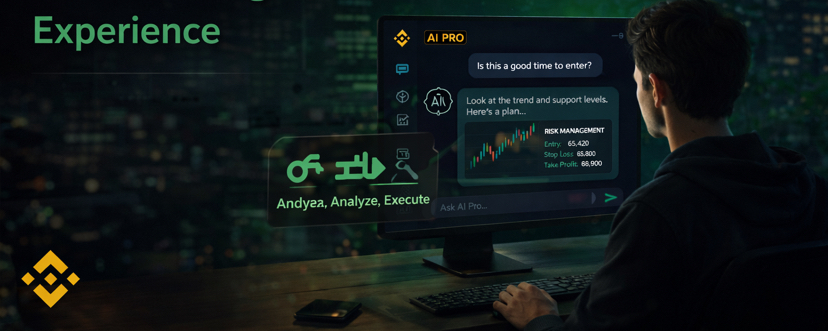
If I had to describe Binance AI Pro in one sentence, I would call it the AI-ification of the trading experience. Not because it suddenly turns trading into something effortless, and not because I think adding AI to a product automatically makes it more advanced, but because it seems to change the shape of the experience itself. The more I think about it, the less I see this as a simple trading feature and the more I see it as an attempt to redesign the interface between the user, the market, and action.
That distinction matters to me. In crypto, we are already used to tools that promise better signals, faster execution, smarter dashboards, cleaner analytics. But most of them still leave the core experience untouched. I still have to move from one layer to another: reading the market, checking risk, deciding what matters, and then finally placing a trade. Even when the tools improve, the flow often stays fragmented. And that fragmentation is not neutral. It is where hesitation grows, where conviction weakens, and where emotion quietly starts rewriting the original plan.
That is why I think the phrase “AI-ification of trading” is more interesting than it first sounds. I do not mean that AI is replacing trading. I mean it is being placed inside the experience, not just on top of it. Instead of acting as a separate analytics tool or a detached automation bot, it seems to sit much closer to the full decision loop. You ask, interpret, test, decide, and potentially execute within one connected environment. That changes more than convenience. It changes how users relate to the process itself.
To me, the real problem in trading has never been the lack of data. Traders are drowning in data. The problem is that data does not naturally become discipline. A trader can have good information and still make bad decisions, because the hardest part is often not understanding the market but acting coherently under pressure. If Binance AI Pro is worth paying attention to, I think it is because it is trying to address that behavioral gap. It takes something that used to be split across multiple interfaces and tries to compress it into a more continuous interaction.
The conversational element is probably the clearest example of this. In a traditional setup, software expects the user to adapt to its logic. Menus, tabs, indicators, parameters, order forms. A conversational layer reverses that direction. The user starts with language, not with interface discipline. That may sound superficial, but I do not think it is. Language changes access. It lowers the friction between uncertainty and inquiry. Instead of translating every thought into a rigid trading workflow, the user can start from a question, a concern, or a hypothesis. That alone makes the experience feel less mechanical and, in some ways, more human.
But the more important point is that the system does not stop at conversation. That is where this moves beyond being a chatbot attached to a trading platform. Once AI is allowed to support execution and position management, the product stops being merely informational. It starts becoming operational. And that is where I think the phrase “AI-ification” becomes useful. What is being transformed is not just the quality of analysis, but the distance between analysis and action.
I can see why that would matter in real use. A part-time trader who cannot monitor charts all day does not necessarily need a machine that promises superior returns. What they may need is a system that helps preserve the structure of their decisions when they are absent, tired, or emotionally exposed. Someone managing a volatile position may not need perfect prediction. They may need a calmer process between signal and response. In both cases, the value is not that AI knows the future. It is that it may help reduce the chaos that often appears between the first idea and the final click.
The separate AI Account is also part of this transformation, and I think people sometimes underestimate why. If AI is going to move closer to execution, it cannot feel boundaryless. The experience only becomes usable if the user feels there is still a defined perimeter of control. That separation matters because it prevents the product from feeling like full surrender. It frames AI as an operating layer with limits, not as an all-access authority. In a financial setting, that is not a minor design detail. It is part of the trust architecture.
Still, I would be careful not to confuse a redesigned experience with a solved problem. AI-ifying trading does not mean removing uncertainty, risk, or bad judgment. In fact, there is a real possibility that a smoother interface could hide complexity rather than resolve it. The more natural a system feels, the easier it becomes to overtrust it. That is one of the oldest tensions in automation. Convenience reduces friction, but it can also reduce vigilance. A product can feel intuitive and still fail under stress.
That is why I am interested in this idea, but not fully convinced by it yet. I think the direction makes sense. I think the attempt to merge dialogue, analysis, and execution into one environment addresses a real weakness in how trading tools are usually designed. But I also think the hard part begins after the interface starts looking elegant. The real test is whether this architecture can still help users think clearly when markets become fast, ugly, and emotionally punishing.
So if I call Binance AI Pro the AI-ification of the trading experience, I do not mean that as praise or as warning on its own. I mean that it seems to mark a shift in where AI is being placed. Not outside the process, but inside it. And that is exactly why it is worth thinking about carefully. The question is no longer just whether AI can assist traders. It is whether turning trading into an AI-shaped experience will actually make users better at navigating uncertainty, or simply make uncertainty feel more manageable than it really is.