
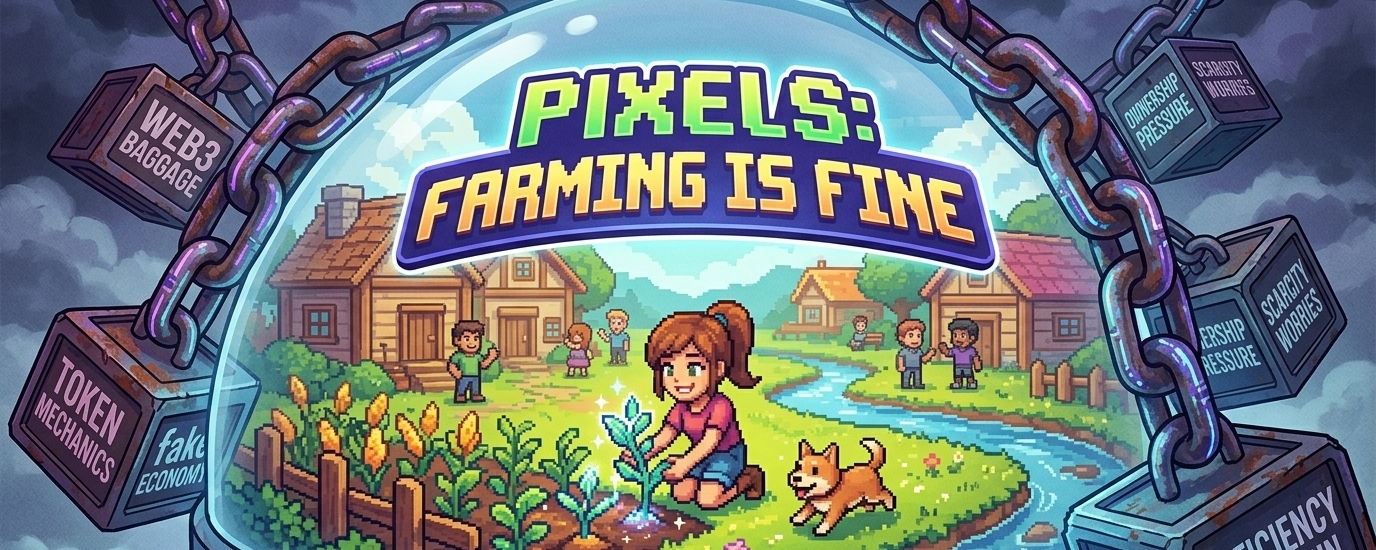
The problem is not that Pixels is a farming game. The farming is fine. The problem is that it comes wrapped in all the usual Web3 baggage, and that baggage has a way of making even decent ideas feel annoying. That is what people are tired of. Not crops. Not exploring a map. Not building up a little space over time. People are tired of every game with a token acting like it deserves applause just for existing. They are tired of being told the economy is the exciting part. It is not. The exciting part, if there is one, is whether the game gives you a reason to stay after the first hour.
That is where Pixels does better than a lot of the trash in this space. It does not instantly feel like a scam wearing pixel art. That sounds harsh, but that is the standard now. Crypto games spent so long overselling half-baked systems that just being playable already feels unusual. Pixels is built around simple stuff. Farming. Gathering. Crafting. Walking around. Meeting other players. Doing a bit more each time you log in. Nothing shocking. Nothing genius. Just basic loops that make sense. And honestly, that is the smartest choice it could have made.
Because nobody wants to learn a fake economy before they know if the game itself is worth a damn. That is where so many of these projects go wrong. They start with ownership, tokens, rewards, scarcity, all that garbage, and somehow forget that the average person still wants the game to feel good moment to moment. Pixels at least seems to understand that order matters. Let the player do things first. Let them get into a routine. Let the world explain itself through action instead of through marketing language. Crazy idea, apparently.
The farming side is solid mostly because it stays in its lane. You plant. You wait. You harvest. You collect materials. You make progress in little chunks. That is enough. It does not need to become some giant statement about the future of digital life. It just needs to be satisfying. And it mostly is. Farming games live off rhythm. If the rhythm works, people come back. If it does not, no amount of token talk is going to save it. Pixels gets that much right. It gives you enough structure that logging in feels easy. You know what you are doing. You know what comes next. That matters more than people think.
The exploring part helps too, mostly because it stops the game from feeling like a static task board. You move around. You see different parts of the world. You gather things. You run into people. You get the feeling that there is at least some life beyond your own chores. That is important. A lot of crypto games feel dead even when they technically have players. They feel like systems, not places. Pixels avoids some of that. It actually feels like a shared space sometimes. Not all the time. But enough.
And that “enough” is kind of the whole story here. Pixels is not amazing because it breaks all the rules or invents some new kind of game design. It is interesting because it avoids being insufferable more often than most Web3 games do. That sounds like weak praise, but weak praise is more honest than the usual hype. This space has been drowning in fake enthusiasm for years. It is nice to talk about something in plain English for once. Pixels works because it mostly remembers to act like a game.
Still, the Web3 part poisons the air whether people want to admit it or not. The second you attach real value, or even the idea of real value, to land, items, progression, or whatever else, the player mindset changes. Everything gets colder. A farming loop that should feel relaxing starts getting treated like a production line. People do not ask what is fun. They ask what is efficient. They do not ask how they want to build their space. They ask what will hold value. They do not explore because they are curious. They explore because they are hunting advantage. That shift wrecks the mood in almost every crypto game, and Pixels is not magically safe from it.
That is the real issue. Not the art. Not the map. Not the basic mechanics. The issue is what happens once a decent little game gets dragged into the same old logic. Suddenly players are not just playing. They are optimizing. Comparing. Hoarding. Watching prices. Thinking like part-time analysts in a world that is supposed to be soft and casual. It does not take much of that to make the whole thing feel worse. One minute you have a cute farming game. The next minute you have a bunch of people treating fake land like a retirement account.
And yeah, Pixels tries to soften that. You can tell. The art style is friendly. The world is readable. The whole thing looks approachable instead of aggressive. That helps. A lot, actually. The game is easy on the eyes. It is easy to understand. It does not come at you with that desperate “we are changing gaming forever” energy that made so many projects impossible to take seriously. It is calmer than that. More normal. Good. More games should aim for normal.
The social side also keeps the game from collapsing into pure routine. Seeing other players in the world makes even simple tasks feel a bit less empty. You notice what people are doing. You get a sense of activity. A sense of community, maybe, on a good day. Shared space matters. It always has. People like worlds that feel inhabited. They like the small proof that they are not just performing actions in a vacuum. Pixels benefits from that. Without the other players, it would probably feel much thinner.
But social worlds come with their own mess. There is always hierarchy. There are always people ahead of you, richer than you, better set up than you, more plugged in than you. In regular online games that can already be irritating. In a Web3 game it gets worse because some of that gap starts feeling financial, not just mechanical. Who got in early. Who owns what. Who has better land. Who knows how to work the system. That kind of thing can make a game feel less welcoming over time, especially for anyone who shows up late and realizes they missed the best part of the ladder.
And once that feeling sets in, the casual vibe takes a hit. Hard to feel relaxed when the world quietly reminds you that timing mattered more than taste. Hard to feel like you are building your own space when half the map already looks spoken for by people who treated the game like a market opportunity before everyone else arrived. Again, not unique to Pixels. This is just what happens when games mix progress with ownership talk. The problem is built in.
Then there is the burnout issue, which is where these games usually show their teeth. At first, the repetition feels nice. That is the hook. Check in. Harvest. Gather. Improve things a little. Maybe talk to people. Maybe explore. Fine. Good, even. But after a while, that same repetition can stop feeling comforting and start feeling mandatory. In a regular game, you can drop it for a week and whatever. In a game with asset logic hanging over it, the brain starts doing annoying little calculations. Am I falling behind. Am I wasting time. Should I be doing this differently. That is how a chill game slowly turns into a mental burden.
Pixels is in danger of that all the time. I do not mean it is a disaster. I mean it is built near the edge. Because any game that mixes routine with value has to fight against the slide from habit into obligation. Once players feel like they have to log in, the mood starts dying. Once every task feels like upkeep, the world gets less charming no matter how cute the crops look. The game has enough warmth to push back on that for a while, but the pressure is still there. You can feel it.
Ronin helps by not making the technical side even worse. That might be the least glamorous part of the whole conversation, but it matters. If the chain layer is clunky, slow, confusing, or expensive, the game is dead on arrival. Nobody wants to wrestle with infrastructure just to do basic actions in a farming game. Ronin at least lowers that friction. It makes the Web3 part less visible in the moment-to-moment experience, and that is exactly what it should do. The tech should disappear. If it is noticeable, something probably went wrong.
And honestly, maybe that is the biggest reason Pixels gets more goodwill than most. It knows when to shut up. It does not make the infrastructure the star. It lets the loop carry the experience. It lets the world do some of the work. It gives players enough actual game that they can forget, at least for stretches, that there is a whole crypto machine sitting underneath it. That is smart. Maybe the smartest thing about it.
What makes me still hesitant is that crypto games always start by saying they are different, and then eventually the same pressure creeps in. The same obsession with efficiency. The same weird social stratification. The same tendency to turn play into labor. I do not think Pixels has escaped any of that forever. I just think it hides it better because there is a real game under the surface this time. That gives it more room. More patience from players. More benefit of the doubt. But it does not erase the basic tension.
And that tension is simple. Pixels wants to be cozy and economic at the same time. It wants to be casual and valuable at the same time. It wants players to relax but also care about systems that can easily make people tense and obsessive. That is a hard balance. Maybe impossible long term. The game works best when the cozy side wins, when the world feels like a place you return to because you like being there. It gets worse when the economic side wins, when everything starts feeling like output and advantage and market positioning with cute visuals painted over it.
So I do not look at Pixels and see some final answer to Web3 gaming. I look at it and see one of the better attempts to make the whole thing feel less obnoxious. That is different. It matters. But it is different. There is an actual game here. A functional one. A social farming game that understands basic pacing, basic readability, and basic player psychology better than most of its peers. That deserves credit. At the same time, the same old crypto sickness is still in the walls. It always is.
Maybe that is the fairest way to put it. Pixels is decent despite the Web3 stuff, not because of it. The farming loop works. The shared world works. The presentation works. The game side is strong enough that it can survive carrying all that extra baggage. But the baggage is still baggage. It still weighs the whole thing down. It still changes how people behave. It still keeps the game from feeling as clean and simple as it probably could have been without all the ownership talk attached.
That does not make Pixels bad. It just makes it a good example of how low the expectations are now. If a crypto game can be playable, understandable, and not instantly exhausting, people notice. They should. It is rare. But I am not going to pretend that means the bigger problem is solved. It is not. People are still tired of being sold the future when they would settle for a game that just works and leaves them alone.
Pixels gets closer to that than most. That is probably the best thing you can say about it. Not that it is revolutionary. Not that it proves anything. Just that when you strip away the hype, there is still enough of a real game left standing. In this space, that is almost impressive.