
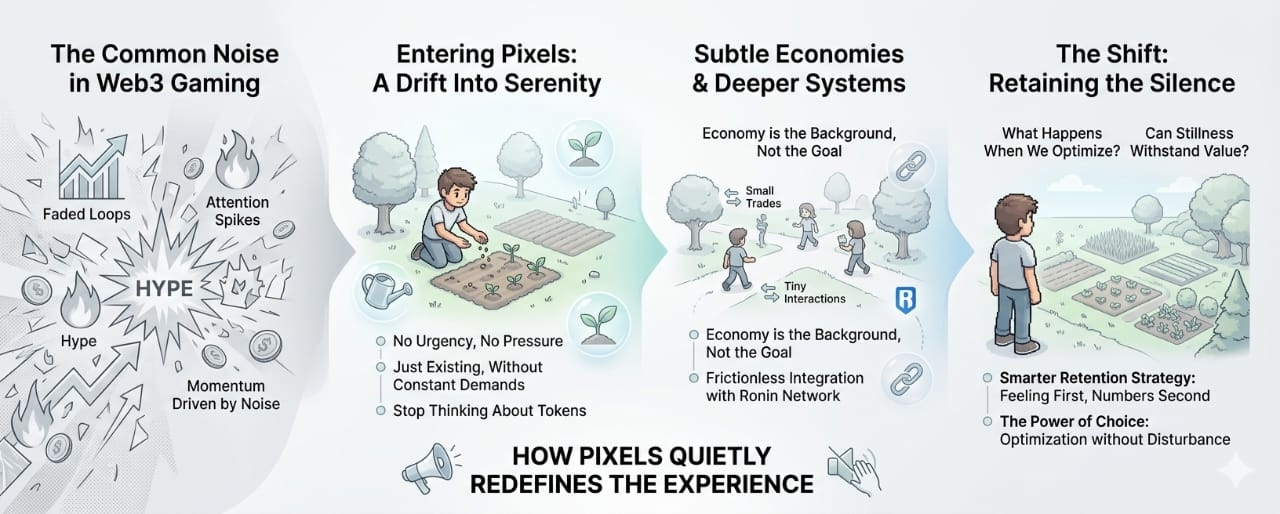
Most projects in this space start to blur together after a while. The wording changes, the mechanics sound new, but underneath it’s usually the same loop—attention spikes, people rush in, activity builds, and then slowly fades until something else takes over. It often feels like momentum is driven more by noise than by something that actually holds.
That’s the mindset I was in when I came across Pixels.
I wasn’t searching for anything. It was one of those slow sessions where charts are open but nothing’s really happening, and you’re just scrolling more out of habit than intent. The kind of time where you’re not even looking for opportunities anymore, just waiting for something to move.
Somewhere in that drift, I clicked into it.
I didn’t expect much. Honestly, I assumed I’d leave within a minute.
At first, it felt almost pointless. You plant something, walk around a bit, maybe interact with something small, then leave and come back later. There’s no urgency, no pressure, no signal telling you that you should be optimizing your time. In crypto, that’s unusual. Most things immediately try to pull you in—optimize this, earn that, don’t miss out.
Pixels doesn’t do that. It just exists.
And somehow, that’s what made me stay longer than I planned.
At some point, without really noticing when, I stopped thinking about tokens entirely. I wasn’t checking value, wasn’t calculating anything, wasn’t trying to be efficient. I was just… there. Not even in a focused way, more like something quietly running in the background of my mind.
That kind of feeling is rare, especially in Web3.
Usually, you’re aware of the system almost instantly. You can feel the structure behind everything, the incentives, the extraction layer. Here, it doesn’t introduce itself like that. It almost stays out of the way.
Then slowly, things start to reveal themselves.
You notice other players moving around. Small trades happening. Tiny interactions that don’t feel forced or designed to grab your attention. Nothing loud, nothing pushing you. Just subtle signs that something deeper is there.
And that’s when it shifts a little.
Because it doesn’t feel like the game is pulling you into an economy—it feels like you’re drifting into one without realizing it.
That’s a very different approach.
Most Web3 projects lead with value and hope you stick around long enough to care about the experience. Pixels flips that. It gives you something familiar first, something easy to settle into. By the time you even recognize there’s an economy underneath, you’re already part of it without trying too hard.
That part stayed with me.
Technically, it runs on the Ronin Network, but you barely feel it. There’s no constant friction, no reminders that you’re interacting with a blockchain every second. It just flows in the background.
And honestly, that made me think.
For years, Web3 has been obsessed with showing the tech—wallets, transactions, confirmations, everything visible like proof that it’s decentralized. Pixels feels like it’s doing the opposite. It hides the complexity instead of putting it front and center.
That sounds better in theory.
But I’m not completely convinced yet.
Because there’s always that moment. The moment when people stop casually playing and start optimizing everything. When it shifts from “this feels nice” to “how do I get the most out of this.”
That shift changes everything.
Right now, Pixels feels calm because nothing is pushing you. But the structure is still there. The token exists. The economy is real. It’s just not in your face yet.
So the question that stuck with me is simple.
What happens when people stop treating it like a place and start treating it like a system?
That’s where most Web3 games struggle. Early on, they feel alive. Open. Human. But once efficiency takes over, everything tightens. It becomes more mechanical, more calculated, less natural.
Pixels, right now, feels like a space.
You don’t enter with a plan. You don’t feel behind. You just move around, do small things, and somehow that’s enough. It builds a kind of quiet connection instead of forcing engagement.
But in crypto, spaces don’t stay soft forever. Value has a way of pulling attention toward optimization. It always does.
So I’m sitting somewhere in between two thoughts.
One part of me thinks this is a smarter direction. Let people settle in first. Let them feel something before you show them the numbers. That alone could solve a lot of the retention problems we’ve seen in Web3.
But another part of me wonders if this calm only exists because we’re still early.
Because once people start chasing efficiency, the whole feeling might change.
Still… I can’t ignore how it felt in that first hour.
No pressure. No urgency. No constant reminder of profit.
Just something simple that didn’t ask anything from me.
And in a space where everything is usually trying to grab your attention as fast as possible…
that silence felt louder than anything else.
