

what keeps a virtual world alive is rarely the size of its map. It is the logic underneath it
I keep coming back to that idea when i look at @Pixels The project is not simply asking players to farm, build, and collect rewards. It is asking them to participate in a functioning economy where land has purpose, crops have value, animals have utility, and energy becomes the hidden force that connects all of it. That matters because most blockchain games have historically failed at the same point… they create incentives to enter, but not reasons to stay. They can attract attention quickly. They struggle to earn trust slowly.
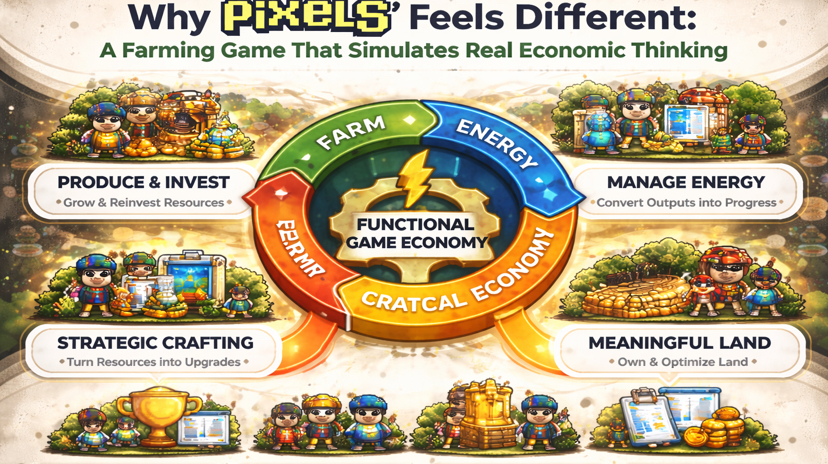
Pixels feels different because it treats gameplay as a system, not a slogan. The loop is not built around speculation first and fun later. It is built around productivity. A player grows crops, raises animals, harvests outputs, converts those outputs into energy, and uses that energy to expand craft build and progress. On paper that sounds simple. In practice, it creates a layered economy where every action has an opportunity cost, every upgrade changes future efficiency, and every plot of land becomes part of a larger chain of production.
That is the real story here.
Pixels is not just a farming game with blockchain elements attached. It is a simulation of how value moves through a small economy.
At the center of the design is a loop that feels almost agricultural in the old economic sense: produce, reinvest expand and repeat. Crops are not just cosmetic assets. They are inputs. Animals are not just collectibles. They are part of a living production structure. Energy acts as the conversion layer between work and progress, between harvesting and building, between routine maintenance and long-term expansion. I think this is where Pixels shows real product intelligence. It understands that a game economy becomes interesting only when the player has to choose between immediate extraction and future growth.
That tension is what gives the world structure.
If every resource were abundant, there would be no strategy.If every resource were scarce without purpose, there would be only frustration. Pixels sits in the narrow space between those extremes
. Energy becomes the currency of decision-making. Do you spend it now to accelerate a build, or conserve it to sustain a larger cycle later? Do you optimize for fast returns, or for compound efficiency? These are not abstract questions. They become visible in how players manage land, schedule harvests, and plan their next upgrade path.
This is where the game starts to resemble an economy more than a typical game loop. And economies, unlike simple reward systems, produce behavior.
Players do not just follow rules in Pixels.
They adapt to incentives. They specialize. They collaborate. They compete. Some will focus on efficient crop rotation and steady energy generation. Others may seek short-term gains through resource timing or market behavior. Over time, these preferences create a player society with distinct roles, not just a crowd of identical participants.
That matters because long term retention in blockchain games depends less on token excitement than on identity formation. People stay when they feel competent. They stay when they become good at something.its core mechanics are not designed to make everyone rich. They are designed to make everyone engaged. That is a much harder problem, and a much more durable one.
The strength of the model is also in how clearly it links ownership to function. In many games, land is symbolic. In Pixels, land is productive. A plot is not just a place on a map….it is an operating asset. Every pixel carries meaning because it can support activity.When ownership is tied to use, the world becomes harder to dismiss as speculative noise. It begins to look like infrastructure.
I think this distinction is crucial. A lot of Web3 games confuse scarcity with depth. They make things rare and assume rarity alone creates value. But value in a real system comes from utility, coordination, and repeat use. Pixels leans into that truth. Land matters because it does something.
Energy matters because it enables something else. Crafting matters because it turns raw production into higher-order capability. The result is a loop with a real internal logic, not just a set of incentives stapled together.
Of course, no economy is self-sustaining by default. It has to balance production against sink, access against advantage, and growth against congestion. That is where the design becomes more interesting. If energy flows too easily the game risks inflation in progress and a loss of meaningful decision-making. If energy is too restrictive the world slows into friction and players feel trapped inside their own assets.
The best economic systems are not the most generous or the most brutal. They are the ones that preserve tension without exhausting the player.
Pixels seems to operate with that balancing act in mind. The goal is not to remove friction entirely. The goal is to make friction meaningful. Harvesting is work. Building has cost. Expansion requires planning.
Those constraints are not flaws. They are what give the game a sense of weight. Without them, every upgrade would feel disposable. With them, each action carries a trace of consequence.
There is also a subtle but important social layer here. Systems like this do not only shape individual progression. They shape cooperation and rivalry. Energy can become a shared opportunity. Players can collaborate on builds, coordinate resource flows, or help each other scale more efficiently. At the same time, the same economy can produce competition over scarce assets, faster production cycles, or better resource positioning. That duality is healthy. A world feels alive when it supports both mutual dependence and strategic tension.
And i have seen many game economies fail because they only reward extraction. Players learn to take, not to build. Pixels pushes in the opposite direction. It rewards creation as much as collection. That changes the emotional texture of play. There is a difference between farming for a payout and farming for expansion. One is transactional. The other is cumulative. One ends when the reward arrives. The other keeps unfolding.
The bi-weekly addition of new industries strengthens this effect. Static economies decay quickly because players solve them. Once the optimal path is discovered, the game becomes a routine rather than a living system. Frequent industry updates keep the economy unsettled in the best possible way. They reopen strategy. They reset assumptions. They force players to adapt rather than memorize. That is not just content cadence. It is systemic renewal.
From a design perspective, this is one of the smartest things a game like Pixels can do. New industries are not merely new features. They are new pressure points. They change how energy is valued, how land is used, and how players think about specialization. A player who mastered one production path may suddenly need to re-evaluate the entire chain. That creates a sense of motion without depending entirely on narrative events or cosmetic updates. The economy itself becomes the live content.
There is a deeper lesson here about blockchain-backed worlds. The technology becomes meaningful only when it supports behavior that would otherwise be difficult to preserve. Ownership matters when it is attached to utility. Trading matters when assets have real roles in production. Interoperability matters when the player experience is smooth enough that friction does not overwhelm strategy♟️. Pixels’ use of Ronin reflects that principle. A seamless environment for land and NFT interactions is not a technical footnote. It is part of the experience architecture. If ownership is meant to feel real, the act of using it has to feel natural.#pixel
That is one of the less-discussed failures of early play-to-earn design. It often asked users to perform economically sophisticated actions inside clumsy systems. The mismatch was fatal. Players do not stay in worlds that make basic interaction feel like administration. Pixels seems to be trying to fix that by making the productive loop feel native to play. The system should disappear into the experience. The player should feel the economy without feeling burdened by it.
Still, there are trade-offs. A self-sustaining universe is never perfectly self-balancing. The more productive an economy becomes, the more important it is to watch for concentration. Players with more land, more energy, or better timing can accumulate structural advantages. That can be motivating for ambitious players, but it can also create distance between early participants and later entrants. The challenge is not to eliminate inequality. In a game economy, some asymmetry is inevitable and even desirable. The challenge is to keep mobility alive. New players need a believable path to relevance.
That is why systems like crafting, energy management, and industry refreshes matter so much. They create multiple routes into the economy. Not everyone needs to win the same way. Some players will optimize throughput. Others will trade. Others will specialize in land efficiency or expansion strategy. A healthy virtual economy does not force uniformity. It rewards competence in different forms.
What stands out to me most is that Pixels appears to respect player intelligence. It does not treat the audience as passive recipients of rewards. It treats them as managers of systems. That is a much more demanding design philosophy, but it is also a more durable one. Players who understand a system tend to return to it. Players who merely exploit a reward tend to leave once the reward weakens.
In that sense the energy economy is doing more than powering progression. It is teaching the player how to think inside the world. Harvesting becomes planning. Crafting becomes conversion. Land management becomes strategy. Expansion becomes a question of timing and resource discipline. The game’s depth comes from the fact that each layer affects the next. Nothing exists in isolation.
That is why Pixels deserves to be understood as more than a blockchain farming game. It is an experiment in making digital ownership functional, not decorative. It is an attempt to build a world where every productive action feeds the next one, and where the economy is not a side system but the heart of the experience. The promise is not infinite growth. That would be unrealistic. The promise is something more interesting: a world where players can build, adapt, and persist within a loop that remains understandable, expandable, and human.
That is a rare design target. And when it works, it changes the feeling of the entire game.
The strongest economies are not the loudest ones. They are the ones that keep giving players a reason to return, refine, and reinvest. Pixels seems to be aiming for exactly that. Not spectacle. Not noise. A living system with enough depth to reward💳 attention, and enough flexibility to keep evolving as the world around it changes.