If you still see @Pixels as a simple farming game, you’re only scratching the surface.
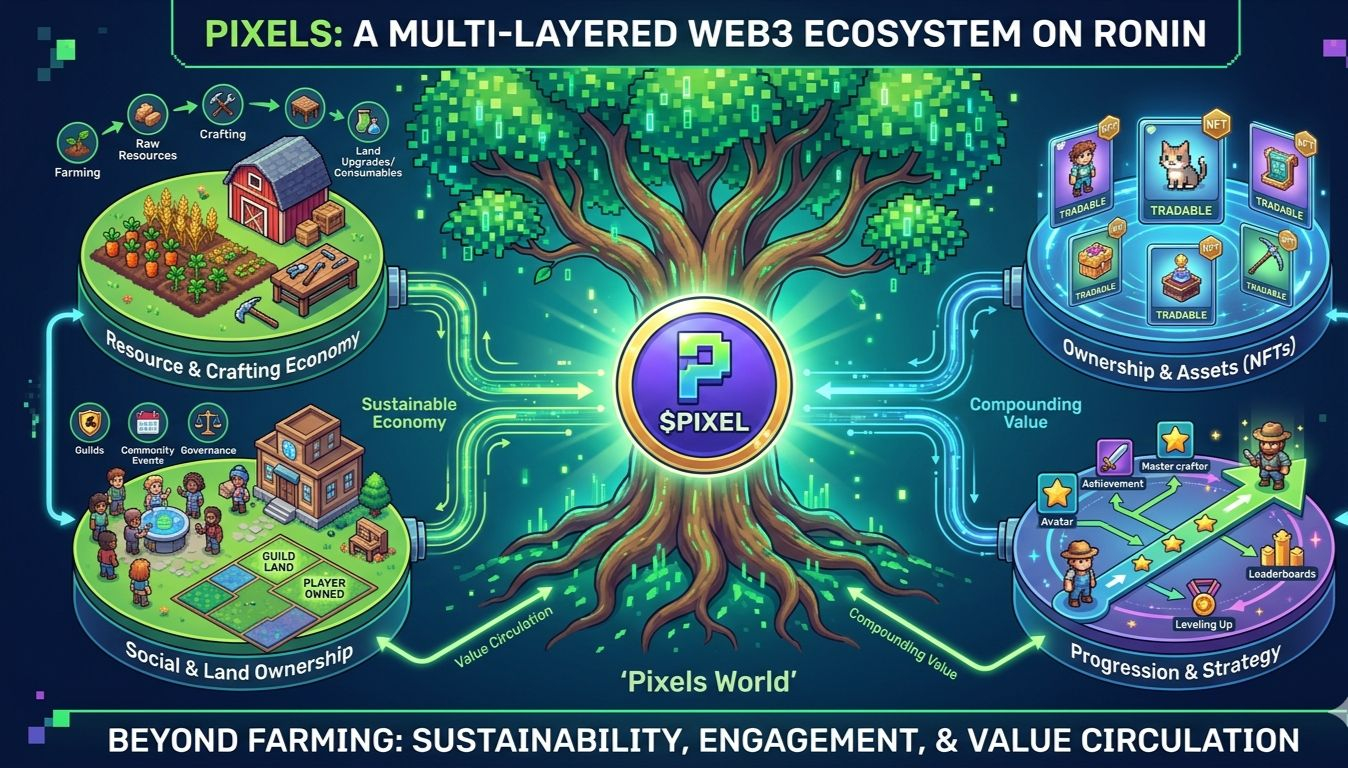
At its core, Pixels is a social Web3 world built on the Ronin network where players farm, craft, explore, and interact but what makes it powerful is how every layer connects into a larger system.
This isn’t just gameplay. It’s infrastructure.
The $PIXEL token sits at the center of everything. It’s not a passive reward it actively powers NFT minting, premium features, guild access, and eventually governance decisions.
That means the more players engage, build, and trade, the more meaningful the token becomes.
But the real innovation shows up when you look at what many overlook the “stacked” nature of the ecosystem.
Pixels isn’t relying on a single gameplay loop. Instead, it layers multiple systems together:
A resource economy driven by farming and crafting
A social layer through guilds and shared land ownership
An ownership layer via NFTs and tradable assets
A progression layer where time, skill, and strategy matter
Each layer feeds the others. Farming creates resources. Resources fuel crafting. Crafting supports trade. Trade strengthens the economy. And the entire loop flows back into $PIXEL
This is what makes Pixels different from typical GameFi models.
Instead of focusing purely on extraction (play-to-earn), it leans toward sustainability encouraging players to participate because the world itself is engaging, not just profitable.
And that’s a subtle but important shift.
Because long-term ecosystems aren’t built on rewards alonethey’re built on systems that people actually want to stay in.
Pixels feels like it understands that.
It’s building a world where value isn’t just generated it’s circulated, layered, and compounded over time.
That’s what a real Web3 game economy looks like.