
I’ll be honest what changed my mind was the moment I realized this wasn’t just another routine. I started taking Pixels more seriously the day I realized I could see the whole casual player angle without owning land, buying a big NFT, or pretending I had endless time. I was just checking in, half expecting the usual Web3 friction, and then it clicked. The part that changes the experience for casual players is not some flashy reward mechanic. It’s that free to play users can still join guilds and get access to higher tier resources through the guild setup. That matters way more than people think, because it lowers the gap between curiosity and actual progress. Pixels also says Chapter 2 is still playable for free users and that land is not required, which is exactly the kind of design choice that decides whether a game becomes a routine or just another wallet connected novelty. 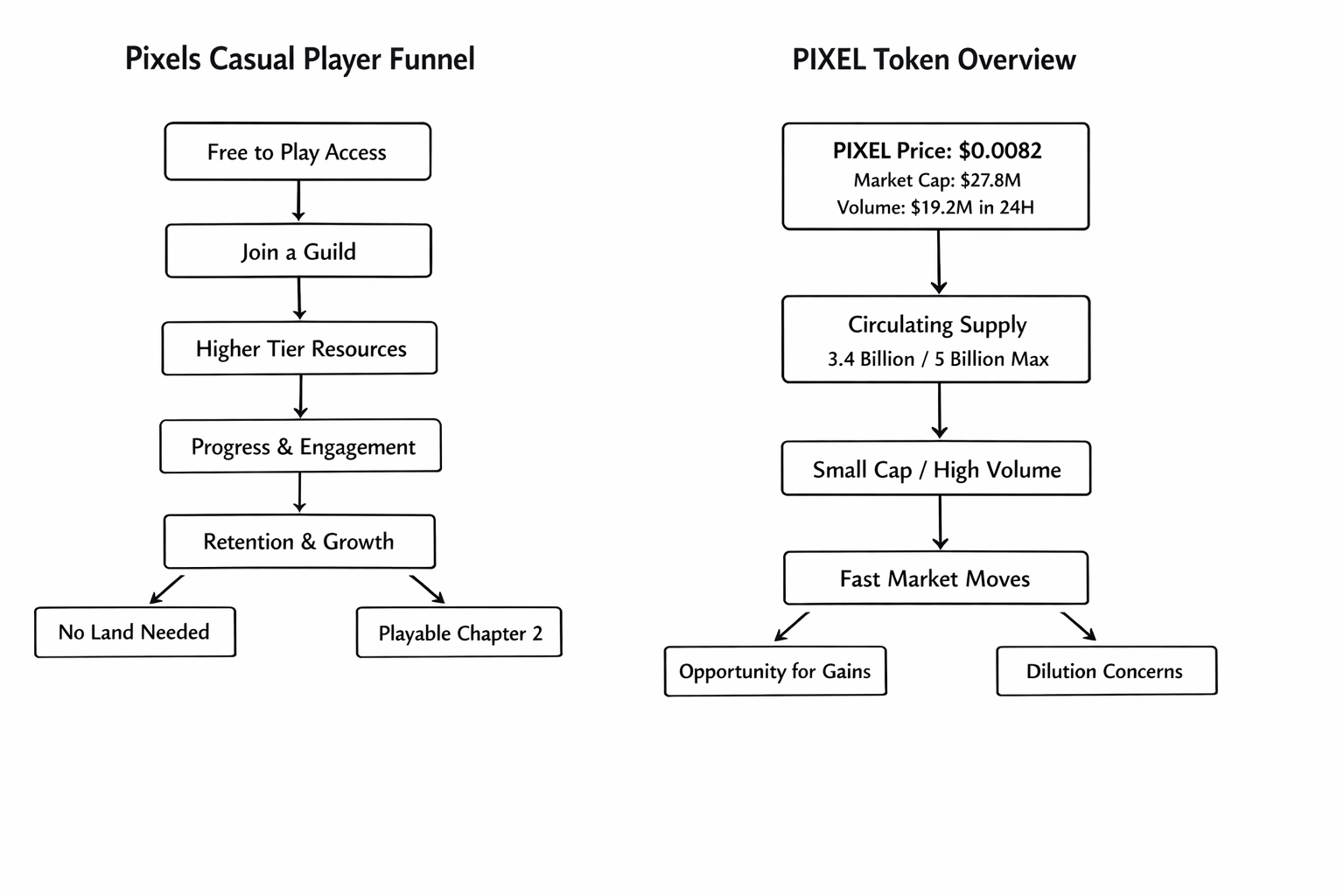 For traders, that feature matters because accessibility is not just a player issue. It’s a retention issue. A lot of GameFi projects lose casual users right at the point where the system starts asking for commitment before the player has built any habit. Pixels is trying to avoid that trap. If a new or low commitment player can log in, join a guild, touch better resources, and feel actual progression without needing land first, the funnel gets wider and the early drop off should be lower. Think of it like letting someone use a gym with decent equipment before asking them to buy the annual membership. You still need them to come back, but at least you gave them a fair shot to feel the value first. Now look at the token side. PIXEL is trading around $0.0082 today, with a market cap near $27.8 million, 24 hour volume around $19.2 million, and a circulating supply around 3.4 billion out of a 5 billion max supply. CoinMarketCap is in the same range, showing about $27.9 million market cap, roughly $19.4 million in 24 hour volume, and about 3.38 billion circulating. That tells me this is still a small, very tradable market where flows can move price fast, but conviction is still fragile. When daily volume sits so close to market cap, it usually means attention is active, but it doesn’t automatically mean holders are deeply committed. Traders are here. Long term certainty is not. That’s where the bull case gets interesting. If Pixels can keep making casual players feel useful inside the world, not just tolerated, then guild linked free to play access becomes more than a quality of life feature. It becomes part of the project’s defense against the Retention Problem. More users staying active means more demand for progression, social coordination, and in-game status loops. Pixels is still pushing the broader free to play angle on its official site, and Chapter 2 added more recipes, tiered industries, faster production times, skill changes, and more core loop depth. In plain English, the game has been trying to give people more reasons to log back in than just token rewards. That’s the right direction. But I’m not blindly sold. Here’s the tradeoff that keeps me cautious. Guild access helps casual players, but it also means the project has to keep social structures healthy. If guilds become too gated, too extractive, or too dependent on a few organized players, casual users can still get pushed to the edge even if the system looks open on paper. There’s also token pressure to think about. A 5 billion max supply against roughly 3.38 to 3.4 billion already circulating means dilution is not a theoretical problem you can ignore. And if the player routine weakens, small-cap liquidity can turn from a strength into a trap very quickly. Fast volume cuts both ways. So yes, I think Pixels is worth watching right now, but not because I expect magic from the chart. I’m watching because the guild-enabled free to play design feels like one of the few practical answers to the casual player problem, and casual players are usually the ones that decide whether a game economy breathes or stalls. If you’re trading PIXEL, don’t just watch candles. Watch whether Pixels keeps making it easier for normal players to stay in the loop without feeling second class. That’s the kind of detail that quietly decides what survives when the market stops being generous. Ultimately, the real test is will the casual players come back?

مقالة
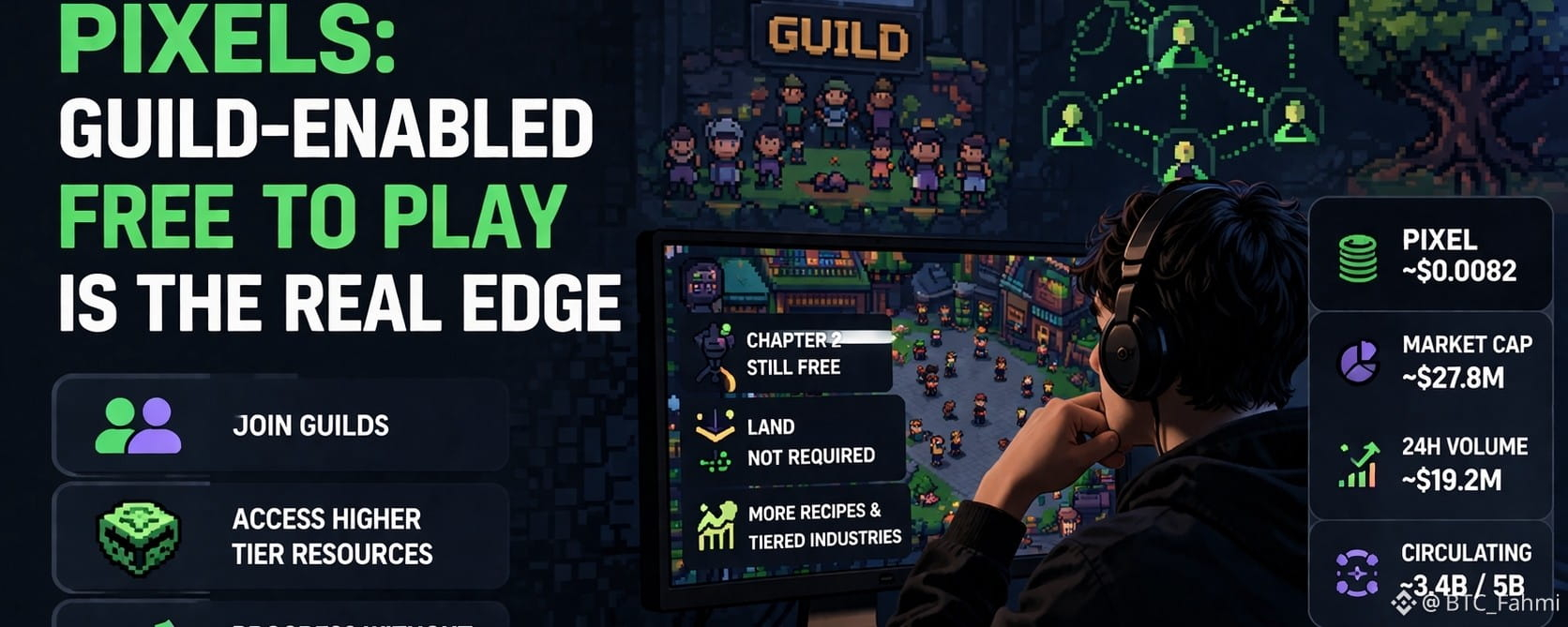
The One Feature in PIXELS That Changes Everything for Casual Players
إخلاء المسؤولية: تتضمن آراء أطراف خارجية. ليست نصيحةً مالية. يُمكن أن تحتوي على مُحتوى مُمول. اطلع على الشروط والأحكام.