
In a market driven by attention, the loudest projects usually win — at least temporarily.
But every cycle, a few quiet systems emerge that don’t rely on noise. They rely on structure.
Pixels appears to be one of them.
This isn’t a claim about price or short-term upside.
It’s an observation about behavior, design, and sustainability — three things most GameFi models struggle to align.
🎮 The Core Problem GameFi Still Has
GameFi has never had a discovery problem.
It has a retention problem.
Projects can attract users through incentives, airdrops, or speculation.
But once the rewards slow down, so does the activity.
This creates a fragile loop:
Users come for profit
Extract value
Leave when incentives drop
What’s left behind is not a game — it’s an empty economy.
🧠 Where Pixels Feels Different
Pixels doesn’t try to immediately solve this with bigger rewards.
Instead, it leans into something more difficult:
👉 Making users stay without forcing them to
The gameplay loop, while simple on the surface, encourages:
Repetition with purpose
Social interaction
Gradual progression
This matters more than it seems.
Because when users stay for the experience, not just the rewards,
the economy starts to stabilize naturally.
💰 $PIXEL and the Question of Real Demand
Most GameFi tokens fail one key test:
Would the token still be used if speculation disappeared?
In many cases, the answer is no.
With Pixels, early signals suggest a different direction.
$PIXEL isn’t just a reward mechanism — it’s being integrated into actual in-game actions.
That doesn’t guarantee success.
But it changes the foundation.
Instead of: Token → Incentive → Exit
It starts to look like: Gameplay → Need → Token Usage
That shift, if sustained, is where long-term value is created.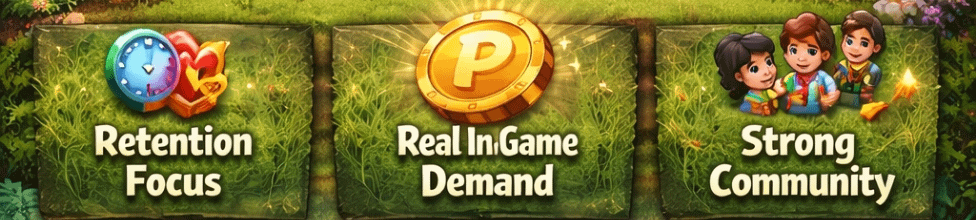
🌱 Community as a Leading Indicator
Metrics can be manipulated.
User numbers can be inflated.
But behavior is harder to fake.
Pixels shows signs of:
Consistent player activity
Organic interaction
Ongoing engagement beyond incentives
These are subtle signals — but they often appear before broader market recognition.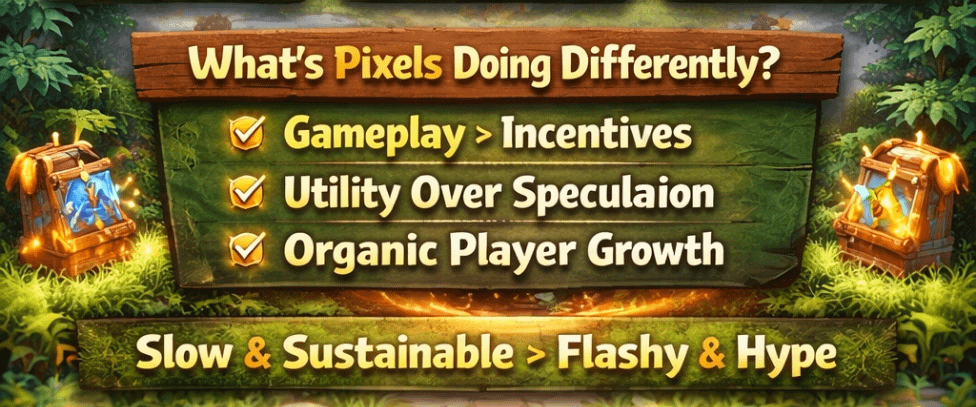
📉 The Risk Most People Ignore
Ironically, the biggest threat to GameFi isn’t failure.
It’s the illusion of success.
Artificial activity, unsustainable rewards, and short-term hype can make a project look strong — until it isn’t.
Pixels doesn’t currently present itself that way.
It feels slower. More grounded.
And in this space, slow is often misunderstood.
👀 Final Thought
Pixels isn’t trying to dominate headlines.
It’s trying to build a system that works — even when attention fades.
That doesn’t make it guaranteed to succeed.
But it places it in a different category than most.
Not hype-driven.
Not purely speculative.
Just… quietly compounding.
And in markets like this,
those are often the projects worth watching first. #pixel @Pixels
