
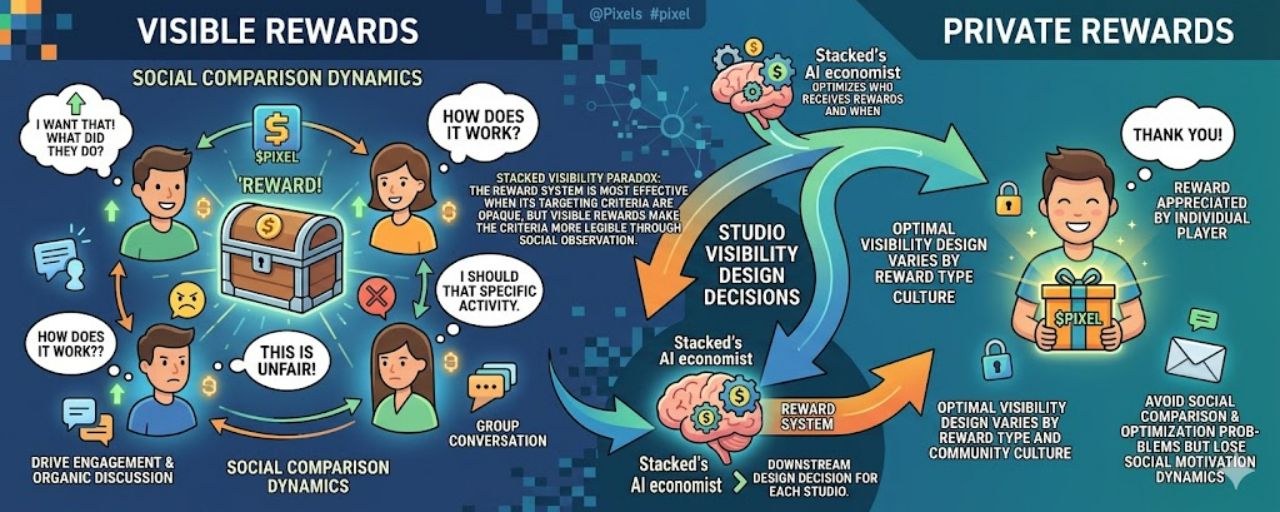
When a player receives a reward, two things happen: the reward is delivered, and a
social fact is created. Whether that social fact is visible to other players, and what form
it takes when it is, shapes the community dynamics of the game in ways that the
targeting and timing of the reward system don't account for.
Stacked's AI economist optimizes who receives rewards and when. It doesn't, by
default, address whether rewards are visible to the community and what the visibility
design implies for social behavior within the game. That's a downstream design
decision for each studio. But it's consequential enough that understanding the social
dynamics of reward visibility is important for evaluating how Stacked-powered reward
systems affect game communities over time.
Visible rewards — rewards that other players can see, either through explicit
announcements or through visible in-game items or status — create social comparison
dynamics. When a player sees that another player received a reward, several things
can happen. They can be motivated — "I want to earn that too, what did they do?" —
or they can be frustrated — "they got that and I didn't, the system is unfair." They can
be curious — "how does the reward system work?" — or they can be calculating — "I
should do whatever generated that reward."
The motivation and curiosity responses are good for game health. They drive
engagement and create organic discussion of the game's reward structures. The
frustration and calculation responses can harm game health. Visible rewards that
appear to some players and not others without clear criteria create perceived
unfairness. And visible rewards where the criteria are legible drive the optimization
behavior that Stacked's behavioral targeting is specifically designed to defeat: players
who see that specific behaviors trigger rewards will perform those behaviors for the
reward rather than for genuine engagement.
This is the Stacked visibility paradox: the reward system is most effective when its
targeting criteria are opaque, but visible rewards make the criteria more legible
through social observation. A player who sees their neighbor in the game receive a
reward after completing a specific activity draws an inference about what generated
the reward. If enough players share their reward experiences in community forums,
the behavioral targeting effectively becomes transparent through collective
observation.
The design response to this paradox is reward delivery design that obscures the
connection between specific behaviors and specific rewards while maintaining the
player's sense that the reward is recognition rather than luck. This requires rewards to
be framed in terms of overall engagement quality rather than specific actions,
delivered with messaging that emphasizes the general quality of participation rather
than a checklist of triggers, and distributed with enough variance in timing and
magnitude that the pattern is difficult to reverse-engineer from community
observation.
Private rewards — rewards delivered without any public announcement — avoid the
social comparison and optimization problems but lose the social motivation dynamics.
A private cash reward or gift card doesn't create community discussion, doesn't drive
other players to engage more in hopes of receiving similar rewards, and doesn't
generate the social proof effect where visible rewards signal to the community that
the game values its players.
For player communities where social dynamics are a primary retention driver — where
players stay as much for the community as for the game — private rewards are
missing an opportunity. The reward is received and appreciated by the individual
player but doesn't contribute to the community's sense that participation is
recognized.
The optimal visibility design probably varies by reward type and by player community
culture. A community where social competition is a primary engagement driver
benefits from visible status rewards. A community where privacy and individual
progress are valued benefits from private reward delivery. A community in the early
stages of formation, where the social norms are still being established, has different
visibility needs than a mature community with established culture.
Whether Stacked's platform provides studios with reward visibility design tools — not
just the targeting and delivery mechanism but the social framing of reward delivery —
determines how much the platform can support the social dynamics of the game
communities it powers. The behavioral targeting is the core capability. The social
design is the layer that determines whether the targeting produces a healthy
community or an optimized but antisocial player base.
The social reward visibility design is also the place where Stacked's platform can add
value beyond targeting and delivery infrastructure. If the team develops community
reward design playbooks — tested approaches to reward visibility that build
community health without triggering the optimization or unfairness dynamics — that
expertise is as valuable to a studio as the AI economist's targeting capability. Game
communities are complex social systems. The behavioral science of what makes
reward systems feel fair, motivating, and community-building is a domain where
practical accumulated experience is rare and valuable. Sharing that experience
through design guidance is a competitive differentiator that no purely technical
platform can easily replicate.
@Pixels $PIXEL #pixel
