
I’m watching, I’m waiting, I’m looking at how people move through Pixels without rushing to define it. I’ve seen games like this before—or at least I thought I had. Simple loops, soft visuals, farming cycles that feel familiar. Social layers that promise more than they deliver. But this one holds my attention in a quieter way. I focus less on what it claims to be and more on how it actually feels when no one is explaining it.
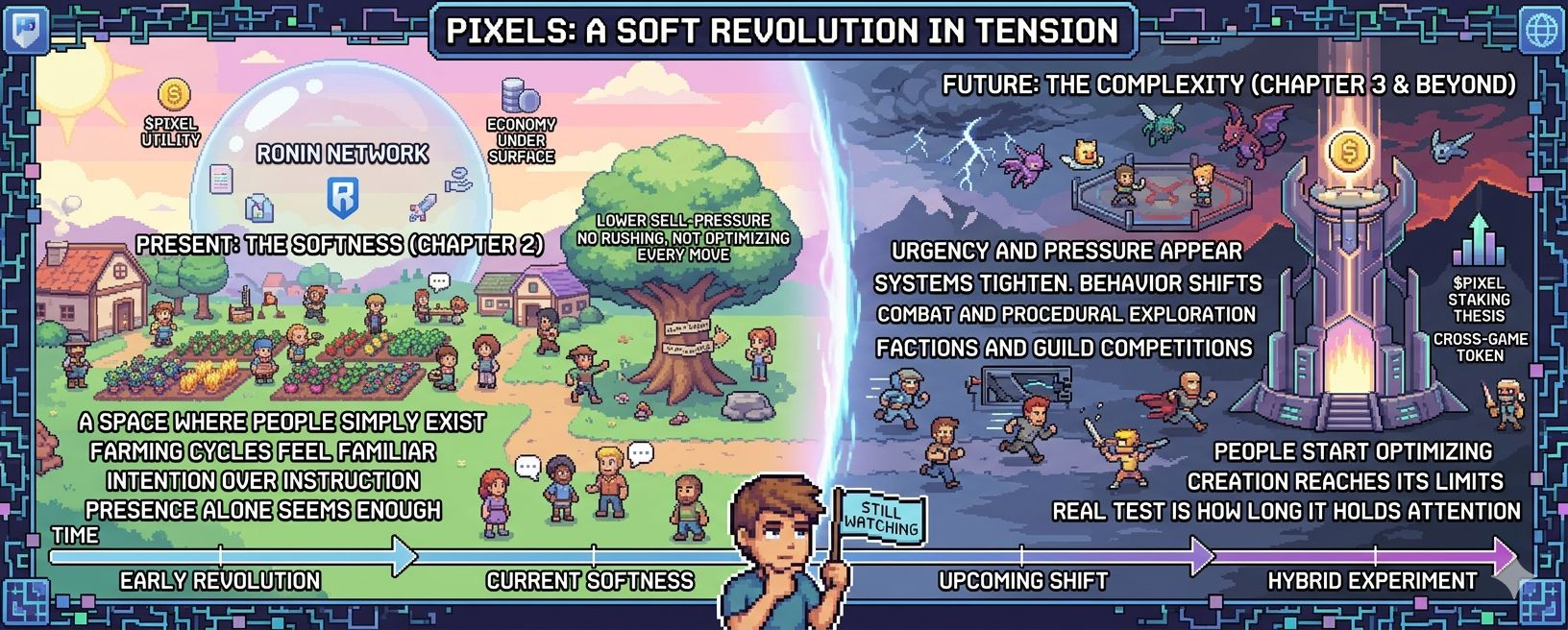
At first glance, it leans into comfort. There’s land, crops, movement that feels light and unforced. It runs on the Ronin Network, which naturally brings certain expectations—ownership, tokens, some kind of economy beneath the surface. But instead of feeling like a system pushing for efficiency, it often feels like a space where people simply exist. Not rushing. Not optimizing every move. Just spending time.
What stands out is how players behave when there’s no pressure. Some are farming, but not like they’re chasing maximum output. Others are just walking around, pausing, interacting in small ways that don’t seem driven by reward. It doesn’t feel competitive. And that’s where the uncertainty begins. Because in most Web3 environments, pressure eventually appears. Systems tighten. Behavior shifts. People start optimizing. Here, that shift feels slower—at least for now.
There’s a quiet tension between what the game allows and what players choose to do. The mechanics are there, clearly built, but they don’t immediately control behavior. That creates a space where intention matters more than instruction. Some treat it like a game. Others treat it like a habit. And some seem to be in between, still figuring out what this world actually wants from them.
I keep noticing that middle group. They log in, they explore, they interact—but there’s hesitation. Not confusion, just caution. Like they’re waiting to see if this world becomes deeper over time, or if it slowly flattens into repetition.
Because that’s where everything is decided—over time. Farming can feel calming at first, almost meditative, but it can also become invisible. Exploration feels open until it starts repeating. Creation feels meaningful until it reaches its limits. The surface works well, but the real test is how long it holds attention.
So far, it doesn’t feel overloaded. It doesn’t feel like it’s collapsing under too many systems. Instead, it feels like something that hasn’t fully decided how complex it wants to be. The layers exist, but they don’t demand attention all at once. That restraint is noticeable. It feels less like a finished product and more like something still unfolding.
The social side is there too, but it’s not forced. People interact, but not in a heavily structured or gamified way. It feels lighter than expected. Conversations happen naturally, without needing to be rewarded. For now, presence alone seems enough.
Still, the underlying system is always there—the token, the economy, the idea of value beyond the game. Even when it’s quiet, it exists. And eventually, systems like that tend to shape behavior more strongly. The real question is whether Pixels can keep its current softness once those pressures become more visible.
Right now, it feels like people are testing it rather than fully committing. And maybe that’s not a bad thing. It creates a low-pressure environment where you don’t have to believe in it completely to stay. You just have to not feel pushed away.
I keep coming back to that feeling—nothing is forcing me to act, nothing is demanding urgency. It’s just there, existing quietly, letting people decide what it becomes.
And I’m still watching. Not because I’m convinced, but because it hasn’t fully shown what it wants to be yet.