
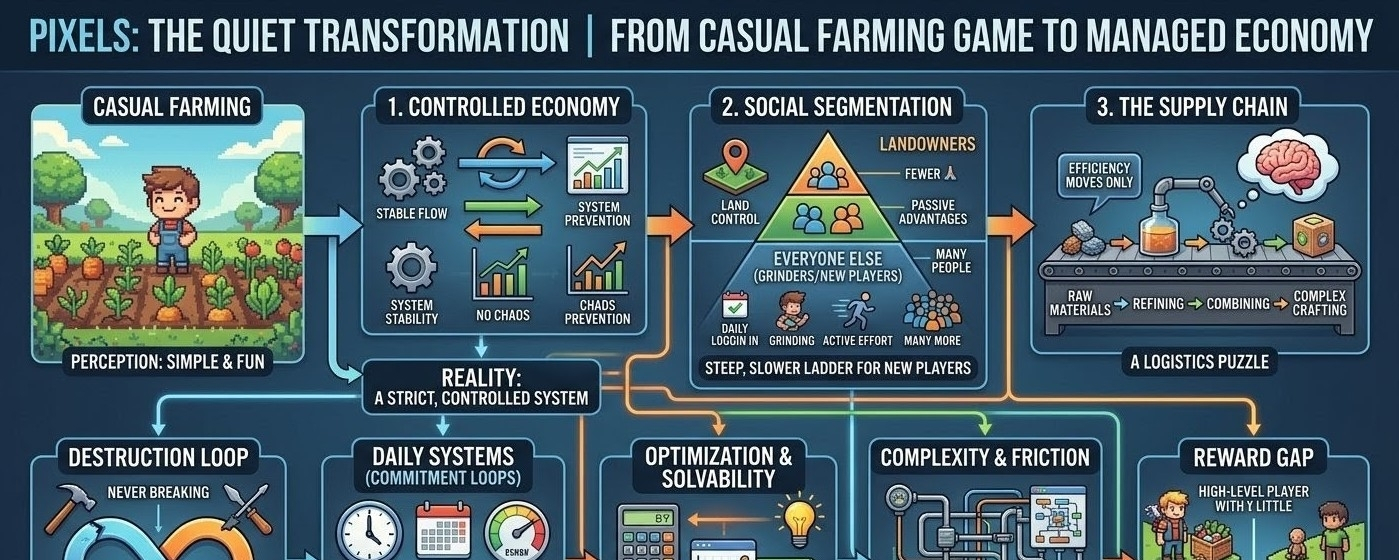
Pixels doesn’t really act like a “casual farming game” anymore. It still looks like one, sure. Cute crops, simple loops, easy to pick up. But once you spend real time in it, you start noticing something else underneath.
It’s not just a game. It’s a system.
And honestly, a pretty strict one.
Look, here’s the thing. PIXELS has slowly turned itself into a controlled economy. Everything feeds into something else—resources, crafting, progression, even how often you log in. It’s all connected. That’s not accidental. The developers clearly want stability. No chaos, no runaway inflation, no broken markets.
From a design standpoint? That’s smart.
From a player standpoint? That’s where things get tricky.
Let’s talk about the power structure, because people don’t call this out enough.
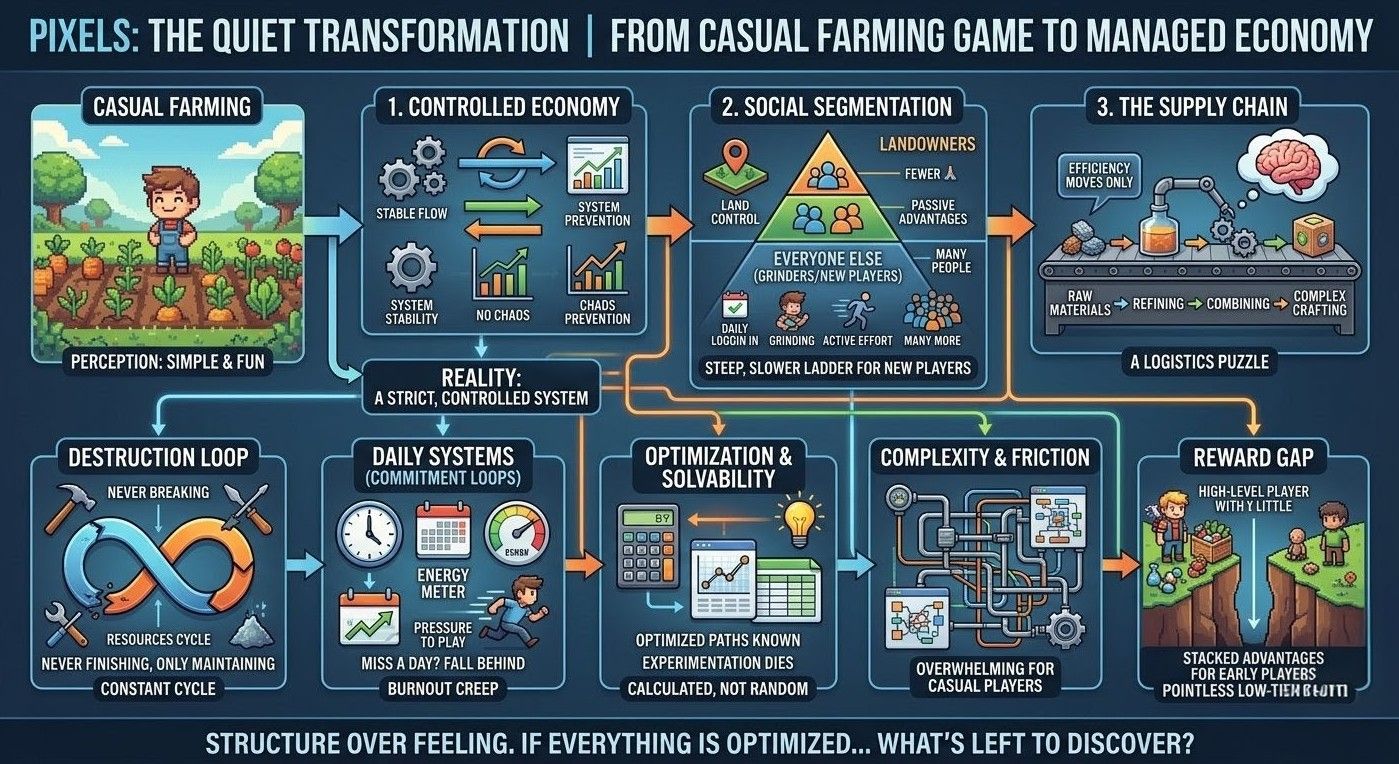
You’ve basically got two groups: landowners and everyone else.
Landowners sit in a very comfortable position. They control land, which means they control production. They’ve got access, scale, and in many cases, passive advantages. Then you’ve got the rest of the players the ones logging in daily, grinding, farming, crafting, doing all the active work.
That’s Social Segmentation, whether the game calls it that or not.
And yeah, I’ve seen this before. It starts subtle, then it becomes the whole game.
Because once ownership matters more than effort, the experience splits. New players aren’t climbing the same ladder as early players. They’re climbing a different one. Slower. Steeper.
That gap doesn’t feel great.
Now layer in the supply chain. This part’s actually kind of impressive, not gonna lie.
Nothing in PIXELS is just “pick up and use.” Everything feeds into something else. You gather raw materials, refine them, combine them, craft something more complex. And then that thing probably feeds into another recipe.
It’s deep. It’s structured.
But yeah… it’s also a lot.
A new player isn’t just farming anymore they’re learning a mini production network. And once you understand that system, your brain shifts. You stop asking, “What do I feel like doing today?”
You start asking, “What’s the most efficient move right now?”
That’s a different mindset entirely.
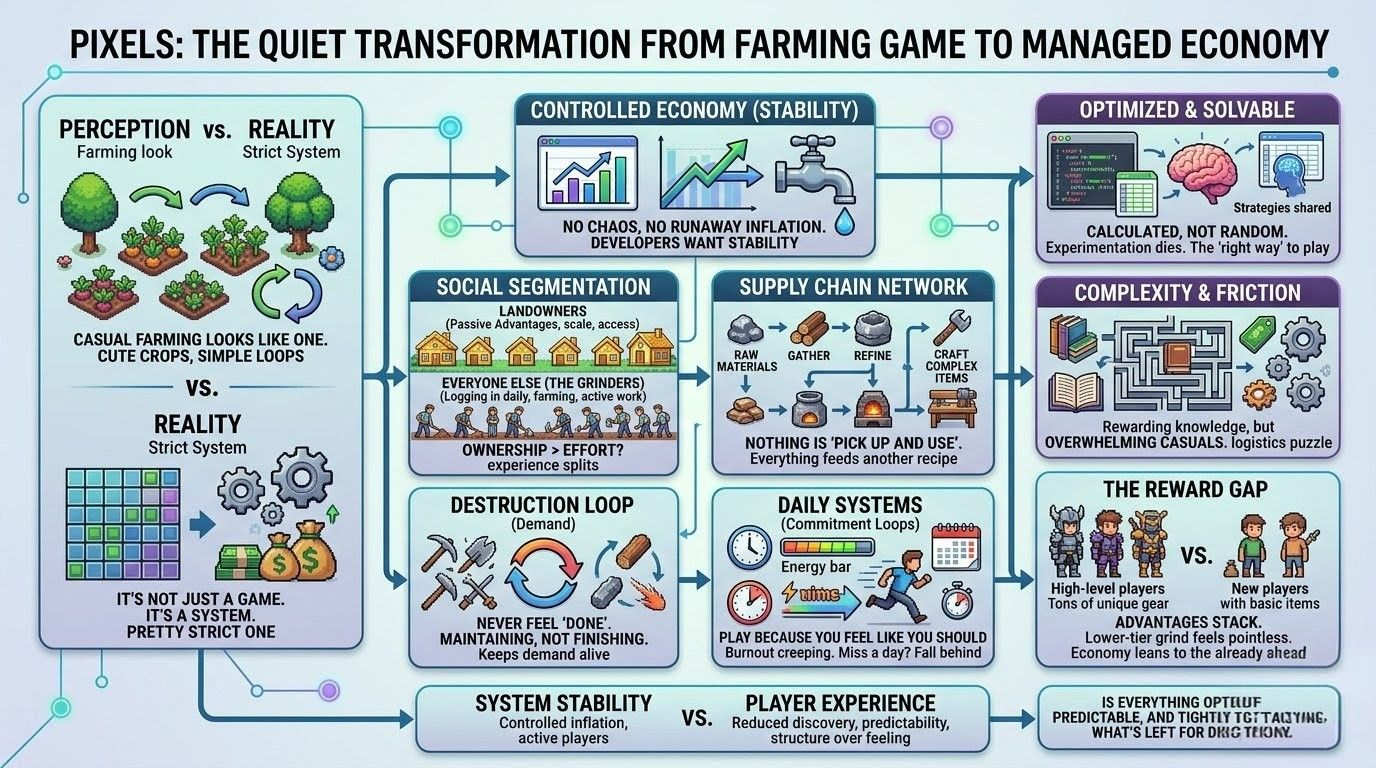
And then there’s the Destruction Loop. This is a big one.
Nothing really lasts in PIXELS. Tools break. Items get consumed. Resources disappear into crafting. You’re always rebuilding, always replacing, always cycling.
From an economy angle, it works. It keeps demand alive. It prevents everything from piling up and becoming worthless.
But let’s be real for a second it also means you never feel “done.”
You don’t reach a point where you can sit back and go, “Yeah, I built something solid.” Because the system won’t let you. It keeps pulling you back in.
You’re not finishing. You’re maintaining.
That’s a very different kind of satisfaction. If it even is satisfaction.
Now add in the daily systems. Timers, energy, resets. All that stuff.
These are Commitment Loops, not just “gameplay.”
And yeah, they’re effective. They keep people coming back. They smooth out activity across the player base. Everything stays active, predictable.
But here’s the catch they also create pressure.
Miss a day? You fall behind.
Skip a cycle? You lose efficiency.
Log in late? You’re already off track.
It’s subtle, but it builds up. You stop playing because you want to. You start playing because you feel like you should.
And that’s where burnout starts creeping in.
Something else that doesn’t get enough attention the game is becoming very… solvable.
Like, there’s a “right way” to play now. Or at least, a most efficient way.
People share strategies. Optimal paths get figured out. And once that happens, experimentation kind of dies off. Why try something new when you already know it’s worse?
That’s the trade-off.
You get a stable system, but you lose that sense of randomness. That little spark where something unexpected happens.
Instead, it’s all calculated.
For some players, that’s satisfying. For others, it gets boring fast.
The growing complexity doesn’t help either.
Every new resource, every new crafting layer it adds depth, sure. But it also adds friction. You’ve got more to track, more to plan, more to understand.
If you’re deep into the game, you probably enjoy that. It rewards knowledge. It rewards commitment.
If you’re casual? It’s overwhelming.
At some point, the game stops feeling like a farming sim and starts feeling like a logistics puzzle. And not everyone signed up for that.
And then there’s the reward gap.
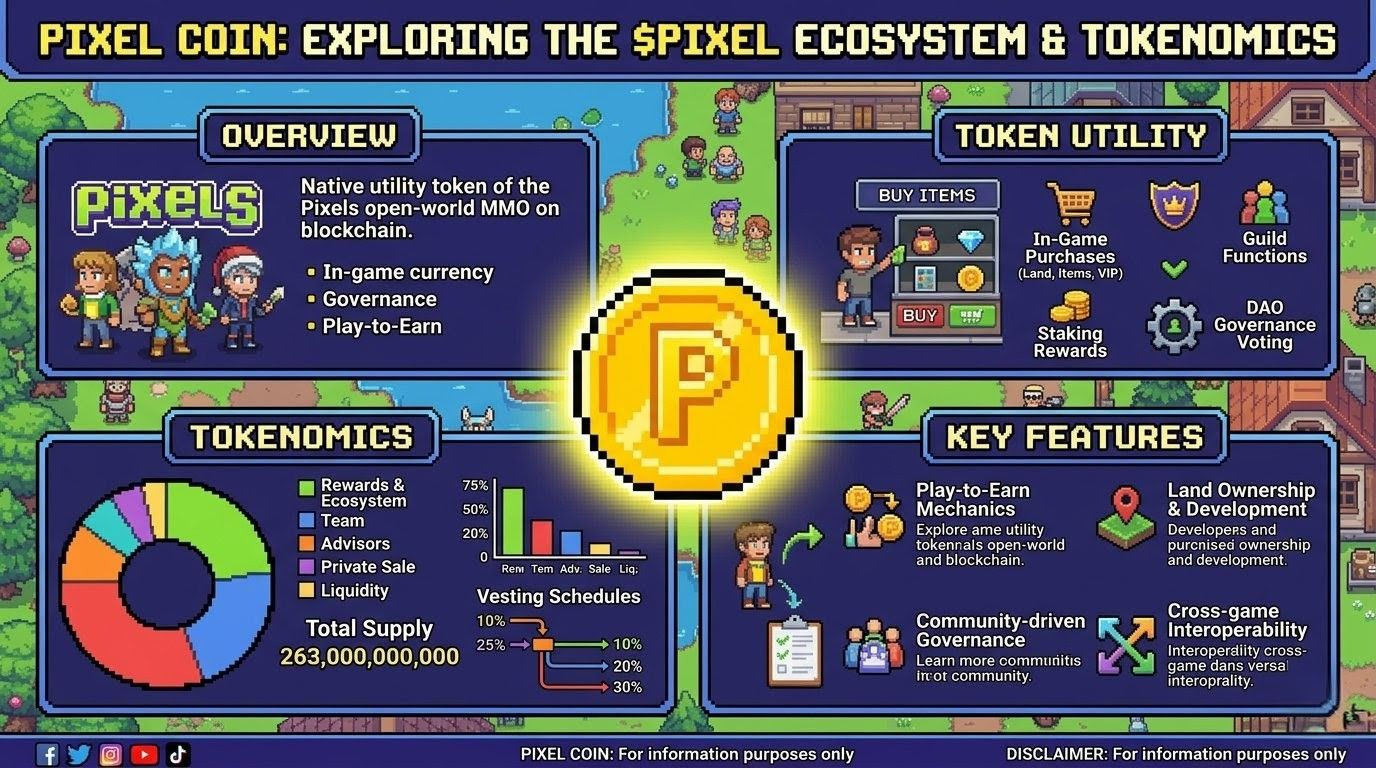
High-level players get better tools, better systems, better everything. That’s normal. Progression should feel rewarding.
But here’s where it gets messy those advantages stack.
Lower-tier activities start feeling pointless. New players grind, but the returns don’t feel meaningful compared to what top players are doing. The economy starts leaning heavily toward the people who are already ahead.
That can kill motivation fast.
Because if early progress doesn’t feel like it matters, why keep going?
So yeah, from a systems perspective, PIXELS is doing a lot right.
It controls inflation.
It keeps demand alive.
It builds a structured, layered economy.
No argument there.
But games aren’t just systems. They’re experiences. And right now, PIXELS is leaning hard toward structure over feeling.
It’s becoming efficient. Maybe a little too efficient.
And that’s the part I keep coming back to
If everything is optimized, predictable, and tightly controlled…
what’s left for the player to actually discover?
