
That morning I opened the game very early, before the day had fully warmed up, planning to submit a few Yieldstones and then move on to other work. But I stood still in front of the union’s Hearth for quite a while, because in just a short stretch, the progress that had just been pushed up was immediately shaved back down. That feeling did not resemble a simple misstep in play, but rather the feeling of watching a collective fall out of rhythm right at the moment when everything seemed to be settling into place. It was from that very small moment that I began reading Pixel as a system of human competition, not merely as a new season with an added mechanic.
What I value in Pixel is that it does not build competition around a few individuals who grind harder than everyone else, but around the organizational ability of the group as a whole. Chapter 3 revolves around 3 unions, 5 tiers of Yieldstones, and a victory condition of pushing Hearth Health to 100 percent. The reward split is also brutally clear, the side that finishes first takes 70 percent of the reward pool, the second takes 30 percent. Those figures say something very clearly, the project wants players to think like a collective that knows how to calculate, not like a crowd that is merely hardworking.
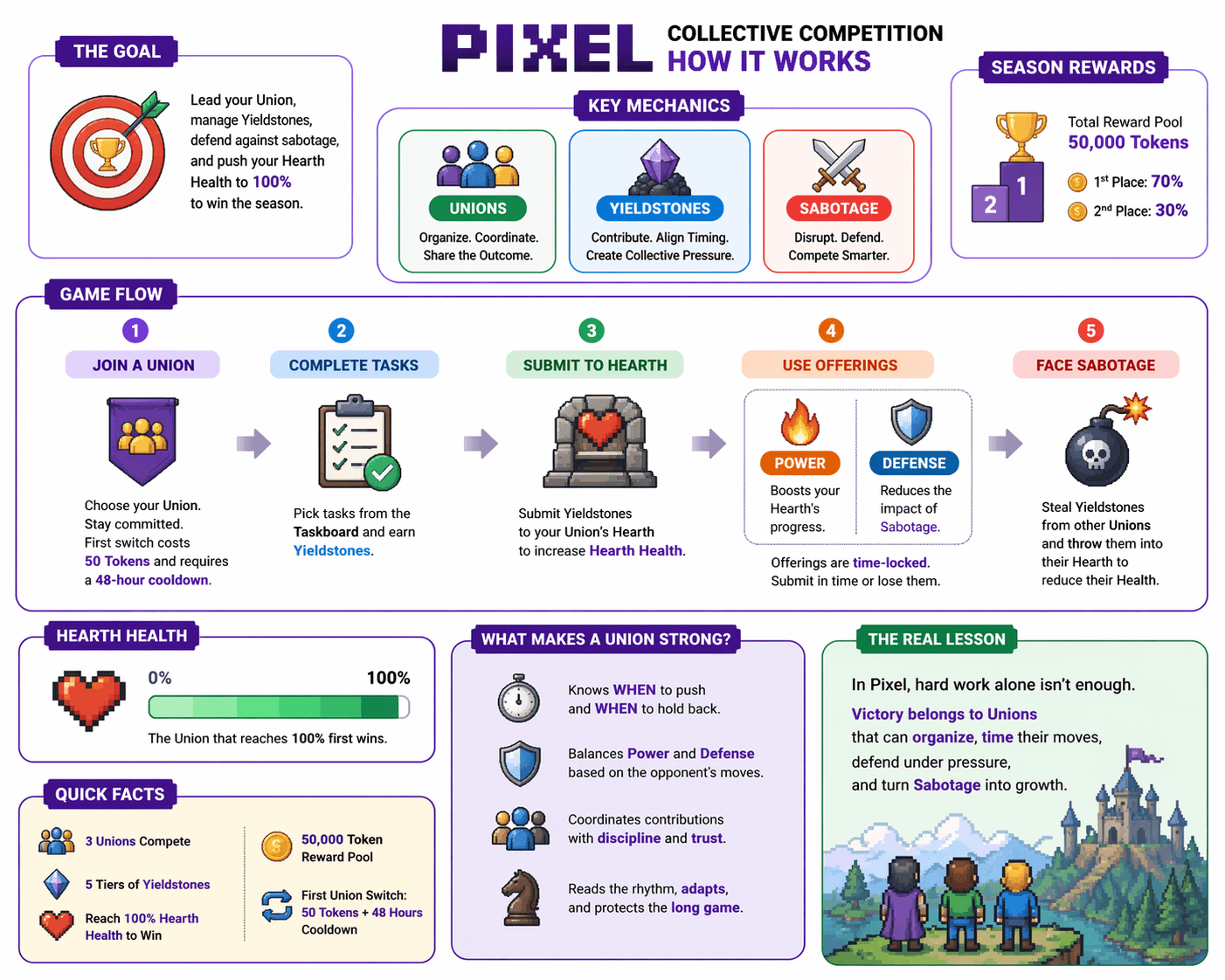
A lot of people still read Yieldstones as items you submit just to fill a requirement, but I think that is the shallowest way to understand Pixel. In this system, Yieldstones are a measure of whether a union knows how to gather scattered labor into pressure moving in the same direction. A single stone on its own is almost meaningless. Its value only appears when dozens of small decisions are stacked at the right moment, toward the right target, in the right rhythm that the Hearth needs. This is the kind of design that exposes organizational quality rather than glorifying sheer diligence.
Sabotage is the cut that pushes Pixel into collective competition. The system allows players to obtain Yieldstones from another union through the taskboard and throw them into the opposing Hearth to drag its health downward. From that moment on, contribution is no longer a neutral act. Every time a stone is submitted, it comes with the question of whether your group is accelerating at the right moment, or exposing its rhythm to be broken by the other side. Ironically, this power to disrupt is exactly what makes cooperation feel more real, because from that point onward, solidarity has to come with vigilance.
And once sabotage sits at the core, Offerings reveal their sharpest function. There are 2 types, Power to amplify your own Hearth and Defense to reduce the impact of sabotage. Both are locked behind countdown timers, which means the whole union has to submit enough before time runs out, otherwise the Offerings are wasted and the Hearth can even drop a level. This may be the detail that makes Pixel fundamentally different from games that only reward presence, because it forces players to understand that mistimed contribution can sometimes be more damaging than contributing too little.
I have seen more than enough models that paint the word community on the surface, while underneath each person is still optimizing their own share and walking away once the benefit thins out. To be honest, Pixel caught my attention because this project does not praise the collective with words. It forces the collective to prove itself through progress, through the ability to defend itself, through discipline under interference. Even switching unions is not left loose, the first switch costs 50 tokens and comes with a 48 hour wait, enough for players to understand that loyalty here is a strategic variable.
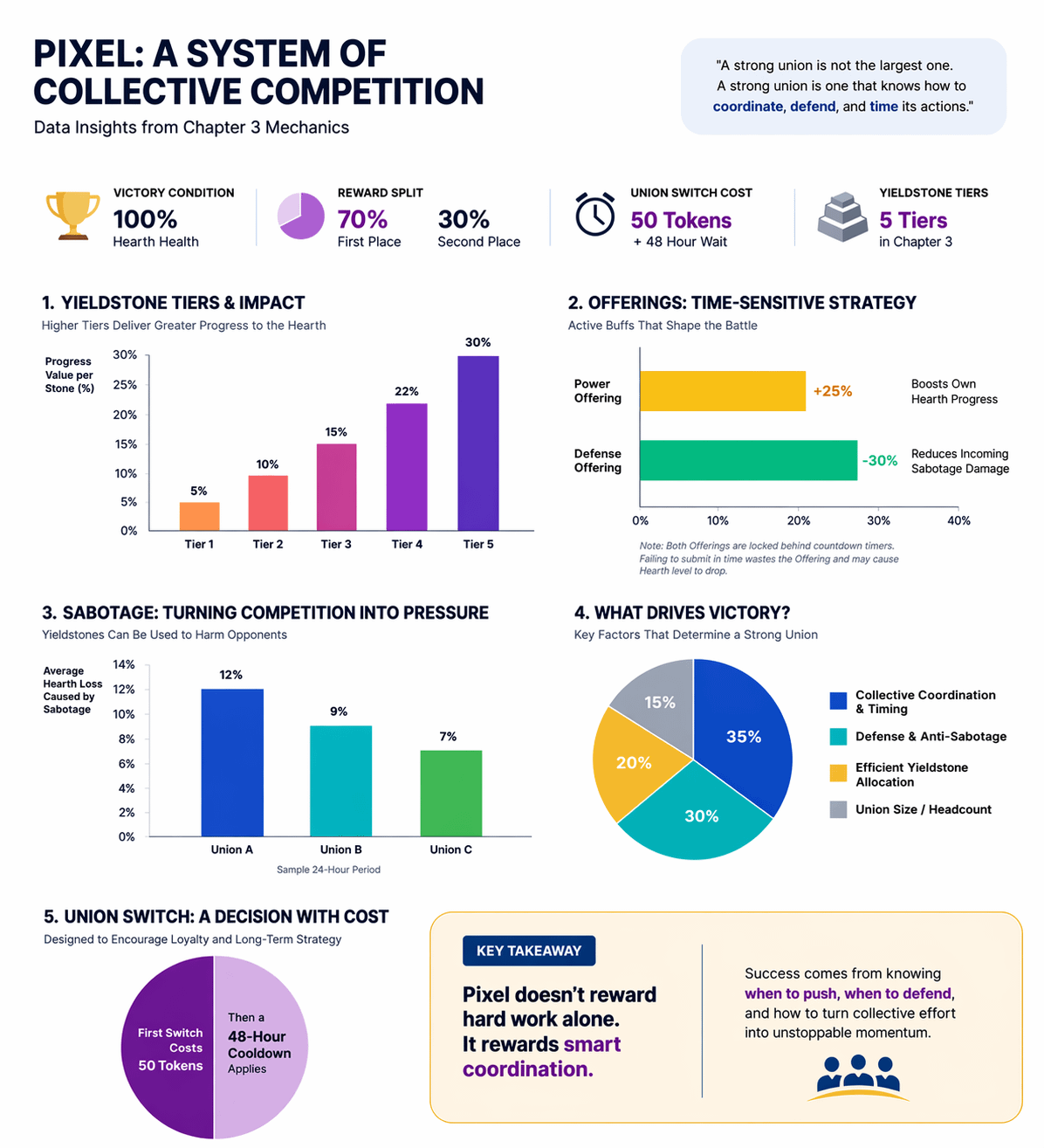
What few people would expect is that the most interesting thing in Pixel is not the 50000 token reward pool, but the way the project forces players to relearn the logic of competition. A strong union is not necessarily the largest one. A strong union is one that knows when to push stones to hit a threshold, when to prioritize Defense because the opponent is about to cut the rhythm, and when to preserve structure instead of chasing short bursts of excitement. That is a fairly real world lesson.
If I had to keep one impression after years of watching all kinds of community mechanics, then for me, Pixel is worth reading because it does not let players hide behind the beauty of familiar slogans. Here, the collective only has value when it knows how to turn Yieldstones into a shared rhythm, turn unions into disciplined structures, and turn sabotage into pressure for maturity instead of panic. I do not see many projects willing to place people into such a direct test, where defeat does not really come from laziness, but more often from poor coordination, bad timing, or the belief that a large crowd will naturally become strength. Could this be the moment Pixel starts stepping out of the frame of a familiar economic game and into a much harder form of collective competition.