
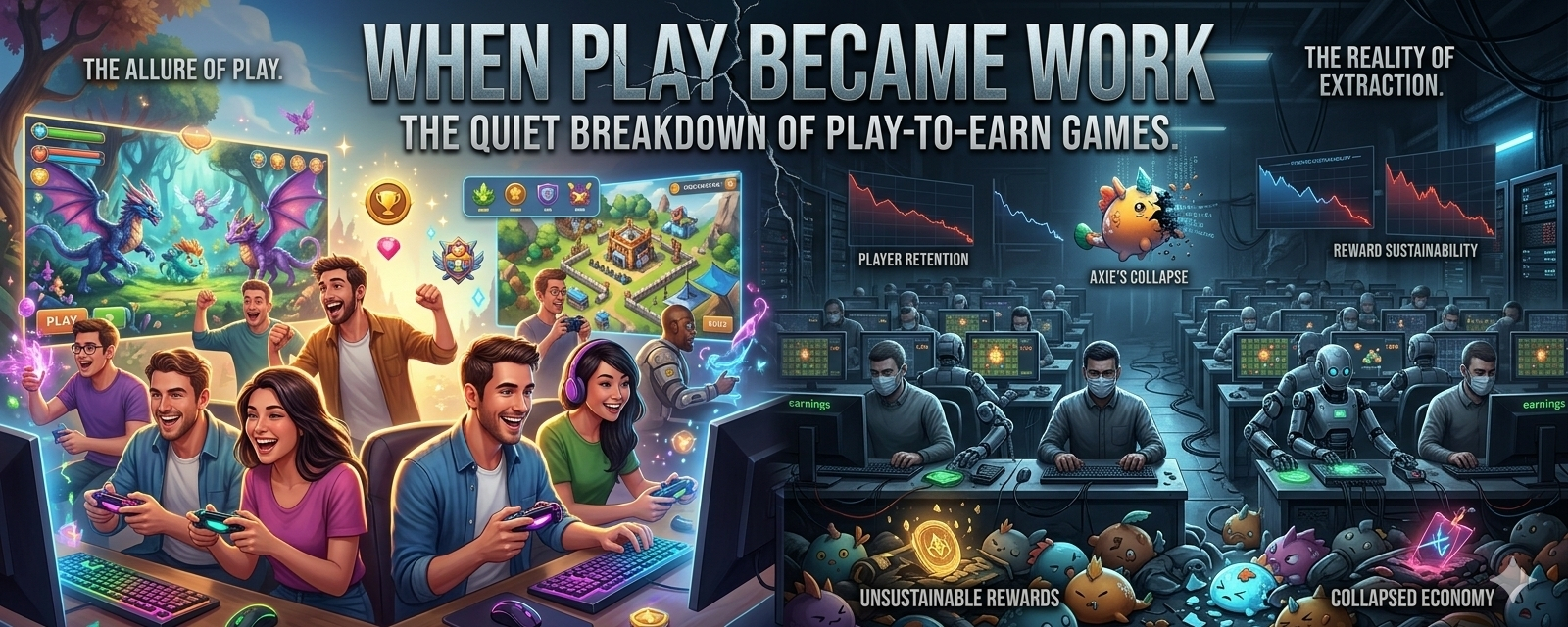
@Pixels I didn’t question play-to-earn at the beginning. Like most people, I was drawn to the idea before I understood the consequences. It sounded simple and even fair in a way that traditional gaming never was. You play, you earn, and your time actually means something beyond entertainment. For a while, that idea carried enough excitement to hide what was slowly going wrong underneath. But over time, something started to feel off, and it wasn’t loud or dramatic. There was no single crash or headline that explained it. It was quieter than that. The games were still running, rewards were still being paid out, and activity still looked strong on the surface. But the feeling inside those games had changed. People weren’t really playing anymore. They were just extracting whatever value they could and moving on.
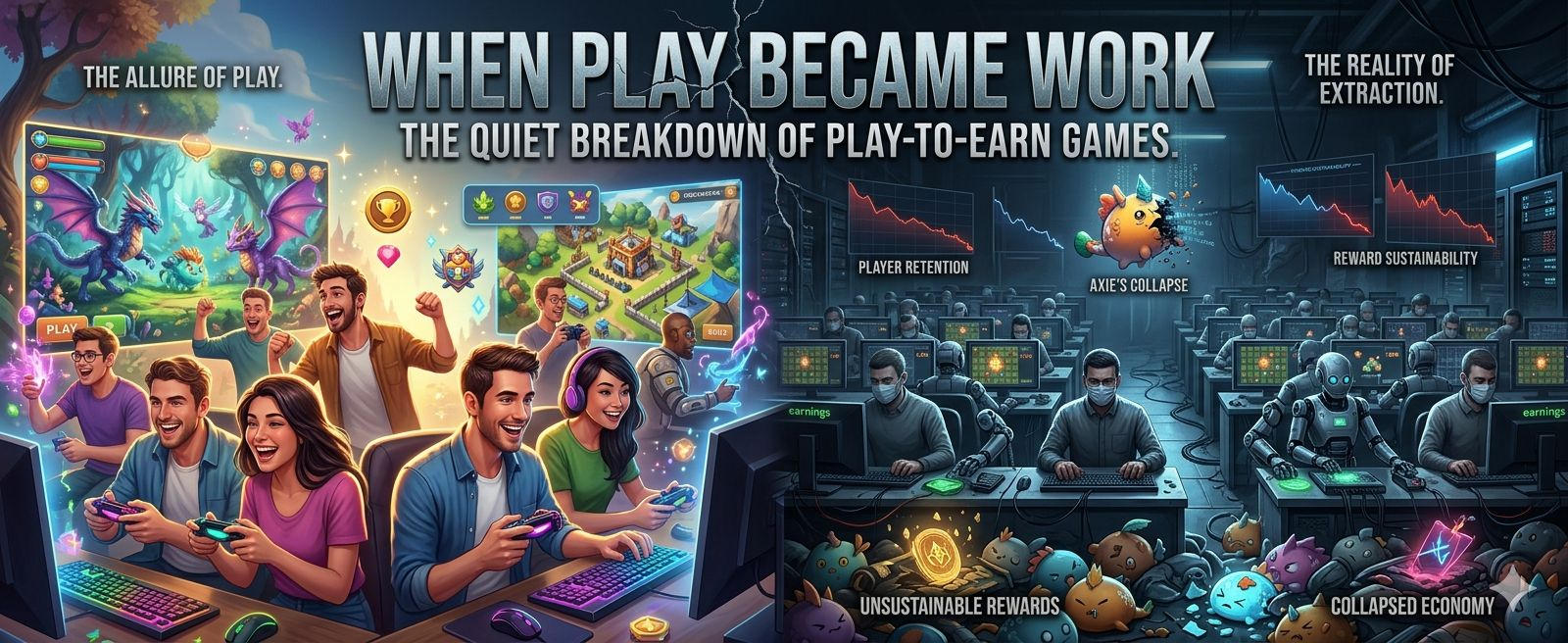
That shift, small as it seemed at first, explains more than most charts or reports ever could. Because once players stop caring about the experience and start focusing only on rewards, the entire foundation begins to weaken. Many people point to the bear market as the reason Web3 games struggled, and sure, timing had its role. But if you look closely, the cracks were already there. The systems weren’t just pressured from the outside. They were unstable from within.
Early play-to-earn models tried to be open and inclusive. Anyone could join, anyone could earn, and that felt like a strength. But what looked fair on the surface created a deeper problem. The system didn’t know the difference between someone who genuinely enjoyed the game and someone who was just there to farm rewards. Both were treated the same, and both were paid the same. That lack of distinction slowly changed behavior. Instead of playing for fun or progression, people optimized for efficiency. And when efficiency becomes the goal, the game itself starts to fade into the background.
You could see it happening in the data, but you could feel it even more in the experience. Retention dropped, even when activity looked high. That’s because activity can be misleading. A game can be busy without being meaningful. Bots, scripts, and farming networks filled the gap, and once they realized how easy it was to extract value, they scaled fast. What started as a few bad actors turned into entire systems built around exploitation. When one person can act like fifty players, the economy stops being about players at all. It becomes about who can game the system best.
From the outside, it still looked like growth. More wallets, more transactions, more movement. But underneath, it was hollow. The real player base wasn’t growing the way it seemed. It was being replaced by behavior that had no intention of staying. And that’s a dangerous illusion, because it gives developers the wrong signals. It makes a weakening system look like a healthy one.
This is why even the biggest success stories couldn’t hold their ground. Axie Infinity is the clearest example. At its peak, it defined the entire space. But when the decline came, it wasn’t gradual. It was sharp and revealing. Trading volume collapsed, and inflation made rewards feel less meaningful over time. What that showed wasn’t just a market downturn. It showed what happens when an economy gives out more than it can sustain. Rewards that were meant to attract players ended up pushing the system out of balance.
At the same time, most teams didn’t really have a clear way to measure what their rewards were doing. Tokens were being distributed, but there wasn’t enough visibility into whether those tokens were actually creating long-term engagement or value. In traditional gaming, every system is tested and adjusted constantly. In Web3, rewards were often just… there. Emitted without enough understanding. That lack of feedback made it almost impossible to fix problems early, and by the time the issues became obvious, they were already deeply rooted.
As rewards became easier to earn and more frequent, they started to take over the experience itself. Players weren’t exploring, competing, or experimenting in the way games are meant to encourage. They were repeating the same actions over and over because those actions paid the most. The gameplay loop flattened into routine. And when rewards slowed down, there wasn’t enough real engagement left to hold players in place. People didn’t leave because the economy changed. They left because there was nothing meaningful underneath it.
By 2025, hundreds of Web3 games had quietly shut down or faded away. That number isn’t just a statistic. It’s a pattern. These projects didn’t fail randomly. They followed the same path again and again. Broad rewards attracted the wrong behavior, that behavior diluted the system, and eventually the economy collapsed under its own weight. Growth kept things alive for a while, but growth alone isn’t stability. Once new players stopped coming in at the same rate, the entire structure started to fall apart.
That’s why newer approaches are starting to look different. What stands out isn’t bigger rewards, but smarter ones. Instead of asking how much to give, the question is shifting toward who should receive those rewards and why. That change sounds small, but it reshapes everything. It means looking at behavior more closely. Not just who logs in, but how they play, what they contribute, and whether they’re likely to stay. When rewards are tied to real engagement, they stop being a drain and start becoming an investment.
The same thinking applies to dealing with bots. It’s not just about removing them after they’ve already taken value. It’s about making it harder for fake behavior to exist in the first place. When systems become better at recognizing genuine players, the entire environment improves. Real players face less competition from artificial activity, and the signals that developers rely on become clearer.
There’s also a growing focus on making game economies more flexible. Instead of fixed reward systems that stay the same no matter what happens, some projects are experimenting with dynamic adjustments. If engagement drops, incentives can shift. If inflation rises, rewards can be reduced. The idea is to create systems that respond in real time rather than breaking under pressure. It’s not a perfect solution, and it comes with risks, especially if adjustments happen too aggressively. But it’s a step toward something Web3 games have been missing: adaptability.
One of the most practical ideas to come out of this shift is measuring the return on rewards. In simple terms, if a game gives out value, what does it get back? Does it improve retention, strengthen the community, or increase long-term activity? Without that understanding, rewards are just expenses. With it, they become tools. That difference changes how games are designed from the beginning.
Another layer that’s starting to matter more is personalization. Not every player is motivated by the same thing, and treating everyone the same has always been a hidden weakness. Some players enjoy competition, others prefer building or exploring. When rewards adapt to those differences, they feel more natural. Instead of forcing players into one type of behavior, the system supports different ways of engaging with the game.
Still, none of this guarantees success. Even the smartest reward system can’t fix a game that isn’t fun. If the core experience isn’t strong, players won’t stay, no matter how well the incentives are designed. Rewards can enhance a good game, but they can’t replace it.
Looking at the bigger picture, it feels like Web3 gaming is slowly maturing. The focus is shifting away from rapid growth and toward sustainability. The excitement of earning hasn’t disappeared, but it’s being balanced with a deeper understanding of what makes people stay. The next phase isn’t about who can give out the most rewards. It’s about who can create systems where rewards actually make sense.
In the end, the biggest lesson from the early play-to-earn era is simple. The problem wasn’t just too many rewards. It was rewards given without enough understanding. When incentives are disconnected from real behavior, they create movement without meaning. And once that happens, even the most active game can start to feel empty.
